Who Holds the Stylus
Abraham of London
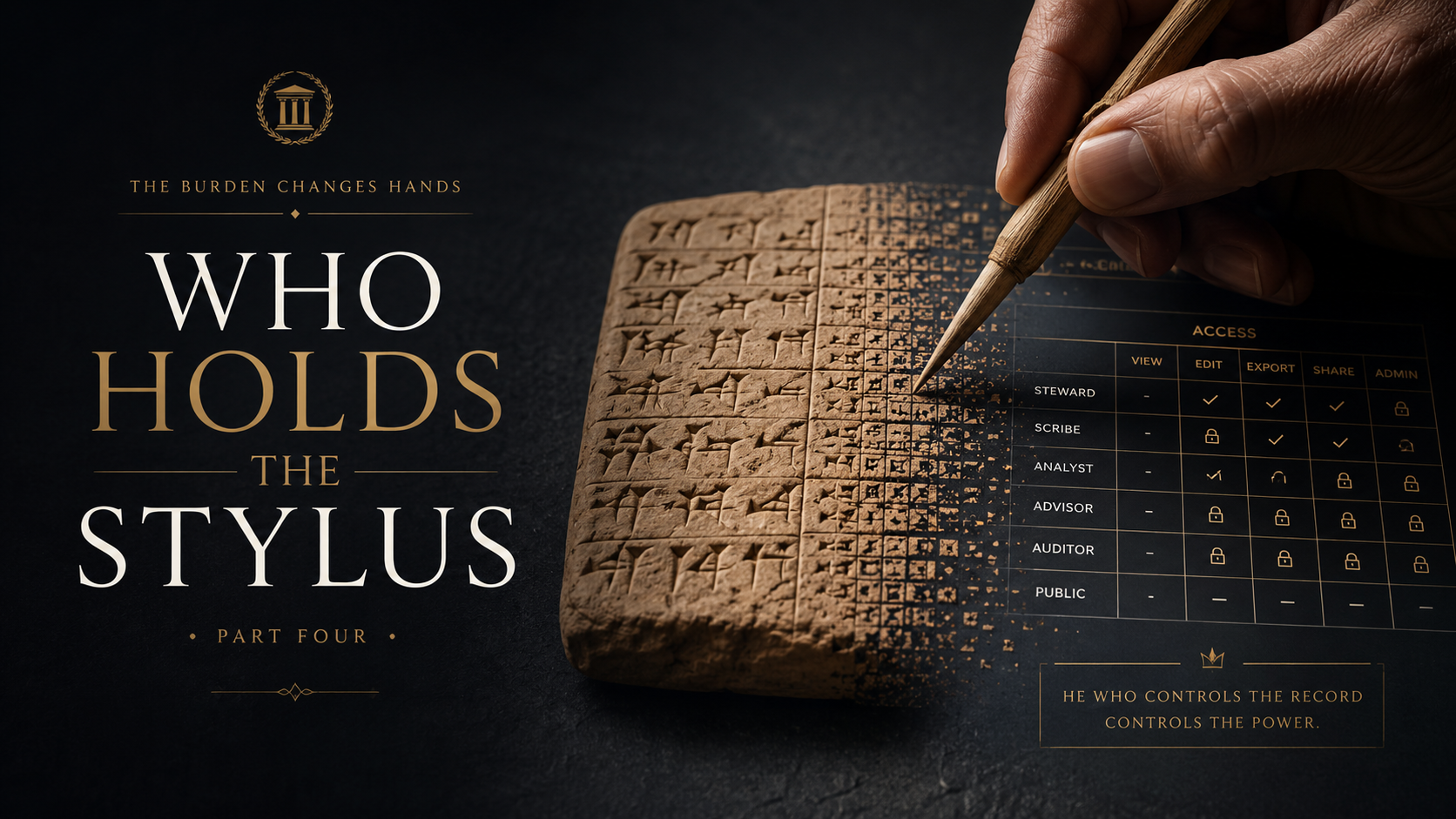
Within three centuries of the first clay tablet, there were scribal schools in Uruk.
This is worth pausing on. The first writing was not taught; it was improvised. Someone with a practical problem and a piece of wet clay found a solution. But within three hundred years — a blink in civilisational time, but long enough for a practice to become a profession — there were formal institutions dedicated to teaching the marks. Children were trained from an early age. The curriculum was long. The standards were strict. The profession of scribe was among the most influential in Mesopotamian society, and it was influential not primarily because scribes were learned, though they were, but because they held the records.
The history of writing is also, from its earliest centuries, a history of access. Who can inscribe. Who can read what has been inscribed. Who decides what the record says, what gets included, what is omitted, and what happens when the record is disputed.
This is not incidental to the story of external memory. It is the political structure of external memory. And it persists, in forms that are only superficially different, in every organisation that runs on documented knowledge today.
The Scribe's Invisible Authority
The scribe's authority was mostly invisible. That was, in part, what made it powerful.
The scribe did not decide what was traded or owned or owed. The officials, merchants, priests, and landowners made those decisions. But the scribe decided — in the practical moment of putting reed to clay — how those decisions were represented. What words were used. Which details were included. Whether the exception that was verbally acknowledged was also recorded. Whether the condition that was informally agreed was part of the official text.
These are not transcription decisions. They are authorial ones. And the person making them is not neutral, even when they are trying to be. They are selecting from a mass of contextual information — the conversation that preceded the agreement, the relationship between the parties, the pressures that shaped the negotiation — and producing a compressed, formalised, portable version that will carry the authority of the original for as long as the clay survives.
What the scribe produced was not a recording of what happened. It was a representation of what happened — shaped by the conventions of the system, the competence and attention of the individual, and the institutional pressures of the moment. A representation has an author. And the author's choices are embedded in every line.
The person who writes the record does not merely document the decision. They make a series of micro-decisions about how the decision will be understood by every future reader who relies on the document as their only window into what occurred.
The Architecture of Access
Writing created not just a record but a topology of access — a landscape in which different people stand at different distances from the knowledge the record contains.
In Mesopotamia, this topology was explicit. Scribes could read; most citizens could not. The archive was physically located in the temple or the palace; most people could not enter. The official who held the seal could authorise a document; everyone else depended on that authorisation. The power differential was visible, acknowledged, and structured into the design of the system.
In modern organisations, the topology is less explicit but no less real. It operates through a different set of mechanisms: system permissions rather than physical access; the ability to create or modify records rather than the ability to inscribe; the authority to define information architecture rather than the authority to design the tablet.
The Information Hierarchy
In any organisation that runs on documented knowledge, there is an information hierarchy that does not appear on the organisational chart. It is determined by who has read access to which systems, who has write access to which records, who designs the documentation frameworks that everyone else fills in, and who decides what counts as the official version when records conflict. This hierarchy shapes decisions, allocates power, and distributes institutional risk in ways that are rarely made visible.
Consider, specifically, the people who design an organisation's documentation systems. The choices they make — what fields to include in a template, what categories to use, how to structure the archive, what information is captured by default and what requires deliberate effort to record — shape what the organisation is able to think about itself for as long as the system is in use. These are not infrastructure decisions. They are epistemological ones. They determine what is knowable about the organisation's own behaviour.
Or consider the people who maintain the record: who can edit, who can delete, who can mark something as superseded. These permissions are not merely technical. They are a form of institutional authority. The person who can correct the record without oversight stands differently in the organisation than the person who must go through a formal approval process to make the same change.
Custody Without Accountability
There is a failure mode that occurs when custody is separated from accountability — when the people who hold the stylus are not the people who bear the consequences of what is written.
This failure mode has a long history. In Mesopotamia, the scribe who falsified a record served the official who commissioned the falsification; the farmer whose grain allocation was misrecorded bore the consequence. The gap between the one who recorded and the one who suffered from the recording was a structural feature of the system.
In contemporary organisations, the same gap appears in subtler forms. The analyst who creates the financial model bears no personal consequence if the model's assumptions are wrong; the business unit that acts on the model does. The compliance team that drafts the policy bears no direct consequence if the policy is unworkable in the field; the operational team that is required to implement it does. The strategy function that defines the direction bears no personal cost if the direction turns out to be wrong; the departments that were reorganised around it do.
None of these are acts of bad faith. They are structural consequences of divided roles in large organisations. But the structure creates a particular incentive problem: the people closest to the record — the ones who designed it, who maintain it, who have the power to change it — are not always the people most exposed to its quality.
The organisations that handle this best are not the ones that have eliminated the gap between custody and accountability — that gap is an inevitable feature of scale. They are the ones that have made the gap visible, named it as a governance risk, and put specific mechanisms in place to maintain the quality of the record when the consequences of poor quality fall on people who are not in the room.
The Design of the System Is the Decision
There is a tendency in organisations to treat information architecture as a technical domain — something that belongs to the IT function, or the data team, or whatever group is responsible for systems and infrastructure. This tendency is understandable; the decisions involved are often highly technical in their implementation. But the frame mislocates the responsibility.
The decision about what fields to capture in a CRM record is a business decision about what the organisation believes is important to know about its customers. The decision about how to structure a project management system is a decision about how the organisation believes projects should be understood, communicated, and governed. The decision about what information is recorded in meeting minutes is a decision about what the organisation treats as having happened.
These are not technical decisions dressed in technical clothing. They are institutional decisions — decisions about what the organisation values, what it intends to learn from its own activity, and how it will govern itself over time. Treating them as merely technical is how organisations end up with information systems that are perfectly functional and epistemically impoverished.
Information Architecture as Institutional Values
Every information system encodes a set of assumptions about what is worth knowing. Those assumptions should be deliberate, reviewed, and owned at the level of organisational leadership — not because leadership needs to understand the technical implementation, but because the decisions about what information to capture and how to structure it are decisions about what kind of institution this intends to be.
Recognising the Stylus
The accountant in Uruk had a stylus and knew he had one. The power he exercised was embedded in the physical act of making the mark. It was visible, if you were looking.
The modern equivalent is less visible, which makes it harder to interrogate and easier to mismanage. The stylus now appears in the form of dashboard design, template standardisation, metadata schema, access permissions, version control policy, and retention rules. The people who hold these tools often do not think of themselves as holding institutional authority — they think of themselves as solving technical problems.
But the questions they answer determine what the organisation can know about itself. And what an organisation can know about itself determines what it can do about what it discovers.
The history of writing has always included this dimension: who gets to make the mark, and what does the mark-making make possible. The question has not become less important with the move from clay to cloud. If anything, because the systems are larger and faster and more consequential, the authority embedded in their design has become more important to examine and more dangerous to leave unexamined.
Who holds the stylus is always a governance question. In most organisations, it is not treated as one.
The Burden Changes Hands is a seven-part series on memory, custody, and the intelligence that organisations build — or fail to build — over time.