What the Tablet Cannot Tell You
Abraham of London
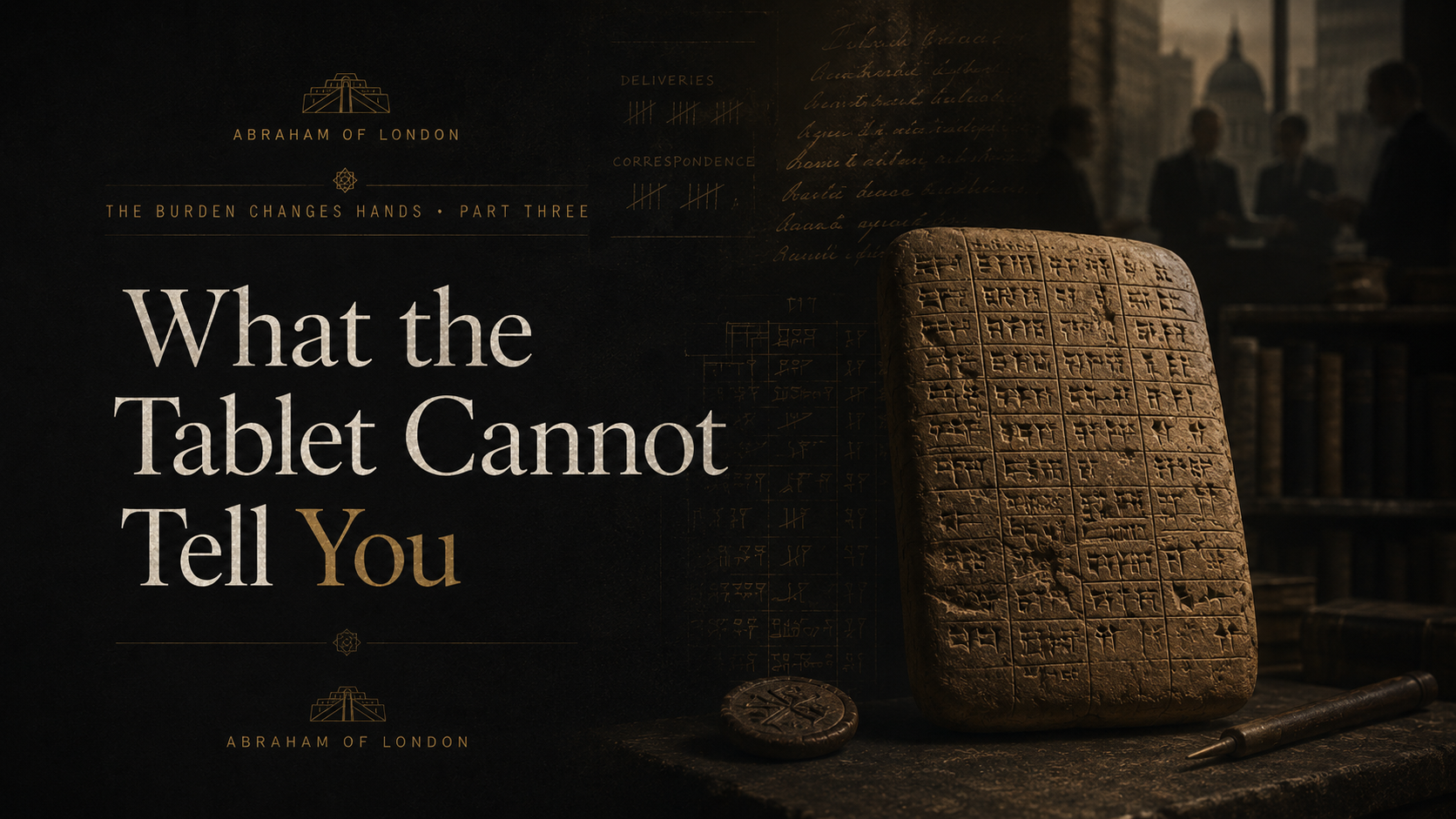
The accountant in Uruk made a mistake.
It might have been tiredness. It might have been a miscount in the chaotic movement of goats through a busy warehouse. It might have been pressure from a superior, or an honest error of judgement about which pile was which. Whatever the cause, the number pressed into the clay was wrong.
And the clay recorded it perfectly.
The same care with which the tablet received a true count received the false one. The same durability that would preserve an accurate record for millennia would preserve an inaccurate one with equal fidelity. The clay did not hesitate, did not signal its doubts, did not add a note saying: I'm recording this, but you might want to check. It simply held what it was given.
This is the central limitation of every external memory system that has ever been built. The medium is faithful to what was entered. It has no means of evaluating whether what was entered was worth entering. It cannot distinguish between a careful notation and a careless one, between a record made under normal conditions and one made under duress, between a claim that was accurate on the day it was pressed and one that was already wrong at the moment of inscription.
The tablet remembers without understanding. And that distinction — between memory and understanding — is where most failures of institutional knowledge are located.
The Authority of Age
The problem would be manageable if it were obvious. If wrong records looked wrong — if they degraded visibly over time, if incorrect information developed some kind of visual signal of its inaccuracy — the limitation would be easy to manage.
But the opposite is often true. Wrong records can acquire authority precisely because they have survived. An old document that has never been challenged has, in a bureaucratic sense, passed a kind of test — not the test of accuracy, but the test of persistence. It is there. It has been there for some time. No one has removed it.
In organisations where institutional memory is thin — where the people who could remember the conditions under which a document was written have since left, retired, or moved on — the old document often fills the vacuum with apparent authority. It becomes the record of how things were decided. And the gap between how things were decided and how things should be decided now goes unexamined, because the examination would require the kind of contextual knowledge that the document was supposed to preserve but cannot actually contain.
The Problem With Authoritative Records
A record that has not been challenged is not the same as a record that has been verified. In organisations where institutional continuity is fragile — where people cycle through roles quickly, where founding context is poorly transmitted — old documents can become more authoritative as they age, regardless of their accuracy. The absence of challenge is not evidence of truth.
There is a particular version of this that affects legal and regulatory frameworks, but the same dynamic appears in every domain where documented knowledge is used to govern ongoing behaviour. Procurement policies written when the organisation had twelve suppliers, now applied to a supplier network of three hundred. Risk frameworks designed for a product portfolio that has since tripled in complexity. Brand guidelines articulated for a market the company no longer primarily serves.
The tablet is still there. It still speaks. No one has yet found the time — or the institutional courage — to press something new into the clay.
What the Tablet Cannot Hold
It is worth being precise about what the external record cannot contain, because the list is longer than it first appears.
The tablet cannot hold the conditions of its own creation. It contains what was decided but not why it was decided — not the real why, not the contextual reasoning that a thoughtful author might have captured in a marginal note if they had imagined the question would one day matter. Most records are made quickly, under pressure, by people who assume the context is obvious to anyone who matters. It is not obvious to anyone who arrives later.
The tablet cannot hold the dissent. The meeting produced a consensus; the minutes record the outcome. What the minutes do not record is the dissenting view that was overruled, or the concern that was raised and set aside in the interests of progress, or the explicit caveat that the decision should be revisited in six months — a caveat that was spoken but not written and therefore, in institutional terms, never happened.
The tablet cannot hold the moment of its own obsolescence. A policy document does not know when the conditions it was written to address have changed. A market analysis does not know when the market it described has been restructured. A technical specification does not know when the technology it specified has been superseded. These are events in the world; the document is not in the world. It is on a shelf.
Inscription fixes a thought in place at a moment in time. That fixity is both its power and its limitation. The record cannot move. The world it describes continues to move. The gap between them is where institutional error accumulates, quietly, without drama, in the form of confident wrongness.
The Judgement That Cannot Be Inscribed
There is a discipline that the tablet cannot contain because it cannot be static: judgement.
Judgement is not the same as memory. Memory holds what was. Judgement asks what is, what it means, and what to do about it. Judgement requires a living mind in contact with a present situation. It cannot be written down in advance, retrieved later, and applied — not because writing is inadequate but because judgement is inherently contextual. It is the faculty that decides whether the record is still applicable, whether the conditions it describes still obtain, whether the instructions it contains are still the right instructions.
The organisation that believes its documentation is a substitute for judgement has made a category error. Documentation is the material on which judgement operates. It is not the operation itself.
What this means practically is that every significant decision that is made by reference to a record should involve a moment — explicit, not perfunctory — in which someone asks whether the record is still right. Not whether it exists. Not whether it is the official policy. Whether it is right, given what we know now, about the situation we are actually in.
This is harder than it sounds, for institutional reasons. The record carries authority. Questioning the record implies a readiness to accept responsibility for departing from it. In organisations where accountability is tied to process compliance rather than outcome quality, the safe move is often to follow the documentation and not ask whether it is still applicable. The tablet said so. The tablet remains.
Compliance Is Not Intelligence
Following a documented procedure is not, by itself, an act of intelligence. It is an act of compliance. In contexts where the procedure is correct and current, compliance and intelligence align. In contexts where the procedure is outdated or inapplicable, they diverge. The organisation that cannot distinguish between the two conditions has given its documentation more authority than its documentation deserves.
The Wrong Count at Scale
The accountant's wrong count was a small thing. Perhaps it affected a single transaction, a single allocation of resources. It could be corrected when the discrepancy was noticed, and most discrepancies of that kind were noticed relatively quickly, because the people involved in the transaction were present and accountable.
Scale removes that correction mechanism.
The larger the organisation, the longer the chain between the person who created the record and the people who rely on it. The more layers there are between the original inscription and the decision it informs, the less likely it is that anyone in that chain has the contextual knowledge to recognise when the record is wrong. They are relying on the tablet in the same way the small organisation relied on the accountant — but the accountant had personal knowledge of the goats. The people at scale have only the record.
This is why the discipline of judgement becomes more important, not less, as organisations grow. The small team can afford to rely on living memory, because the people with living memory are in the room. The large institution cannot. It is dependent on documentation in ways the small team is not — which means it is more exposed to the failure mode of documentation, which is the patient preservation of incorrect information alongside correct information, with no visible means of distinguishing the two.
The tablet that is wrong for a small organisation costs a goat. The tablet that is wrong for a large one can cost a great deal more — a market position, a regulatory relationship, a reputation that took years to build and days to lose.
Reading the Record Critically
There is a practice that serious institutions cultivate and that less serious ones do not: the practice of reading the record critically rather than receptively.
Receptive reading treats the document as a source of answers. It consults the record to find out what to do and then does that. Critical reading treats the document as a source of questions. It consults the record to understand what was decided and then asks whether that decision is still right, what conditions have changed since it was made, whether the assumptions embedded in it are still valid.
This is not scepticism for its own sake. The record is valuable; it should be respected. But respect and credulity are different things. The record earns its authority not from its age or its formality or its location in a particular system, but from the ongoing quality of what it contains — and that quality can only be maintained if someone is routinely checking it against the world it claims to describe.
The clay is patient. The world is not. The discipline of keeping them aligned is human, organisational, and permanent.
The Burden Changes Hands is a seven-part series on memory, custody, and the intelligence that organisations build — or fail to build — over time.