The Slow Intelligence
Abraham of London
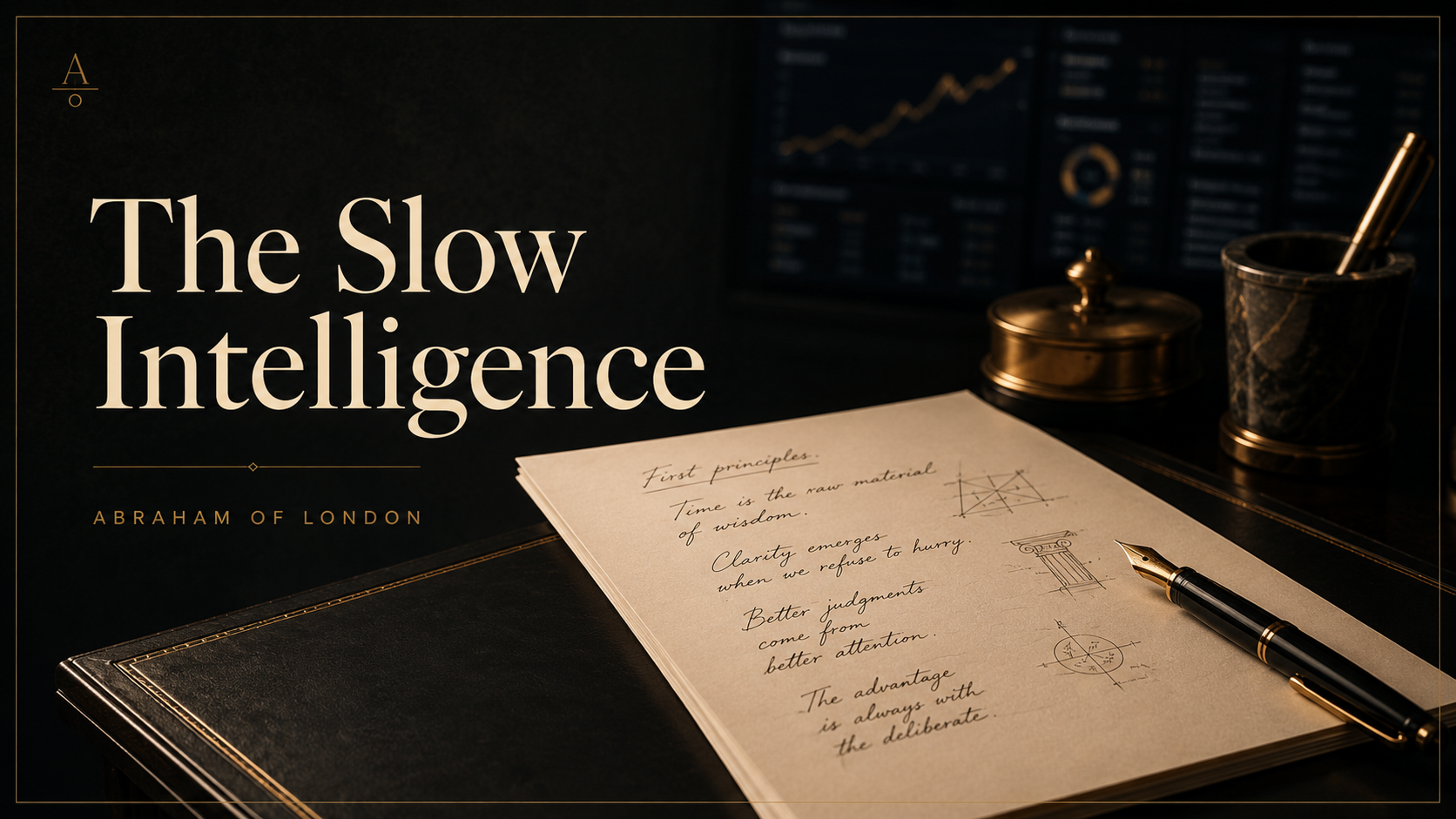
The moment worth attending to is not the moment of inscription.
It is the moment that became possible once inscription existed: the moment when one tablet was placed beside another and someone noticed that the two did not agree.
The accountant in Uruk who pressed a count into clay was solving an operational problem. But the Babylonian scholar two centuries later who placed this year's astronomical observations beside last year's was doing something categorically different. He was building an argument. Not an argument between two people, but an argument between two moments in time — a comparison that could only occur because both moments had been fixed in a medium that outlasted the people who witnessed them.
This is what cumulative intelligence looks like at its origin. Not retrieval. Not storage. The systematic placement of one record beside another to produce a third thing that neither record contains on its own — an insight into pattern, tendency, change, or error that is invisible from inside any single moment.
The history of knowledge is, in many ways, the history of this capability growing. Medicine became something more than accumulated anecdote when physicians started comparing records across patients and across time. Astronomy became predictive when observations were organised and compared across centuries. Law became systematic when judgements were collected and examined for their underlying principles. In each case, the same move was made: individual records placed in conversation, producing understanding that the individual records could not produce alone.
This capability is what most organisations have failed to build. Not because they lack data, but because they have confused speed of access with depth of understanding — a confusion that is both understandable and expensive.
Two Kinds of Intelligence
It is useful to draw a distinction that is rarely drawn explicitly in institutional contexts.
There is retrieval intelligence — the ability to locate a specific piece of information quickly and accurately. This is the capability that modern data infrastructure is primarily built to provide. Search, indexing, tagging, dashboarding, real-time reporting. The assumption behind these tools is that the limiting factor in organisational decision-making is access: if people can get to the information they need, they can make better decisions.
There is comparative intelligence — the ability to place information in conversation with other information across time, and to derive from that conversation something that neither piece of information contains on its own. This is the capability that allows an organisation to understand its own patterns — to see that what looks like a one-off event in this quarter is actually the third occurrence of a recurring dynamic, or that the conditions currently obtaining were last present a decade ago and produced a specific result that has since been forgotten.
These are genuinely different capabilities. Retrieval intelligence is, at its limit, a technology problem — a question of infrastructure, speed, and search design. Comparative intelligence is an institutional problem — a question of whether the organisation has the memory, the method, and the judgement to place its records in conversation with each other and attend carefully to what emerges.
A fast database retrieves. A slow intelligence understands. Most organisations have built the former and called it the latter. The gap between the two capabilities is where institutional learning either happens or doesn't.
Why Slow Intelligence Is Hard
There are several reasons why comparative intelligence is difficult to build and easy to underinvest in.
The first is time horizon. Comparative intelligence becomes valuable across periods that are longer than most organisational planning cycles. Comparing this quarter to last quarter is reporting. Comparing this decade's patterns to the previous decade's is intelligence. But organisations are rarely governed on a decade-long timescale; their incentive structures, reporting rhythms, and accountability mechanisms are oriented toward shorter horizons. What is most useful for governance is not always what is most visible within the current incentive framework.
The second is discontinuity. Comparative intelligence requires that the records being compared are comparable — that the same categories, definitions, and measurement conventions have been applied consistently enough that a comparison yields genuine signal rather than artefact. Most organisations' records are not comparable over long periods. Systems change. Definitions are revised. Categories are reorganised. The records of five years ago were built in a different system, for different purposes, under different conventions, and placing them beside this year's records requires a level of interpretive effort that most organisations find easier to avoid than to perform.
The third, and perhaps most important, is that comparative intelligence requires holding two things true simultaneously: that the past record is worth examining, and that it is not necessarily authoritative. This is a disciplined intellectual position that runs against two common institutional instincts — one that dismisses the past as irrelevant to the present, and one that treats documented history as settled truth. The institution that has built genuine comparative intelligence maintains neither of these instincts. It holds the record as evidence worth examining, not as conclusion worth citing.
The Discontinuity Problem
Long-term comparison is made structurally difficult when an organisation changes its information architecture. Every system migration, every redefinition of categories, every shift in reporting conventions creates a break in the comparable record. Organisations that treat these changes as purely technical transitions are routinely surprised to discover that they have lost the ability to compare across the break — that the historical record exists but cannot be meaningfully read beside the current one.
The Staircase of Argument
There is an image that is useful here, from the history of knowledge itself.
Cumulative intellectual progress is sometimes described as building a staircase — each step resting solidly on the one below, the whole structure extending higher because the lower steps are reliably in place. What makes this metaphor useful is its implication about pace. A staircase built well is built slowly. Each step has to be solid before the next one is placed. The value of the structure is in its navigability — not just that you can get higher, but that you can move between levels, check your footing, and descend to verify a lower assumption when a higher one is challenged.
This is what well-developed comparative intelligence looks like in an organisation. Not a rapid accumulation of data points, but a slow, careful building of interpreted understanding — where the earlier levels of understanding are available to interrogate when later conclusions are contested, and where the structure is strong enough to support examination rather than collapsing when it is questioned.
The organisations that have built this kind of intelligence tend to have certain characteristics in common. They keep records of reasoning, not just outcomes. They document the conditions under which decisions were made, not just the decisions. They maintain the ability to return to earlier thinking when later conditions make the earlier reasoning newly relevant. And they employ people — or develop people — with the specific discipline of pattern recognition across time: the ability to ask whether this situation resembles any situation the organisation has previously navigated, and what that historical familiarity implies for the current moment.
Speed as a Default Virtue
There is a reason most organisations have invested more heavily in retrieval than in comparison. Speed is legible and valued; slowness is not.
Fast retrieval produces visible results: the dashboard that loads in two seconds, the search that surfaces a document in milliseconds, the report that is automatically generated and distributed before 9 a.m. These are demonstrable organisational capabilities. They can be measured, benchmarked, and improved. They signal competence in immediately visible ways.
Comparative intelligence produces results that are harder to demonstrate and slower to emerge. The analyst who spends three weeks examining the organisation's historical response to market contractions is not producing something that announces its value in the same immediate way as a new reporting dashboard. The institutional benefit of what she produces may not be visible until the next market contraction, at which point the organisation either has the comparative context to respond intelligently or discovers, too late, that it does not.
Speed has become the dominant organisational virtue, in knowledge management as in most things. But intelligence is not fast by nature. The insight that emerges from comparison across time is, by definition, the product of time — it cannot be retrieved because it has not yet been produced. It has to be derived, slowly, by placing records in conversation and attending to what the conversation reveals.
What the Slow Intelligence Requires
Building comparative intelligence requires several things that most organisations are not currently set up to provide.
It requires archival commitment: the decision to maintain records in a form that remains useful across long periods, with the metadata and contextual documentation that makes comparison possible rather than merely technical. This is an ongoing investment, not a one-time infrastructure decision.
It requires analytical patience: the willingness to employ — and protect the time of — people who do the slow work of comparison rather than the fast work of reporting. These are different disciplines. Organisations that treat them as the same, or that expect the same people to do both, typically get neither well.
It requires institutional memory at the leadership level: the capacity to bring historical context to bear on current decisions, to ask whether this situation has a precedent within the organisation's own experience, and to take that precedent seriously as evidence rather than dismissing it as history.
And it requires, most fundamentally, a belief that comparison across time is worth the investment — that what the organisation has done, learned, and experienced is a resource rather than an archive, a form of intelligence rather than a record of past events.
The Babylonian scholars who placed one season's observations beside another's did not produce their understanding quickly. But they produced it. The organisations that will navigate the next decade most intelligently are, in many cases, the ones that are already placing their records in careful conversation with each other — not because the conversation is fast, but because what it produces cannot be obtained any other way.
The Burden Changes Hands is a seven-part series on memory, custody, and the intelligence that organisations build — or fail to build — over time.