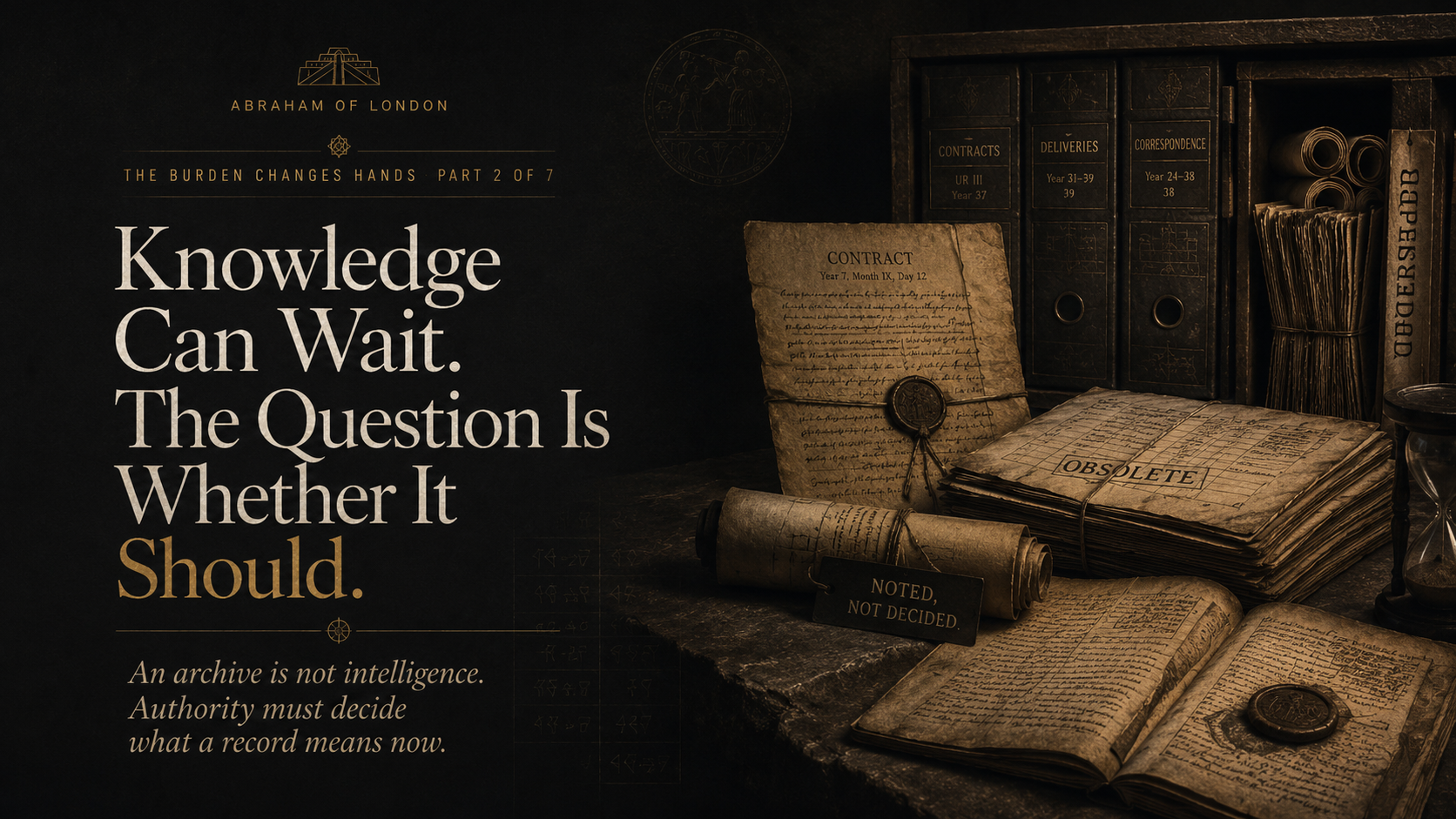
Knowledge Can Wait. The Question Is Whether It Should.
Abraham of London
There is a particular kind of letter — written in wartime, sent across unreliable routes, travelling for months through conditions its author could not predict — that arrives after everything has changed.
The sender may be dead. The circumstances that prompted the letter have dissolved. The urgency that shaped every word is now historical. And yet the letter arrives, speaks in present tense, makes requests, issues instructions, describes a world that no longer exists with the perfect confidence of the living voice.
This is the strange power that writing gave to knowledge. Before inscription, knowledge travelled by living continuity — it moved between people who were present, who shared context, who could adjust the message to the moment of its reception. Writing broke that constraint. It created what might be called durable discontinuity: the ability for a thought to travel across time and space without its author, arriving intact and authoritative in a world the author never saw.
For five thousand years, this has been the foundational promise of documented knowledge. And it has delivered. Trade routes extended across deserts and generations. Legal codes outlasted the rulers who commissioned them. Scientific knowledge accumulated across centuries, each generation building on records the previous generation left behind. The entire architecture of institutional life — the company, the government department, the professional body, the university — rests on the assumption that knowledge can be written down and reliably retrieved.
But the letter that arrives from the dead soldier poses a question that this assumption has never quite answered: when knowledge waits, what exactly is waiting — and for whom?
The Gain Is Real
Before examining the problem, it is worth stating the gain clearly, because it is easy to treat the complications of documented knowledge as an argument against documentation. They are not. They are arguments for doing it better.
The ability of knowledge to survive discontinuity is not a minor operational convenience. It is the mechanism that makes institutional scale possible.
Consider what it means, concretely, that a record can outlast its author. A company founded by two people can grow to ten thousand without the two founders needing to be present in every decision. The knowledge they possessed — about the founding logic, the product architecture, the relationship with a key supplier — can be captured, transmitted, taught, and applied by people who never met them. The organisation extends beyond the biology of its founders.
Consider what it means that knowledge can wait through illness. A critical project does not collapse because the person who holds the key technical context is hospitalised for three weeks. If the context has been properly documented, it can be accessed, interpreted, and acted upon. The work continues.
Consider what it means for succession. The organisation that has developed the discipline of externalising its knowledge — genuinely externalising it, not performing the motion of documentation while actually continuing to rely on the living carriers — is the organisation that can navigate leadership change without existential disruption. The successor inherits not just a title but a record. A context. A foundation.
These are not trivial advantages. They compound across generations.
The organisations that can survive discontinuity — that can maintain coherent direction across leadership changes, expansion into new territories, and the ordinary attrition of experienced people — are the ones that have learned to make knowledge wait in forms that can still be understood and acted upon when it wakes.
The Problem Is Also Real
But here is what the soldier's letter reveals about waiting knowledge: survival across time is not the same as relevance across time.
The letter arrives. It is perfectly preserved. It describes a situation with clarity and urgency. And every instruction it contains is wrong — not because the author was wrong when he wrote it, but because the situation has changed so thoroughly that acting on the letter now would be actively harmful.
This is not a failure of documentation. It is a property of documentation. Knowledge that can wait is knowledge that can become obsolete without knowing it. The record cannot update itself. It cannot notice that the world it described has shifted. It cannot add a footnote that says: this was true in the conditions of its writing; check before applying.
It simply waits, patient and inert, and speaks in the same present tense it always has.
The Obsolescence That Looks Like Continuity
The most dangerous kind of institutional knowledge is not the knowledge that is visibly wrong. It is the knowledge that was right once, that is still being acted upon, and that no one has thought to question. It persists with the full authority of inscription and the full silence of the dead.
The organisations most vulnerable to this are those that have confused the presence of documentation with the currency of documentation. They have built libraries of policy, procedure, and institutional principle. They have done the work of writing things down. And then they have treated that work as finished — as if inscription were a one-time event rather than the beginning of a continuous obligation.
The obligation is this: someone must read the record, and reading here means more than retrieval. It means interpretation. It means asking whether the conditions that gave the document its meaning still obtain. It means having the institutional confidence to say, when they do not: this has waited long enough. It should now be revised or retired.
Waiting as a Decision
There is a subtler point here that organisations rarely consider explicitly.
When knowledge is committed to record and filed, a decision has been made — usually implicitly, usually without being named as a decision — about how long it should wait and for whom. The knowledge is being held in trust for a future reader who will apply it in future conditions. But the terms of that trust are almost never specified.
How long should this policy remain authoritative before being reviewed? Under what conditions is this procedure still valid? What changes in the environment would make this principle inapplicable? These questions are almost never asked at the moment of inscription, which means they are almost never answered.
The result is that waiting knowledge accumulates in organisations not as a deliberate archive but as an undifferentiated mass — a mixture of the still-relevant, the outdated, the superseded, and the never-used. And because retrieval systems are better than curation systems, it is often easier to find something than to know whether finding it is a good idea.
Speed of retrieval is not the same as quality of intelligence.
An organisation that can surface any document in three seconds has not necessarily built a more intelligent institution than one that can surface the right document in thirty. The discipline of knowing which knowledge should wait, and which should be promoted, revised, or retired, is separate from the technology of search — and more important.
The Institutional Tempo of Knowledge
There is a concept worth naming, even if organisations rarely use the term: the institutional tempo of knowledge.
Different kinds of knowledge age at different rates. Technical specifications become obsolete when the technology changes. Market intelligence has a half-life that depends on the volatility of the sector. Strategic principles, if well-formed, can remain directionally valid for a decade. Foundational values, if genuinely foundational, can endure for generations.
The organisation that treats all its documented knowledge as equally durable — that reviews its technical documentation on the same cycle as its brand values, or that applies the same retention policy to a regulatory procedure as to a customer insight — is not managing knowledge. It is warehousing it.
Managing knowledge means matching the review cycle to the decay rate. It means building into the architecture of documentation a layer of metadata — not bureaucratic metadata, but epistemic metadata — that answers the question: when should this stop speaking?
A record is not a conclusion. It is a claim, with a date, made under specific conditions. The institution that treats its documented knowledge as claims requiring ongoing validation operates differently from the institution that treats it as settled fact requiring only retrieval.
The Letter Still Arrives
The soldier's letter continues to arrive in organisations every day.
Not from wartime correspondents, but in the form of policies written when the company was forty people, now governing an organisation of four hundred. Procedures designed for a market that has been restructured twice since. Principles articulated by founders who left eight years ago, still cited in onboarding decks and leadership discussions, still shaping decisions, still speaking in present tense.
These documents were not written badly. They were written well, with care and intelligence, for their moment. The failure is not in the writing. The failure is in what happened — or didn't happen — after the writing. No one came back to ask whether the letter was still the right letter to send.
The capacity that writing gave to knowledge — the capacity to wait, to survive discontinuity, to speak across absences — is not self-regulating. It requires human oversight. Someone must tend the archive not just as a collection but as a living instrument — deciding what to keep active, what to retire, and what to revise so that it speaks truthfully about the world it still describes.
This is not a task that can be delegated to a retrieval system. Retrieval systems find; they do not judge. That judgement is human, institutional, ongoing.
The knowledge waits. The question is who is watching the clock.
The Burden Changes Hands is a seven-part series on memory, custody, and the intelligence that organisations build — or fail to build — over time.