The Accountant in Uruk
Abraham of London
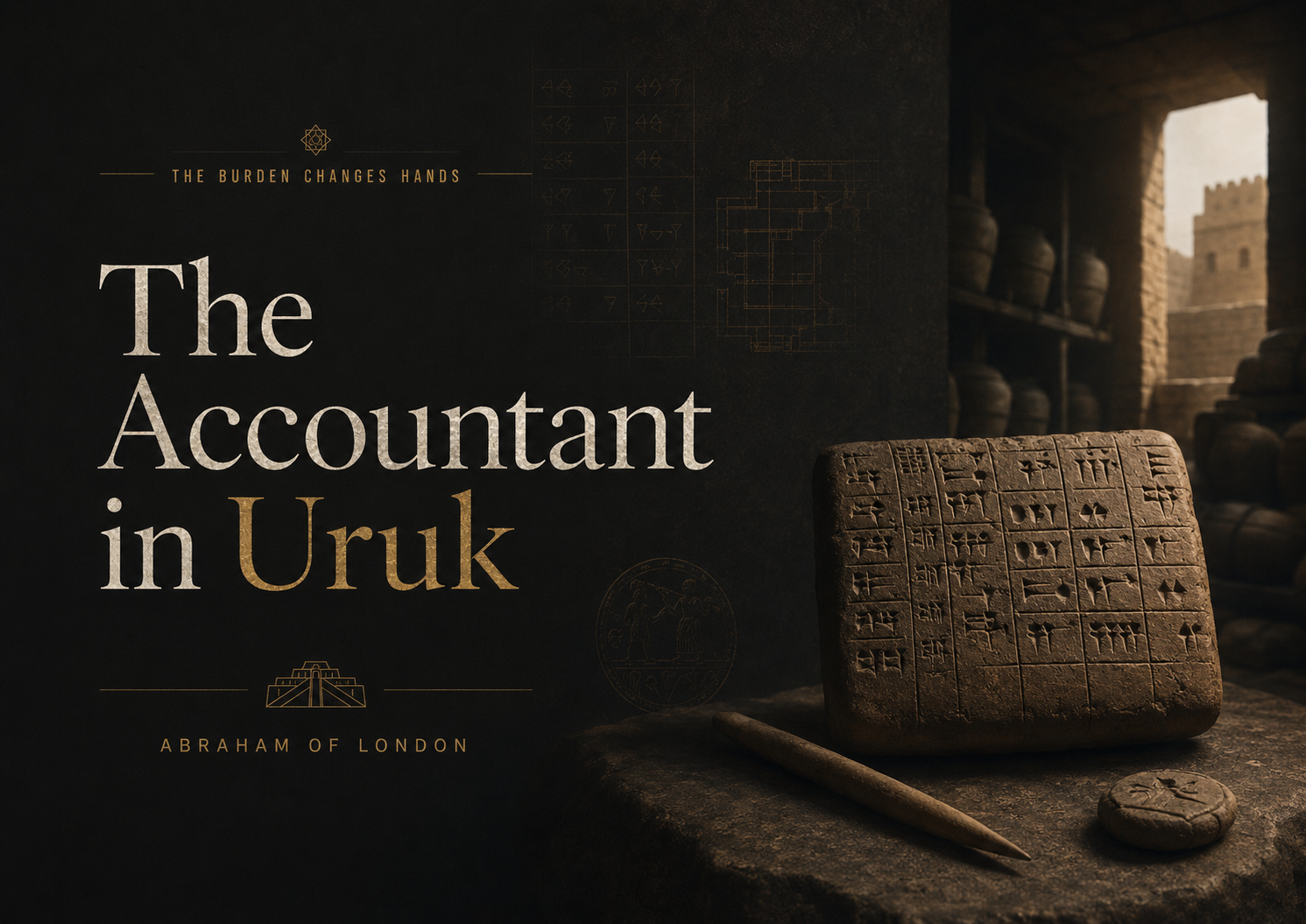
Consider the warehouse in Uruk around 3200 BCE.
It is hot. Grain dust sits in the air. Beer jars are stacked against one wall; textiles crowd the other. Animals move through in lots — some offered, some owed, some already allocated to obligations that exist only inside the accountant's head. Twelve black goats from one family's offering. Seven brown goats from another. Four white goats promised elsewhere and not yet delivered.
The accountant is not unintelligent. He is overwhelmed. There is more to hold than a single mind can reliably hold under pressure, across shifts, through illness, past argument, into the next month. Memory is failing — not through weakness but through sheer volume.
So he picks up a reed, sharpens it into a stylus, and presses a mark into wet clay.
Not a portrait of a goat. Not a carefully rendered scene. A sign. A compact agreement between hand and surface: this impression will stand for something after the speaker has gone.
What happened next is easy to miss, because it looks so modest. A man made a mark. But what he was actually doing was founding the architecture of every institution that has existed since.
The Problem Was Never Intelligence
The first thing to understand about the origin of writing — and about the origin of institutional memory more broadly — is that it had nothing to do with philosophy or art or the desire to transmit wisdom. Those came later, centuries later, after the system had been running long enough for people to imagine what else it might be used for.
The first external memory was created to solve an operational problem. Too many obligations, moving too fast, to fit reliably inside a single skull.
This matters because we have a tendency to frame the management of institutional knowledge as an intellectual challenge — a question of analysis, synthesis, curation. Sometimes it is. But the founding act was simpler and more urgent: don't lose the count. Don't let the obligation disappear when the official leaves the room. Don't let the promise evaporate when the speaker falls ill.
The accountant in Uruk was not trying to build a knowledge base. He was trying to get through the week.
And yet, in trying to get through the week, he stumbled onto something that would define every organisation that came after him. The moment memory leaves the skull and enters a medium — clay, papyrus, parchment, database — something irreversible happens. The system gains a second memory. External, persistent, and subject to its own rules.
The move from memory to inscription was not a technological event. It was a governance event. Someone decided that matter would hold what the mind no longer could. That decision, made five thousand years ago, is still being made in every serious institution in the world.
What the Clay Changed
Once the tablet exists, time starts behaving differently.
Before the mark, knowledge travelled by living continuity. The accountant knew the count because he had been there for the counting. His deputy knew it because the accountant had told him. If both were unavailable, the count was uncertain — memory was embodied, located in specific people who had been present at specific moments.
After the mark, knowledge can wait.
It can wait for the accountant to return from illness. It can wait for a second official to verify. It can wait through dispute, succession, travel, and death. The record can be checked against a claim. A previous count can be compared to a new one. An obligation can be pointed to by someone who was never party to the original agreement.
This is not mere storage. It is a different relationship with institutional time.
The organisation that holds living memory is constrained by the presence and continuity of its people. The organisation that has learned to hold written memory can outlast any individual member and accumulate knowledge that no single person could carry. It can compare this season's count to last season's. It can notice patterns that are invisible to anyone standing only inside the present moment.
Trade expands. Administration grows. The grain warehouse becomes a temple complex becomes a city becomes a civilisation, each layer supported by the accumulating record. Not because the tablets were magical, but because they freed the people within the system to think at a higher level of abstraction than the raw operational emergency.
That is the gain. It is enormous.
The Burden Does Not Disappear
But here is what the accountant could not see from inside his hot warehouse, pressing marks into clay to get through the week: the burden does not disappear when it leaves the body. It changes address.
The tablet receives the cognitive load. The skull is slightly less crowded. The night is slightly less anxious. This is real and valuable. But now someone must learn to read the marks. Someone must teach them. Someone must verify the tablet's authority. Someone must protect the surface from weather, theft, fire, and the kind of institutional indifference that lets a generation of records moulder because no one could quite justify the cost of maintaining them.
When memory leaves the body, custody begins.
Custody is not neutral. The person who can read the tablet stands differently from the person who cannot. The official who controls the archive stands differently from the farmer whose obligations appear within it. Access to inscription and access to record are both forms of power — not incidental forms, not side effects, but structural ones, built into the design of the system from the moment the first mark was pressed.
The Founding Governance Problem
The invention of external memory did not eliminate the problem of holding knowledge. It transformed it into a problem of stewardship. Someone must write. Someone must read. Someone must decide what counts as a valid record. Someone must protect the surface. These are not administrative afterthoughts. They are the central governance questions of any institution that relies on a shared external memory.
This is why treating institutional knowledge management as a technology problem misses the point almost entirely. The clay tablet was technology. The question of who pressed the marks, who verified them, who had access to the archive, who could correct a record — those were governance questions. They have always been governance questions.
The Same Move, Five Thousand Years On
Every organisation that routes a decision through a documented process rather than a person's memory is performing the same act as the accountant in Uruk. Every time institutional knowledge is moved from someone's head into a system — a CRM record, a policy document, a set of meeting minutes, a technical specification, an operating procedure — the same bargain is struck.
The mind is freed from holding the detail. The detail is delegated to matter.
And immediately, the same questions arise. Who maintains the record? Who verifies its accuracy? Who can access it and under what conditions? Who is responsible when it is wrong?
Most organisations answer these questions badly — not because they are incompetent, but because they treat the technology of knowledge storage as the solution rather than as the beginning of the problem. They implement the CRM and move on. They write the policy and file it. They record the decision and forget that a record requires a reader.
The accountant in Uruk was smarter than that, in the sense that his operational situation gave him no room to be otherwise. The tablet he pressed was in his hands that night. He touched it again the next morning. The knowledge was live, present, continuously tended.
What most modern organisations build, by contrast, is an archive that accumulates faster than it is read. A record that is technically maintained but practically inaccessible. A documentation system that functions as a conscience — available in principle, consulted in crisis, otherwise ignored.
What the Founding Act Requires
The move from living memory to external memory is not finished at the moment of inscription. It begins there.
What it requires, continuously and without exception, is the discipline of stewardship. Someone who treats the record as alive rather than static. Someone who understands that a tablet left unread is not institutional memory — it is institutional archaeology. Someone who asks, regularly and without embarrassment, whether the record still reflects the reality it was made to describe.
This is not glamorous work. It was not glamorous in Uruk. The accountant's job was not celebrated. He was not a philosopher or a poet. He was a man with a reed in a hot warehouse, trying to make sure the count was right.
But the discipline he began — offloading cognitive burden to matter and then tending the matter as if it mattered — is the discipline that makes scale possible. It is the discipline that lets an organisation grow beyond the individuals inside it, survive beyond the generation that founded it, and accumulate the kind of intelligence that no single lifetime can produce.
The reed is still wet. The clay is still warm. The question is whether anyone in the organisation understands what they are actually building when they open a new document and begin to type.
The Burden Changes Hands is a seven-part series on memory, custody, and the intelligence that organisations build — or fail to build — over time.