What Deserves to Survive
Abraham of London
She is looking at a photograph on her phone. She does not know who took it. She does not know where it was taken. She knows only what it shows — and she is trying to decide whether it shows something that happened.
She shares it. That is the decision. She will not remember making it.
Every generation has made this decision with the best tool available. The tool has changed. The decision has not.
This is the record.
The hand on the wall. The king's inscription. The emperor's canvas. The portrait of a captive prince. The poster of abundant grain. The cropped photograph. The algorithm's feed. The synthetic face.
You have read them all now. You know what they cost.
There is a particular discomfort in understanding how something works. You cannot unknow the frame. You cannot look at an image again without asking who held the camera and what stood just behind them. You cannot read a claim without hearing whose voice is carried inside it.
That discomfort is not a problem to be solved. It is the beginning of something.
We have spent eight parts watching the same operation performed by different hands with different tools. A king who needed his victory to outlast memory. An emperor who needed his coronation to look like destiny. An empire that needed a captive prince to look like a son. A state that needed a famine to look like abundance. A photographer who needed a moment to look like a monument. A platform that needed engagement to look like connection. A technology that needed no purpose at all.
Eight versions of the same decision: what to show, what to hide, which metric to optimise, whose interest to serve.
The connecting thread is not only power, though power runs through all of it. The thread is the human need for the record to be more than it is — not just documentation but legitimation, not just memory but authority, not just what happened but what it means that it happened. Every king who carved a stele, every court painter who corrected the canvas, every algorithm that optimised for engagement was answering the same hunger: to have the record confirm the story, not just the event.
The story is always more satisfying than the event. The story has a shape, a meaning, a moral. The event is messy, ambiguous, unfinished. A record that serves the story is always more appealing than a record that serves the truth.
That hunger is not shameful. It is human. It is also dangerous, because it leaves records exposed to anyone who understands that serving the hunger matters more than serving the truth.
The series has shown you those people. You have seen what they made. You have seen what they left out. You have seen what survived, what did not, and whose interests the survival served.
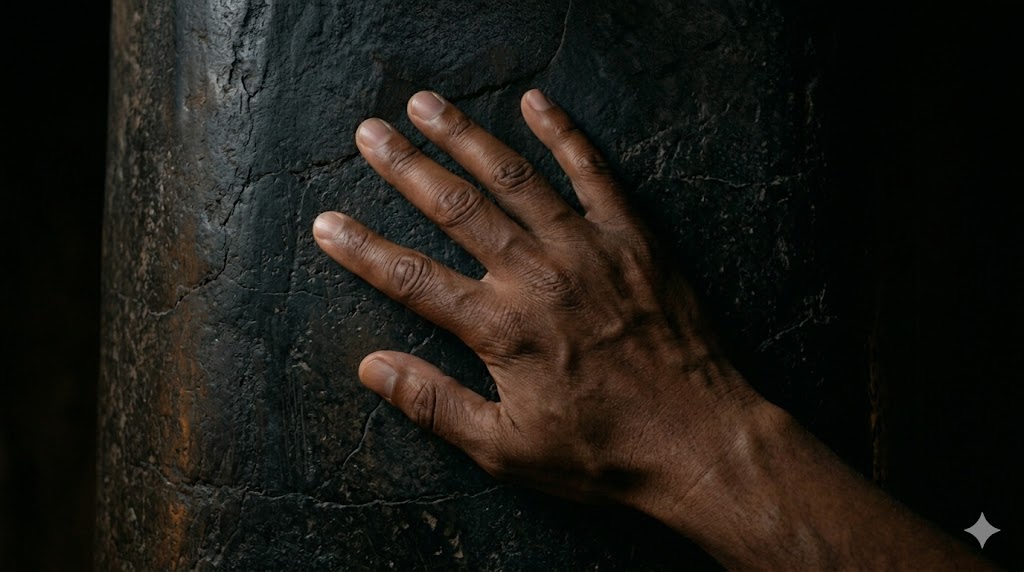
The handprint does not answer for itself.
The person who pressed it cannot be questioned. The record survives. The witness is absent. That absence is what the series has been about from the beginning — the gap between the mark and the hand, between what the record says and what the record is hiding. That gap does not close by itself. It has never closed by itself. In every era, it is filled by whoever encounters the record and decides whether to believe it, to question it, to verify it, to challenge it, or to pass it on as though it were the whole truth.
You are the person who fills the gap.
Not someday. Not when you are in a position of power or influence. Now. Today. In the next message you send, the next story you tell, the next account you give of something that happened and that someone else will have to decide whether to believe.
Look for the handprint. Ask whose hand it was. Ask what they needed the mark to say, and what they needed it to hide. Ask who was in the room and who was just outside the doorway. Ask what is happening just beyond the edge of the frame.
This is not a metaphor. It is a practice. It takes longer than believing what you see. It takes longer than sharing what confirms what you already think. It makes you less certain about more things — and that uncertainty is not weakness. In a world where the tools for manufacturing records are more powerful and more accessible than the tools for verifying them, reflexive certainty is not confidence. It is negligence.
Your hand has been on the wall this entire time.
Every message you send, every account of events you give, every choice you make about what to include and what to leave out — these are handprints. Small ones. But the same operation, in miniature, as everything the series has documented. You crop the photograph when you choose which detail to mention. You adjust the canvas when you soften what happened to protect someone's feelings. You optimise for engagement when you tell the version of the story that will land hardest. You are not standing outside the frame. You are inside it. You always have been.
The question the series has been asking is not only: whose handprint is this?
It is: what will yours say, what will it hide, and who will be able to tell the difference?
The handprint on the cave wall has survived for thirty-six thousand years. The person who pressed it has not. We do not know their name. We do not know what they intended. We know only that they were here, and they wanted something to remain.
That is enough to make the mark.
It is not enough to make the mark honest. Honesty requires someone, in every generation, who is willing to ask what the mark is hiding.
The truth does not defend itself.
That is your job.