The Synthetic Truth: When Seeing Is No Longer Believing
Abraham of London
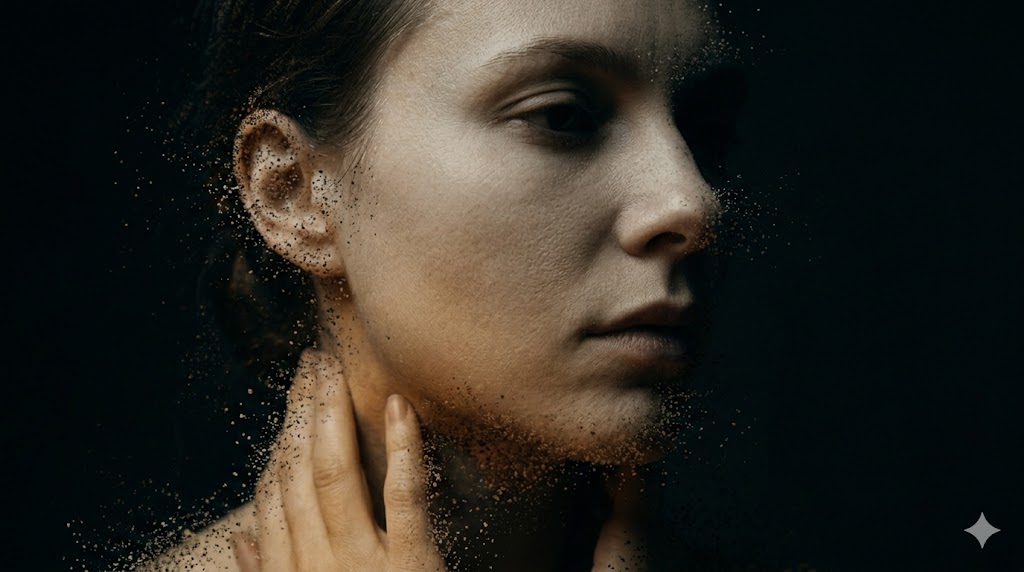
You are watching a video of a person you know.
They are saying something they did not say. You know they did not say it because you know them — the cadence of their speech, the way they pause before certain words, the micro-expressions that cross their face when they are being sincere and the different ones that appear when they are performing. You have years of data that no training set contains. You are watching the video, and you know it is not real, and you cannot point to a single frame that proves it.
You cannot tell. Not from the video. Only from what you know about the person in it — from the trust you have built, the context you carry, the years of witness that no image can replace.
This is the condition the series has been moving toward since the handprint on the cave wall. The handprint was the mark of a specific person, in a specific community, pressed deliberately for a purpose only they fully understood. The synthetic image is the mark of no one, generated by a system trained on the marks of everyone, for any purpose or none at all. The distance between those two marks is the distance the series has travelled. You have travelled it with the series. You are now at the furthest point from the cave wall, and the question is what you carry with you.
The appetite for believing a convincing image predates digital technology by a century. In 1917, two girls in Bradford, England, produced photographs of themselves with fairies. The fairies were cardboard cutouts, drawn by one of the girls, propped up with hatpins, and photographed with a camera that belonged to her father. The photographs were not technically sophisticated. The fairy wings were visibly translucent. The lighting was inconsistent. The poses were stiff.
Arthur Conan Doyle, the creator of Sherlock Holmes — a man whose fictional detective had built a reputation on the rigorous examination of physical evidence — examined the photographs and declared them authentic. He wrote a book about them. The Strand Magazine published them. A significant portion of the British public accepted them as evidence that fairies existed.
The photographs were not exposed as a fabrication until 1983, when one of the girls, Elsie Wright, admitted at the age of eighty-three that they had made the whole thing up. The confession made headlines. The confession did not undo sixty-six years of belief.
The photograph looked real. The desire for it to be real did the rest. The technology of fabrication was primitive — scissors, paper, a camera, a hatpin. The human mechanism that accepted the fabrication was not. It was the same mechanism that would later accept a deepfake: the assumption that a photograph is a reliable record of something that happened in front of the camera.
The Cottingley fairies were not a deepfake. They were a warning. The technology would catch up to the appetite.
It caught up sooner than anyone expected. In 1982, National Geographic moved the Pyramids of Giza closer together. The magazine needed a vertical cover image. The photograph they had was horizontal. The pyramids were too far apart to fit the format. An editor made a decision: use the newly available digital tools to shift the pyramids closer together, creating a composition that fit the cover without requiring a new photograph.
The alteration was not malicious. It was aesthetic. It was not political. It was practical. The editor needed a vertical format. The pyramids were horizontal. The tool existed to fix the problem. The tool was used.
National Geographic did not disclose the alteration. Readers assumed the photograph was an accurate record of the spatial relationship between the pyramids. It was not. The pyramids had not moved. The image had been altered to fit the frame rather than the frame being chosen to fit the image.
This was the first widely documented case of a major publication using digital tools to alter a factual photograph without disclosure. It was not the last. The same logic — the tool exists, the problem exists, use the tool — is the logic that produced everything that followed. The series has shown seven versions of the same choice. Here is version eight: a small, practical, undisclosed alteration to make a photograph fit a frame. The distance between that and a synthetic face is not a moral gulf. It is a technology curve.
In multiple countries during the 2024 election cycle, AI-generated video footage of political figures circulated showing them saying things they did not say. Detection tools existed. They lagged behind generation tools by a measurable interval — weeks, sometimes months. Several cases involved audio and video that trained experts could not identify as synthetic without access to the original metadata. The footage was shared on the same platforms whose amplification algorithms Part 7 described. The platforms' detection systems flagged some of it. The flags were applied after the footage had already been viewed millions of times.
The era in which a photograph or video constituted evidence of an event has ended. Not diminished. Ended.
This is not an argument about the future. It is a description of the present. The technology to produce convincing synthetic video of a person saying something they never said is available to anyone with a consumer-grade graphics card and access to open-source models. It is not restricted to intelligence agencies or state propaganda ministries. It is not expensive. It is not difficult. It is not rare. A person with a laptop and an internet connection can generate a video of a public figure saying anything they choose, in any setting, with any expression, and distribute it to millions of people before any detection system has identified it as synthetic.
The detection tools improve. The generation tools improve faster. This is not a race that detection will win, because detection requires identifying a signal that generation has already learned to reproduce. Every improvement in detection is a training signal for generation. The two systems are locked in a cycle that generation will always lead because generation has no cost for being wrong and detection has no tolerance for being wrong. A false positive — labelling a real video as synthetic — destroys trust in the detection system. A false negative — missing a synthetic video — allows the damage to spread. Detection operates under constraints that generation does not share.
Every previous part of this series showed a record being manipulated by someone who needed the manipulation to serve a purpose — legitimacy, empire, doctrine, engagement. The manipulation was intentional. There was always a commission, a choice, a hand on the chisel.
The synthetic image requires none of that. The technology can produce convincing false records as a byproduct of its existence, without a commissioner, without an intent, without a hand. A model trained on images of a person can produce new images of that person in situations that never occurred, not because anyone asked it to, but because that is what the model is capable of. The handprint of Part 7 belonged to everyone and therefore to no one. The handprint of Part 8 belongs to a training dataset and a parameter count. There is no one to ask.
The synthetic image carries the handprint of everyone who contributed to the training data and the handprint of no one who decided this image should exist. It is the first mark in human history that was pressed by a crowd that never assembled, for a purpose that was never stated, on a wall that has no location.
You are still watching the video. You still cannot tell. What you are using to verify this is not the image. It is everything you know about the person in the image — the years of conversation, the weight of prior witness, the accumulated credibility of someone who has been honest with you before and has reason to continue. You are using trust. You have always been using trust.
The photograph gave you the illusion that you were using something more reliable. You were not. You were trusting the photographer, the editor, the publication, the institution, the chain of custody from event to image to your hands. The photograph appeared to have no commissioner. It appeared to be the world pressing itself onto film. That appearance was the most successful illusion in the history of documentation. You were not wrong to trust it. You were wrong to think you were trusting the machine rather than the people who operated it.
The synthetic image has removed the illusion. What remains is what was always there.
That is not nothing. It is the oldest verification mechanism in human history. It is the question the cave community asked of the person who pressed the handprint. It is the question the conquered people asked of the king who carved the stele, and the answer was no, and they were right, and their knowledge did not survive because they had no stone. Personal trust — the verification of source, the weight of prior relationship, the accumulated credibility of witness over time — is the technology that preceded photography by thirty thousand years. The synthetic image does not defeat it. The synthetic image reveals that it was always what you were actually relying on, even when you thought you were relying on the image.
The return of personal trust is not a retreat. It is a recognition.
The question is what you do with it.
Next in the series: What Deserves to Survive — This is the record. The hand on the wall. The king's inscription. The emperor's canvas. The portrait of a captive prince. The poster of abundant grain. The cropped photograph. The algorithm's feed. The synthetic face. You have read them all now. You know what they cost. The question is what you will do with what you know.