The King's Shadow: How Writing and Monumental Art Created Official Memory
Abraham of London
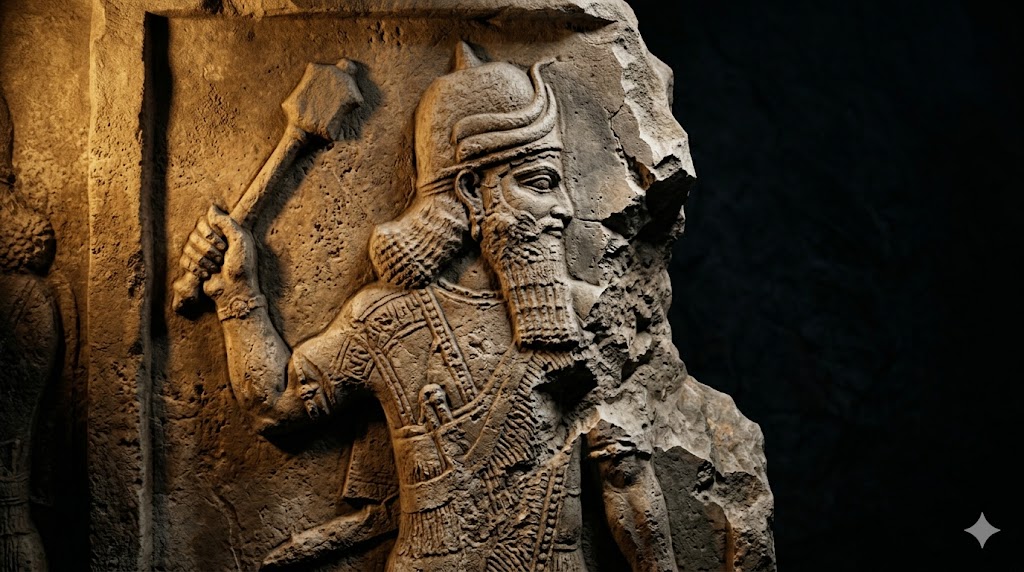
When the first king carved his victory into stone, he was not recording history.
He was fixing a version of it that would outlast anyone who remembered otherwise.
The stone is still there. The people who lost are not. The stone says the king was victorious, the gods favoured him, the enemy was nothing, and the kingdom would last forever. The stone does not say how many of his own soldiers died. It does not say what the enemy's children were told that night. It does not say whether the battle was as decisive as the carving claims, or whether the carving was commissioned because the victory was smaller than the king needed it to be.
The stone cannot answer these questions. That is why the king chose stone. The community may not have sang his song.
The community sang no song for him. But the stone sang his name.
The handprint on the cave wall was anonymous. It belonged to no ruler, no dynasty, no office. It was a signature without rank — the mark of a person who existed, not a person who ruled.
The king's inscription changed that. For the first time, the mark named the one who made it. And the one who made it was not a member of the community. He was the one who commanded the community. The mark no longer said I was here. It said I am the one who decides what happened here.
This is the moment documentation becomes a technology of power.
The shift is visible in the earliest surviving royal inscriptions from Mesopotamia and Egypt. The Palette of Narmer, dating to roughly 3100 BCE, shows the king smiting his enemies on one side and inspecting their decapitated bodies on the other. It is not a report. It is a statement of the king — his record: that his rule was divinely sanctioned, that his enemies deserved their fate, that the order he imposed was the only possible order.
The palette was not stored in an archive. It was displayed in a temple. It was not made to be consulted by future historians. It was made to be seen by the gods and by the people who entered the temple — to fix in their minds a version of events that would not be questioned because the alternative had been literally decapitated.
The handprint had been a claim to belonging. The inscription was a claim to authority. And authority, unlike belonging, requires that alternative versions disappear.
The oldest surviving record of a battle is the Stele of the Vultures, carved by the Sumerian city-state of Lagash around 2450 BCE after its victory over Umma. It shows the king leading his army, the god Ningirsu holding the enemy in a net, and the victorious dead receiving proper burial. The enemy dead are shown as carrion for birds. The stele was made by the winner. The losers left no stele.
The king pressed his handprint into history and called it stone. The conquered pressed nothing. That is why we know one name and not the other.
The name survived because someone wrote it down. And the person who wrote it down answered to the king, not to the conquered. Writing made this possible because writing could be separated from the witness.
In an oral culture, the story is held by the community. If a king wanted to change the story, he had to convince the storytellers, the elders, the people who carried the memory. They could push back. They could say: that is not what happened. I was there. I remember.
Writing removed that check. Once the record was fixed in clay or stone, it could be stored in a place the community could not access. It could be controlled by a class of specialists — scribes, priests, archivists — who answered to the king, not to the people. The scribe did not need to have witnessed the event. He only needed to be able to write what the king dictated.
The community lost its role as the guardian of memory. The record no longer belonged to everyone. It belonged to the person who could afford a scribe.
This is not an accident of history. It is a structural feature of writing as a technology. Writing centralises memory in the same way that taxation centralises wealth. Both require a class of administrators who are loyal to the centre, not to the periphery. Both make it possible for the centre to claim knowledge that the periphery cannot verify.
The handprint on the cave wall was verifiable by anyone who entered the cave. The king's inscription was verifiable only by the king's scribes. That difference is the entire history of official memory. Access.
And access meant the king could show what he chose. The carvings show the lions he killed. They do not show the keepers who drove the lions toward him. The Assyrian reliefs from the palace of Ashurbanipal at Nineveh show lion hunts so numerous and so heroic that the king appears to have single-handedly depopulated the Mesopotamian lion population. The carvings are meticulous: every muscle of the lion, every fold of the king's garment, every detail of the weaponry is rendered with precision that suggests documentary accuracy.
But the reliefs do not show the lions that got away. They do not show the hunts that failed. They do not show the keepers who drove the lions toward the king's chariot so that the king would not have to find them himself. The carvings present a curated reality in which the king is always victorious, always brave, always in control — and the medium of stone makes that reality feel permanent and true.
The same pattern appears in Egyptian temple reliefs, Roman triumphal columns, and Persian palace inscriptions. The medium is different. The structure is identical. The ruler is victorious. The enemy is contemptible. The gods approve. The order is eternal.
What is missing from every one of these records is the perspective of the people who lost. The Nubian archer who faced the Egyptian chariotry does not appear in the Egyptian record except as a body count. The Persian soldier who died at Marathon does not appear in the Persian record at all — the Greek record is the only one that survived, and it was written by the victors. The Gaulish chieftain who fought Caesar does not appear in the Gallic record because the Gauls did not have writing, and Caesar's account is the only one we have.
The absence of the defeated is not a gap in the archive. It looks like it is the archive's purpose.
But the archive could do more than omit. It could erase. The Roman damnatio memoriae — the official erasure of a disgraced emperor's name from inscriptions and monuments — is the most explicit example of documentation as a weapon. When the Senate condemned an emperor after his death, his name was chiselled out of every public inscription. His statues were destroyed. His portraits were defaced. His official records were purged.
The goal was not merely to punish the dead. It was to remove them from the historical record entirely — to make it as though they had never ruled. The physical act of chiselling a name from stone was a ritual of forgetting, performed by the state on behalf of the state, for the benefit of the state's future legitimacy.
The handprint on the cave wall could not be chiselled out. It was not a name. It was a presence. But the king's inscription was a name — and names can be removed.
This is the vulnerability that writing introduced. If the record is controlled by the centre, the centre can also delete the record. The same technology that made memory permanent also made forgetting administrative.
But deletion is not the only silence the archive produces. The stone that was never carved is silent too. The stone is still there. The inscriptions are still legible. We can read the king's version of events with perfect clarity, three thousand years after they were carved.
But the stone cannot tell us what the king was afraid of. It cannot tell us whether the battle was as decisive as he claimed, or whether he commissioned the carving because his hold on power was weaker than he needed his subjects to believe. It cannot tell us what the enemy thought, what the enemy felt, what the enemy would have carved if they had had stone and a scribe.
The stone is permanent. It is also partial by its limited nature. And its permanence has given the king's version of events a survival advantage that no counter-narrative could match. The king's version was carved in stone. The enemy's version was carried in memory. The stone outlasted the memory. The king's truth became history. The enemy's truth became silence.
This is not an argument against writing. It is an argument for understanding what writing does. Writing does not preserve the past. It preserves a version of the past — the version that had access to stone, to scribes, to the resources required to fix a story in a medium that would outlast every living witness.
The handprint on the cave wall was made by a person who had no access to those resources. It survived because the cave sealed, not because anyone preserved it. The king's inscription survived because the king paid for it to survive. That is the difference between a mark made by a community and a mark made by power.
The question is not whether the king's inscription is true. The question is whose truth it serves, and whose truth it erased.
Before the inscription, there had been a different kind of truth — one carried by people who could be questioned. In the ancient world, the witness was the gold standard of proof. A legal transaction required witnesses. A treaty required witnesses. A marriage required witnesses. The witness was the person who had seen the event and could testify to it. Their memory was the record.
Writing did not replace the witness. It replaced the need for the witness to be present when the record was consulted. A written contract could be brought to a court and read aloud. The witnesses did not need to be there. Their testimony had been captured in the text.
But this created a new vulnerability. If the text could be separated from the witness, the text could also be altered without the witness's knowledge. A scribe could change a number. A king could add a clause. An archivist could lose a document. The witness was no longer the guardian of the record. The record was now guarded by the people who controlled the archive.
The handprint could not be altered. It was made by direct contact between the hand and the wall. The king's inscription could be altered — and was, repeatedly, by subsequent kings who wanted to rewrite the history their predecessors had carved.
The first lesson of documentation is that every technology of memory is also a technology of forgetting. The second lesson is that the forgetting is never evenly distributed.
The king's inscription is still there. You can visit it in a museum. You can read the king's version of events. You can admire the craftsmanship, the precision, the permanence of the stone.
But if you read it without asking who paid for it, who was erased by it, and who had no access to the stone at all, you are not reading history. You are reading power's account of itself.
The handprint on the cave wall asked nothing of you. It was content to be present. The king's inscription demands something: your belief. It was made to be believed. It was made to outlast every alternative. It was made to fix a version of events so firmly that no one would think to ask what was missing.
The question the inscription does not want you to ask is the only one that matters: what else happened that day?
The stone cannot answer. But somewhere — in a song that was not written down, in a story that was not carved, in a memory that was carried in a body and turned to dust — the answer existed.
The king's victory was real. But so was the enemy's loss. And only one of those truths was carved in stone.
Next in the series: The Emperor's Canvas — In 1804, Napoleon walked into Jacques-Louis David's studio, looked at the coronation canvas, and said: add my mother. She was not there. David painted her in. The painting hangs in the Louvre. No one who sees it knows she was absent.