Before the Word: What the Cave Walls Remember
Abraham of London
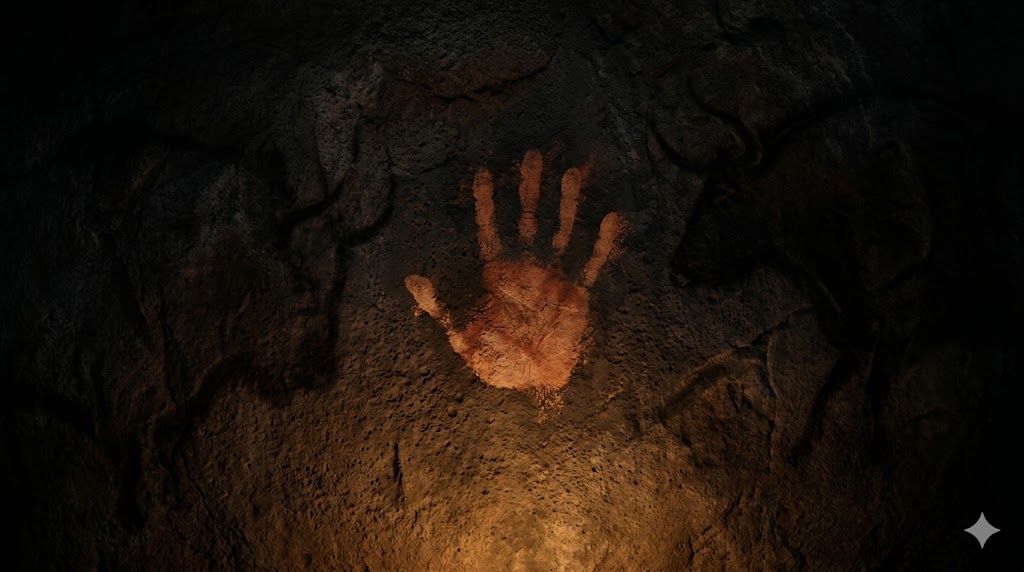
Thirty thousand years before anyone invented writing, a hand was pressed against a cave wall in what is now France, and pigment was blown around it.
The outline that remains is not a painting of a hand. It is a signature. A declaration: I was here. I existed. This is not nothing.
The person who made that mark did not know they were making a document. They were making a claim — the same claim every human since has made, in every medium available: that their presence mattered, that it should outlast them, that the world would be poorer for forgetting they had been in it.
The handprint has outlasted every kingdom that came after it. Every empire that rose and fell between that cave and this sentence. Every language that was spoken, every song that was sung, every name that was carried by voices that turned to dust. The songs are gone. The stories are gone. The names are gone. The handprint survived.
The cave was not a gallery. It was a record. The animals painted on its walls — bison, horses, deer, lions — were not decoration. They were what the community needed to remember: what to hunt, what to fear, what to honour, where the water was, how the world worked. The paintings were practical memory, stored in the one place the community could return to, generation after generation, and find the same images waiting.
Oral tradition worked differently. It was not fixed in place. It was carried in the body — in rhythm, in chant, in the repetition of stories that changed slightly with every telling but preserved their core across centuries. The griot of West Africa did not memorise a script. He held a lineage, a cosmology, a legal code, a genealogy, and a moral archive in his nervous system and his voice. When he performed, he was not entertaining. He was transmitting what would otherwise be lost.
These were not primitive technologies. They were sophisticated memory systems adapted to the conditions of a world without writing. They worked because they were communal: the knowledge was held by many, checked by many, corrected by many. If a storyteller changed the genealogy, someone in the audience knew. If a painting was altered, the elders remembered what it had shown before.
The truth was not guaranteed by the medium. It was guaranteed by the community that watched the medium.
That is the first lesson, and it is the one every subsequent technology has tried to replace.
The handprint on the cave wall was pressed by a person who belonged to the community. It did not need to be believed. It needed only to be present. That is the difference between a mark made by a witness and a mark made by power — and every part of this series is about what happens when the second replaces the first.
For most of human history, the ability to make a permanent mark was not a private act. It was a communal one. The cave painter painted for the group. The storyteller performed for the group. The carver carved what the group needed to see. The mark belonged to everyone because everyone had a stake in what it said.
This is important because it means the earliest documents were not made by power. They were made by the collective, for the collective, as a service to collective memory. The handprint on the wall is not a king's signature. It is a person's. Anonymous, unranked, unrepeatable — but present. The mark said: I was part of this. This is my community. This is what we knew.
The handprint is not a claim to authority. It is a claim to belonging.
That changes when writing arrives. Writing did not begin as literature. It began as accounting. The first written records, in Sumer around 3400 BCE, were not poems or prayers. They were ledgers: who owed what, how much grain was stored, which temple received which offering. The first writer was not a poet. He was a bureaucrat.
But the invention of writing did something that oral tradition and cave painting had never done. It separated the record from the community. Once a mark was made in clay, it could be carried away from the people who had witnessed what it described. It could be stored in a palace, a temple, an archive that ordinary people could not enter. It could be shown to a stranger who had never been present and presented as truth.
The person who controlled the clay controlled the record. The person who controlled the record controlled what the institution believed had happened.
This is the moment the handprint changes meaning. The handprint on the cave wall was made by the person who belonged to the community. The mark on the clay tablet was made by a scribe on behalf of a king. The hand that pressed into the clay may not be the hand that had witnessed the transaction. It could be a hand that had been paid to record it.
The community no longer watched the record. The record watched the community.
Oral cultures understood what was at stake. Many traditions refused to commit their most sacred knowledge to writing — not because they could not, but because they understood that writing fixed meaning in a way that could be controlled. A song that lives in the body can be changed by the singer, corrected by the audience, adapted to the moment. A song that is written down can be owned, edited, censored, or destroyed by whoever holds the page.
The decision to remain oral was not primitiveness. It was a theory of truth.
The theory was that truth is not a static thing that can be captured in a mark. It is a living thing that must be held by a community, tested by experience, and passed on by people who can be questioned. A written record can be interrogated only by the literate. An oral tradition can be interrogated by anyone who speaks the language.
This is not nostalgia for a pre-literate past. It is a warning that every technology of memory is also a technology of forgetting — and that the forgetting is usually not accidental.
The handprint on the cave wall is thirty thousand years old. Every other record from that time — the songs, the stories, the names — is gone. That is not because the handprint was more truthful. It is because the handprint was more durable. It was fixed in a place that could not be burned, could not be lost, could not be rewritten by a king who wanted a different story. The cave sealed. The handprint survived.
But durability is not the same as fidelity. The handprint survived because it was made of mineral pigment on stone. The songs did not survive because they were made of air and memory. The medium that preserved the handprint was the same medium that made it impossible to correct, impossible to update, impossible to question. The handprint is permanent. It is also silent. It cannot tell you whether the person who made it was happy or terrified, whether they were recording a successful hunt or praying for one, whether they were free or enslaved.
The handprint is a document. It is not the whole truth. No single document ever is.
The series you are beginning is about the gap between the mark and the truth. Every part that follows will examine a moment in history when someone made a choice about what to show and what to hide — a king commissioning a carving, a painter adjusting a canvas, a photographer cropping a frame, an algorithm amplifying a feed, an AI generating a face that never existed. Each of those choices is a handprint. Each of them claims to tell you what happened. Each of them leaves something out.
The question is not whether the mark is true. The question is who made it, who paid for it, who benefited from it, and who was erased by it.
The handprint on the cave wall was made by a person who belonged to the community it served. That is the standard against which every document since has to be measured.
The king's carving did not meet that standard. The emperor's canvas did not meet it. The colonial portrait did not meet it. The socialist poster did not meet it. The cropped photograph did not meet it. The algorithm's feed does not meet it. The synthetic face does not meet it.
The question the series leaves you with is not whether you can find a document you can trust. It is whether you are willing to do the work that trust requires — to ask who pressed the hand to the wall, and what they wanted you to believe, and what they needed you not to see.
Because the handprint has outlasted every kingdom. But it has never answered for itself.
That is what the witness is for.
Next in the series: The King's Shadow — When the first kings carved their victories into stone, they were not recording history. They were fixing a version of it that would outlast anyone who remembered otherwise. The stone is still there. The people who lost are not.