The Grain Is Abundant: Socialist Realism and the Manufacture of Utopia
Abraham of London
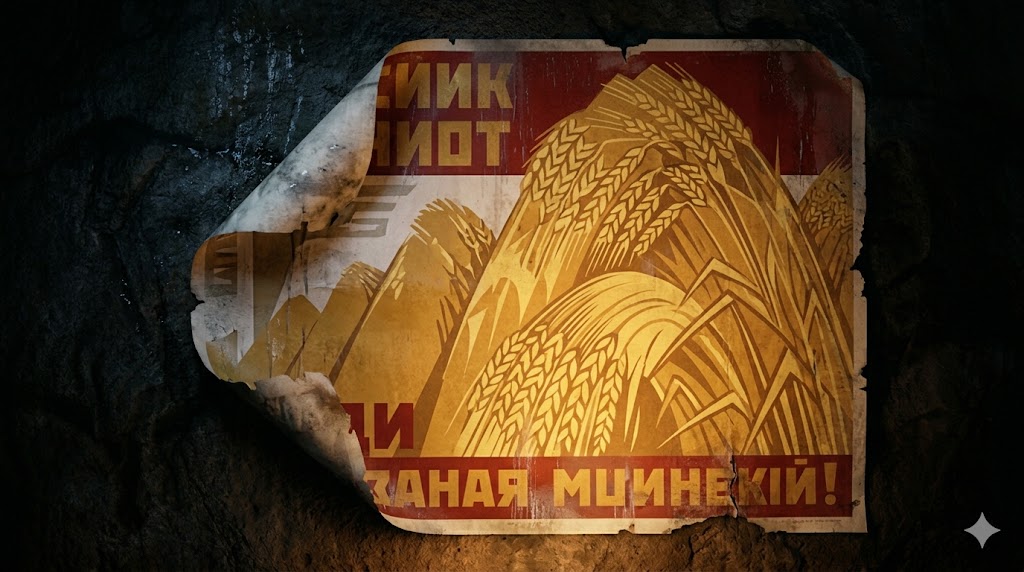
In 1958, a Chinese peasant starved while a poster on the wall beside him showed a harvest so abundant that grain spilled from the edges of the frame.
The poster was not a lie in the narrow sense. It was a prediction that had been painted as though it had already happened. The state called it socialist realism. The peasant called it hunger.
In 1934, the Soviet Writers' Congress issued a mandate that would define official art for half a century. Socialist realism was not to depict life as it was. It was to depict life as it was becoming — the Communist future, already visible in the present, rendered with such conviction that the viewer would believe the transition had already occurred. The painter was not a documentarian. The painter was a prophet whose prophecies were required to come true.
The practical consequence was that a painter could not paint what they saw. They could only paint what the doctrine required them to see. If the harvest failed, the harvest was not painted. If the factory was dangerous, the danger was not painted. If the leader was wrong, the leader was not painted as wrong. The painter's eye was subordinate to the party's plan.
Boris Ioganson's At an Old Ural Factory (1937) shows workers in heroic light — muscles tensed, faces determined, the machinery of industry gleaming around them. The painting is technically accomplished. The composition is dynamic. The workers look like the vanguard of history. The Gulag was operating forty miles from the factories Ioganson painted. The prisoners who built the railway that carried the factory's output were not included in the composition. They could not be. The doctrine did not permit it.
Ioganson was not a villain. He was a painter who chose between his knowledge and his survival. The painting is not a lie in the narrow sense. The factory existed. The workers existed. The muscles and the determination existed, somewhere, some of the time. What the painting omits is not fabricated. It is selected. But the selection is not innocent. It is obedience.
You are the painter. You have been given a commission. The harvest poster is needed by next week. You know what you know — that the grain is not abundant, that the collective farms are failing, that people are already beginning to starve in the villages where your own family lives. You also know what happened to the last painter who refused a commission. He is not painting anymore. You take the commission. You paint the grain. You make it abundant because that is what the poster requires. The poster is printed. It is distributed. It hangs on the wall of a peasant who is starving beneath it. You do not paint that part. You were not asked to.
The poster-maker pressed their handprint to the wall in the name of the future. The peasant pressed nothing. Hunger is not the kind of mark that gets preserved.
In 1932, the Soviet state printed a poster titled The Grain Is Abundant. It shows a collective farm worker standing in a field of wheat that reaches her shoulders. She is smiling. The sky is clear. The wheat is golden and thick and stretches to the horizon. The caption reads: "Fulfil the Bolshevik harvest plan — the country needs grain."
The poster measures approximately 100 by 70 centimetres. It was printed in an edition of at least fifty thousand copies. It was displayed in village reading rooms, collective farm offices, railway stations, and schools across the Ukrainian Soviet Socialist Republic — the same region where the Holodomor, the famine caused by the state's seizure of grain reserves, was killing an estimated four million people between 1932 and 1933.
The poster does not show the grain requisition squads who took the harvest from the farmers who grew it. It does not show the storage silos where the grain was held while people starved. It does not show the children whose deaths were recorded in Soviet medical ledgers as "weakness from birth" because the state did not permit famine to be listed as a cause of death. The poster shows a woman in a field. The wheat is abundant. The caption says the country needs grain. The country got the grain. The people who grew it did not.
The Ukrainian famine killed between three and five million people in two years — and the Holodomor was not the only famine of the twentieth century produced by a state that was simultaneously printing posters of abundance, because the same mechanism operated during the Great Leap Forward in China, where between fifteen and fifty-five million people died depending on which historical estimate you use and historians are still arguing the figures because the state that produced the famine also controlled the records that would count the dead, and the posters of abundant grain were printed in both countries, in the same years, by the same logic, with the same consequence: the people who starved left no mark, and the people who printed the posters left an archive that is still consulted by researchers who must decide whether to trust the official figures or the counter-estimates produced by demographers working with fragmentary data and the knowledge that their own careers may depend on which number they choose to publish. The Soviet government continued to export grain throughout the period. The posters continued to be printed. The official line was that the harvest had been successful and the famine was a fabrication of Western propaganda.
The counter-record was produced by a small number of journalists who travelled to the affected regions and reported what they saw. Gareth Jones, a Welsh journalist who had worked as a translator for Lenin, visited the Soviet Union in 1933 and filed dispatches describing mass starvation. He was dismissed as anti-Soviet. The New York Times correspondent Walter Duranty won a Pulitzer Prize in 1932 for dispatches that denied the Ukrainian famine was occurring. Duranty wrote that there was no famine, that reports of starvation were exaggerated, that the Soviet government was managing food distribution effectively. He was wrong. He was awarded journalism's highest honour for being wrong.
The distribution argument is not about the poster alone. It is about the system that ensured the poster would be believed and the counter-evidence would be suppressed. It was not enough to make the abundant grain visible. The starvation also had to be made invisible. And it was — systematically, through control of access, through control of reporting, through the awarding of prizes to journalists who told the state's version and the dismissal of those who told the truth.
The posters did not lie. They selected. But the selection was enforced by the same apparatus that controlled the journalists, the photographers, the foreign correspondents, and the historians who would later try to count the dead. The frame was not a choice. It was a policy.
The poster-as-prediction-painted-as-accomplished-fact did not die with the Soviet Union. It found a new medium. Every major corporation now publishes an annual sustainability report. The format is glossy. The metrics are specific. The emissions targets are presented as trajectories that are already being achieved. The diversity commitments are illustrated with charts showing progress toward parity. The social impact figures are audited, verified, and printed on recycled paper.
The underlying data frequently shows the opposite. Emissions are rising. Diversity metrics are stagnating. Social impact programmes are funded at fractions of the levels the reports imply. But the report must be published, because the report is required by the capital markets that screen investments against ESG criteria. The corporation that does not publish a sustainability report is at a competitive disadvantage. The corporation that publishes an honest sustainability report is at an even greater disadvantage, because honesty would show that the targets are not being met, and the capital would flow elsewhere.
The commission cannot be refused. The commission comes from the market, not from the party. The consequence is the same. The future is painted as present. The prediction is rendered as accomplished fact. The reader of the report — the investor, the regulator, the consumer — is shown a world that does not yet exist and told that it does.
No gun. The same choice.
The poster of abundant grain is still in the archive. You can view it in the Library of Congress. It is still beautiful. The woman is still smiling. The wheat is still golden. But the poster cannot contain what was happening outside the frame. The grain requisition. The starvation. The children whose deaths were recorded as weakness. The journalist who told the truth and was dismissed. The journalist who told the state's version and won a prize. The four million people who died while the poster hung on the wall of the village reading room, promising abundance.
The poster is not a lie. It is a selection. But a selection that was enforced by the systematic suppression of every alternative record is not a document. It is a weapon.
The posters did not document what was happening. They documented what the state needed people to believe was happening. When the famine was over and the purges were done, the posters remained — a beautiful, terrible archive of a history that never happened. The peasant left no archive. The poster is still in the museum. History preserved what the state wanted preserved. It has always worked this way.
The question is not whether it is happening now. The question is what you are being shown instead of the famine.
Next in the series: The Camera Never Lies (But the Photographer Can) — In 1945, Joe Rosenthal took a photograph of six men raising a flag on Iwo Jima. It became the most reproduced image of the war. What the photograph does not show is that it was the second flag-raising that day, that the first flag had been smaller, that the moment was staged for the camera. The men were real. The hill was real. The victory was real. But the photograph is not a window. It is a crop.