The Camera Never Lies (But the Photographer Can)
Abraham of London
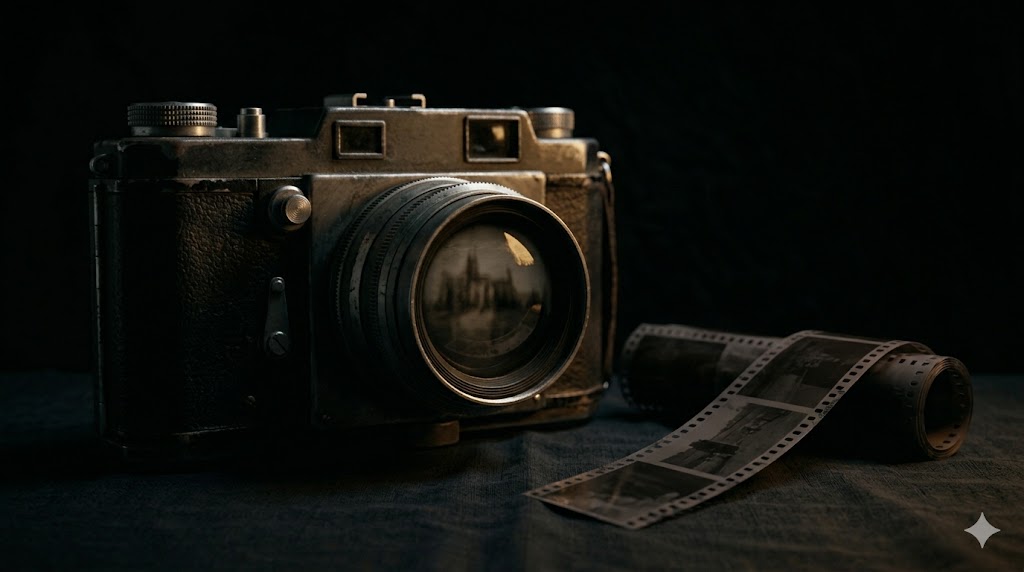
The photograph appears to have no commissioner.
That is what makes it different from everything that came before it. The cave painting was made by a community that needed to remember. The stele was ordered by a king who needed to be remembered. The canvas was commissioned by an emperor who needed to be believed. The portrait was hung by an empire that needed to be seen as benevolent. The poster was printed by a state that needed the future to arrive on schedule. Every record in this series so far has a visible hand pressing a visible mark into a visible surface for a visible purpose. You could see who made it, who paid for it, who benefited from it, and who was erased by it. The analysis was difficult. The question was clear.
The photograph appears to have none of that. It appears to be the world pressing itself onto film through a machine that has no ideology, no patron, no agenda. The camera does not care what it sees. It records what is there. The photographer is a technician operating a device. The device is neutral. The image is mechanical. The human element — the choice, the bias, the commission — seems to have been removed from the process entirely.
That appearance is the most consequential development in the history of documentation since writing. Because a record that appears to have no commissioner is a record that appears not to lie. And a record that appears not to lie is a record that cannot be interrogated.
The previous five parts showed records the reader could interrogate. The king's inscription was obviously partial. The emperor's canvas was obviously curated. The colonial portrait was obviously staged. The socialist poster was obviously a prediction dressed as a record. The reader could see the hand of power in every one of them. The analysis was difficult. The question was clear.
The photograph hides the hand. That is its power. That is also its danger. And that is what this episode exists to make visible.
On 23 February 1945, Joe Rosenthal took a photograph of six men raising an American flag on Mount Suribachi, Iwo Jima. The men were real. The hill was real. The flag was real. The war was real. The photograph is not a fabrication.
What the photograph does not show is that it was the second flag-raising that day. The first flag had been smaller. A larger flag was brought up the hill. Rosenthal photographed the second raising. The moment was staged for the camera — not in the sense that the men were actors, but in the sense that they were asked to repeat an action they had already performed, so that the camera could capture it more effectively.
The photograph became the most reproduced image of the Second World War. It was used in a bond campaign that raised $26.3 billion. It was turned into a monument. It was printed on stamps, posters, magazine covers, and history textbooks. It became the official memory of a battle that most Americans could not have located on a map.
The photograph was true. The meaning was manufactured. Can those two things be separated?
Rosenthal pressed his handprint to the shutter at the right moment. The men in the photograph pressed their hands to a flagpole on a hill. The bond campaign pressed its handprint to the icon and raised twenty-six billion dollars. The moment and the meaning are different objects.
The Iwo Jima photograph shows what distribution does to a true image. The meaning is manufactured after the fact, by people who were not there, for purposes the men on the hill did not consent to. But the next photograph in this sequence does something different — it escapes the manufacture entirely.
On 8 June 1972, Nick Ut took a photograph of a nine-year-old girl running down a road in Trang Bang, South Vietnam, after a napalm attack. Her clothes had been burned off. Her arms were outstretched. Her mouth was open in a scream that the photograph cannot transmit but that anyone who sees it can hear.
Ut was working for the Associated Press. He was not commissioned by the state. He was not ordered to produce a specific image. He was a war photographer in a war zone, doing what war photographers do: documenting what was in front of him. The photograph that resulted was not curated by a propaganda ministry. It was not approved by a military censor. It was filed, transmitted, and published because it was true and because the truth was what the Associated Press paid him to capture.
Ut did something else that day. After taking the photograph, he drove the children to the nearest hospital before filing his film. He broke protocol. He was not supposed to stop and help. He was supposed to take the picture and move on. He did not move on. He put the camera down and became a person for the time it took to get a child to a doctor. Then he picked the camera up again and filed the photograph that changed how America saw the war.
The photograph that the Nixon administration had tried to prevent from circulating — through censorship, through restricted access, through the systematic framing of the war as a necessary struggle against communism — was taken by a man who almost did not take it because he was too busy being a human being. That is not incidental. That is the evidence that the person behind the camera matters as much as the machine.
The photograph escaped the official record. It became the counter-record. It was published around the world. It shaped public opinion. It accelerated the end of a war that the official record had been trying to justify for a decade.
Sometimes the photograph escapes the manufacture and becomes its own evidence. Sometimes the handprint of the photographer and the meaning of the image are not separated. They are the same act.
But the third photograph in this sequence presents a problem neither of the first two faced. On 5 June 1989, a man stood in front of a column of tanks on Chang'an Avenue, Beijing. He was carrying a shopping bag. He stepped into the path of the lead tank. The tank stopped. He stepped to his left. The tank steered around him. He stepped in front of it again. This continued for several minutes. Then he climbed onto the tank and spoke to the crew. Then he got down. Then he was pulled away by bystanders.
His identity has never been confirmed. His fate is unknown. He is referred to as Tank Man because he has no other name that the record has preserved.
Multiple photographers captured the event from the windows of the Beijing Hotel, which overlooked the square. Their photographs were smuggled out of China and published around the world. The image of a single man standing in front of a column of tanks became the defining image of the Tiananmen Square protests — not because it showed the scale of the movement, but because it showed the courage of a single person against a state that had decided to use force.
The Chinese government has spent the decades since systematically removing the photograph from every digital platform it controls. The image is not accessible on Chinese search engines. It is not shown in Chinese museums. It is not printed in Chinese textbooks. A generation of young Chinese people has grown up without seeing the photograph that the rest of the world recognises as the defining image of their country's modern history.
The photograph exists. Multiple versions exist, taken by different photographers with different cameras from slightly different angles. The Chinese government cannot unmake it. What they can do — and do, continuously — is prevent it from reaching the people it most concerns. The photograph is simultaneously the most recognised image of the twentieth century and a photograph that the majority of young Chinese people have never seen.
We do not know who he was. We do not know what happened to him. The photograph is complete. The person is not.
The photograph escaped. The people it was taken for have not seen it.
The three photographs are in conversation with each other. Iwo Jima shows what distribution does to a true photograph — the meaning is manufactured after the fact, by people who were not there, for purposes the men on the hill did not consent to. Napalm Girl shows what a true photograph does to official distribution — the counter-record breaks through, not because the system allowed it, but because one person broke protocol and the image was true enough to survive the suppression. Tank Man shows what happens when the photograph wins and distribution still controls who sees it — the image is free, the people it belongs to are not.
The photograph of the flag is true. The photograph of the girl is true. The photograph of the man in front of the tanks is true. What you do with a true image, who sees it, what meaning gets pressed into it, what wall it gets hung on and whose hands did the hanging — that is not photography. That is everything that surrounds photography. And that is what this series has been about from the beginning. The handprint is not the mark. The handprint is whoever got to decide the mark would survive.
The camera records the surface. What is behind the surface is not always available. Not to the photographer, not to the historian, not to the reader. Sometimes the handprint is all you get, and you will never know whose hand it was.
Next in the series: The Algorithm's Gallery — In 2020, Facebook's internal research showed that the company's own algorithm was amplifying false information at a rate the company's data scientists called dangerous. The research was presented to senior leadership. The decision was made not to change the algorithm. The engagement metrics were too strong. The algorithm knew. The people who built it knew. The amplification continued.