The Emperor's Canvas: Napoleon and the Invention of Modern Propaganda
Abraham of London
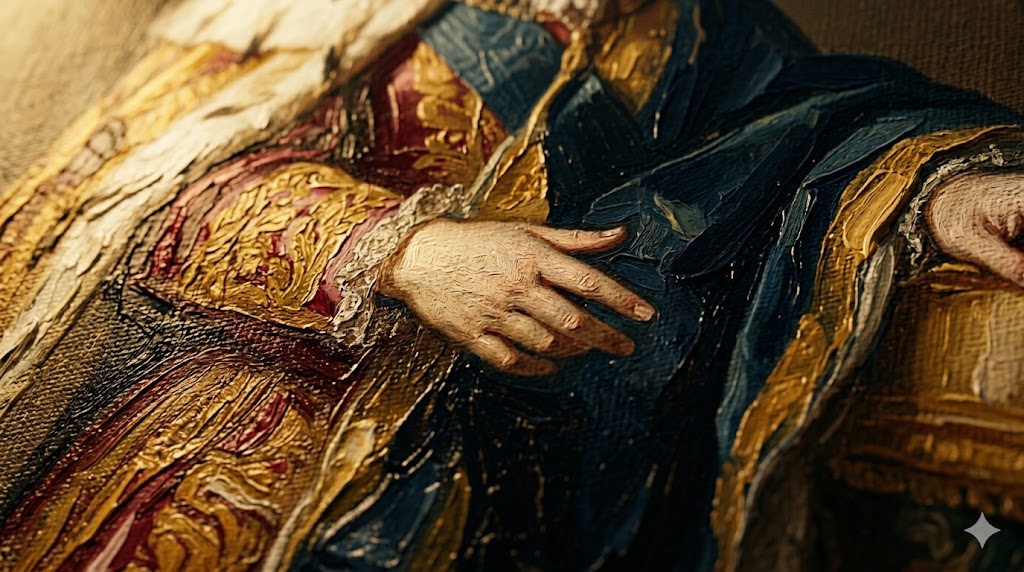
In 1804, Napoleon Bonaparte walked into Jacques-Louis David's studio, looked at the nearly finished coronation canvas, and said: add my mother.
She was not there.
Napoleon's mother, Maria Letizia Bonaparte, had not attended the coronation. She was in Rome, in self-imposed exile, disapproving of her son's ambition. But Napoleon needed her on the canvas. The coronation was supposed to be a family affair — a dynasty, not a coup. A man who crowns himself emperor in the presence of his mother is a son fulfilling his destiny. A man who crowns himself emperor in the absence of his mother is a man who has no one to share the stage with.
David did not hesitate. He had survived the Terror by being useful, survived the Directory by being indispensable, and attached himself to Napoleon with the same instinct that had kept him alive through twenty years of political slaughter. He picked up the brush and painted her in.
She sits in the elevated gallery, centre-left, dressed in blue, watching her son with an expression of solemn approval. She looks exactly as a mother should look at a moment of supreme familial triumph. She looks real.
She was not there.
The painting hangs in the Louvre. It is nine metres wide, six metres tall. Millions of people have stood before it. Most of them have no idea that Napoleon's mother was absent from the event the painting claims to document. The painting has become the memory. The painting has replaced the event.
David understood what Napoleon needed. He needed legitimacy. He needed continuity. He needed to be seen not as a Corsican general who had seized power through military luck and political cunning, but as the natural heir to Charlemagne, to Augustus, to the great emperors of history whose images had been carved in stone and painted on palace walls. David gave him that. He gave him a visual language that borrowed from Roman imperial iconography, from Renaissance religious painting, from the classical tradition that every educated European recognised as the vocabulary of authority. Napoleon in David's paintings does not look like a man who rose through violence. He looks like a man who was always meant to rule.
The coronation canvas is the masterpiece of this project. It shows Napoleon crowning Josephine while the Pope sits behind him, reduced to a spectator. Every detail is calculated: the light falls on Napoleon's hand, not on the Pope's. Josephine kneels in white silk, her head bowed in acceptance. The assembled dignitaries watch with expressions of reverence. The composition is flawless. The message is unmistakable: Napoleon is the source of authority. The Church blesses him, but it does not confer power upon him. He confers power upon himself, and the Church is there to witness, not to grant.
None of this is accidental. Every figure, every gesture, every fold of fabric was chosen by David in consultation with Napoleon. The painting is not a record of the coronation. It is a political argument disguised as a record. And it worked so well that the painting has defined the public memory of the coronation for two centuries. When people imagine Napoleon's coronation, they imagine David's painting. They do not imagine the actual event, because the actual event was messier, less dignified, less certain. The painting replaced the event. The argument became the memory.
Napoleon's mother was not the only absence the canvas corrected. The painting shows the Pope giving his blessing. In reality, Pius VII had been pressured into attending and would later be imprisoned by Napoleon. The painting shows the dignitaries united in support. In reality, many of them were plotting against Napoleon within months. The painting shows a seamless transfer of legitimacy. In reality, Napoleon had to snatch the crown from the Pope's hands and place it on his own head because the Pope refused to crown him.
David painted the version Napoleon needed. He painted out the resistance, the resentment, the political calculation. He painted in the unity, the devotion, the divine approval that Napoleon's project required.
This is not lying in the simple sense. The coronation happened. Napoleon did crown himself. The dignitaries were present. The Pope was there. The painting is not a fabrication. It is a selection — a choice about what to emphasise and what to omit. But a selection that shapes what millions of people believe is not merely a selection. It is a construction of reality.
The handprint on the cave wall did not select. It recorded what was there. The king's inscription selected, but its selection was obvious — the king's victory, the enemy's defeat — and the genre was understood to be celebratory, not documentary. David's painting was different. It claimed to be documentary. It used the visual language of realism — precise anatomy, accurate architecture, identifiable faces — to create the impression that what it showed was what had happened. That impression was false. Not because the painting was a lie, but because realism is not the same as truth. Realism is a style. Truth is a relationship between a claim and reality. The style can be perfect and the relationship can be broken.
While David was painting Napoleon's mother into a scene she had never witnessed, another painter was watching the same empire from the other side. Francisco Goya was in Spain when French troops occupied Madrid in 1808. He watched as French soldiers rounded up Spanish civilians and shot them. He went home and made a painting.
The Third of May 1808 shows a line of French soldiers aiming their rifles at a group of Spanish civilians. The central figure is a man in a white shirt, his arms raised, his face a mixture of terror and defiance. He is about to die. The soldiers are faceless, identical, mechanical. The lantern at their feet casts a harsh light on the scene, illuminating the bodies of the dead and the faces of the condemned.
Goya's painting is as realistic as David's. The anatomy is precise. The composition is deliberate. The faces are individual. But Goya used realism for the opposite purpose. He did not glorify power. He documented its brutality. The painting does not tell you that the French were justified, that the Spanish were rebels, that the occupation was necessary. It tells you that men died, that they were afraid, that the soldiers who killed them were interchangeable and anonymous and would not be held accountable.
David's painting was commissioned by power. Goya's was painted in spite of power. David's painting was displayed in the palace. Goya's was hidden in his studio, not published until after his death, because he knew what would happen to a painter who showed the empire what it really looked like.
Two painters. Same war. Two completely different versions of what a painter is for.
Napoleon's handprint is on every canvas David painted. His mother's is on none of them — even the ones she appears in.
The comparison between them is not only about what each painter chose to show. It is about what each painter's work could do in the world, and that depended on something neither painter controlled: the means of reproduction. David's coronation canvas was the original, but thousands of copies spread across Europe — engravings, prints, illustrated books — carrying Napoleon's curated reality into the homes of people who would never see the original and would never know what had been painted out. Goya's painting could not circulate. It was hidden. The difference between them was not only intention. It was distribution.
Napoleon understood this. He understood that a painting could be more powerful than a battle, because a painting could be reproduced. A battle is over in a day. The dead are buried. The ground is retaken. But a print of a painting of the battle can be distributed, displayed in palaces and public buildings and private homes for generations. It can shape what people believe about the battle long after every participant is dead. It can turn a tactical draw into a decisive victory, a strategic blunder into a heroic sacrifice, a brutal massacre into a necessary act of order.
Kings had been commissioning victory monuments for thousands of years. But Napoleon perfected it, because he understood that the new medium of mass reproduction changed the scale of the operation. It was no longer enough to control the official record. You had to control the copies. You had to ensure that the version of events that circulated most widely was the version that served you.
Every propaganda ministry that followed understood this too. The tools changed — photography, film, television, the internet — but the logic remained the same: control the image that circulates, and you control what people believe.
The coronation canvas is still in the Louvre. It is still beautiful. It is still convincing. But it cannot hide what it was made to do. It was made to make Napoleon look legitimate. It was made to erase the political calculation, the resistance, the absence of his mother. It was made to present a carefully staged fiction as a documentary record.
The painting does not lie. It selects. But a selection that shapes what millions of people believe is not neutral. It is power, exercised through the most persuasive medium available.
Goya's painting survived too. It survived because Goya painted it anyway, knowing it could not be shown in his lifetime, knowing that the empire would suppress it, knowing that the truth would have to wait. It waited. It is now in the Prado. More people have seen Goya's painting of the execution than ever saw David's painting of the coronation — not because David's painting is less famous, but because Goya's painting tells the truth about what power looks like when it is not being curated.
The handprint on the cave wall was made by a person who belonged to the community. David's painting was made for an emperor. Goya's painting was made in spite of an emperor. The difference between them is the difference between documentation and propaganda. Documentation serves the truth. Propaganda serves power. The style can be identical. The intention is everything.
The question the canvas leaves you with is not whether the painting is accurate. It is whether you can learn to see the difference between a painting that was made to show you what happened and a painting that was made to show you what someone needed you to believe.
Because the style is the same. The difference is invisible — unless you know to look for the mother who was not where she was placed.
Next in the series: The Empire in the Frame — In 1858, Franz Xaver Winterhalter painted the portrait of a young king. The boy wore silk and jewels. Queen Victoria hung the painting in her private rooms as proof of a devoted son. What the painting does not show is that the boy had been taken from his throne at ten, his kingdom annexed, his diamond stolen. He was not a son. He was a captive.