The Generation That Refuses to Pass It On
Abraham of London
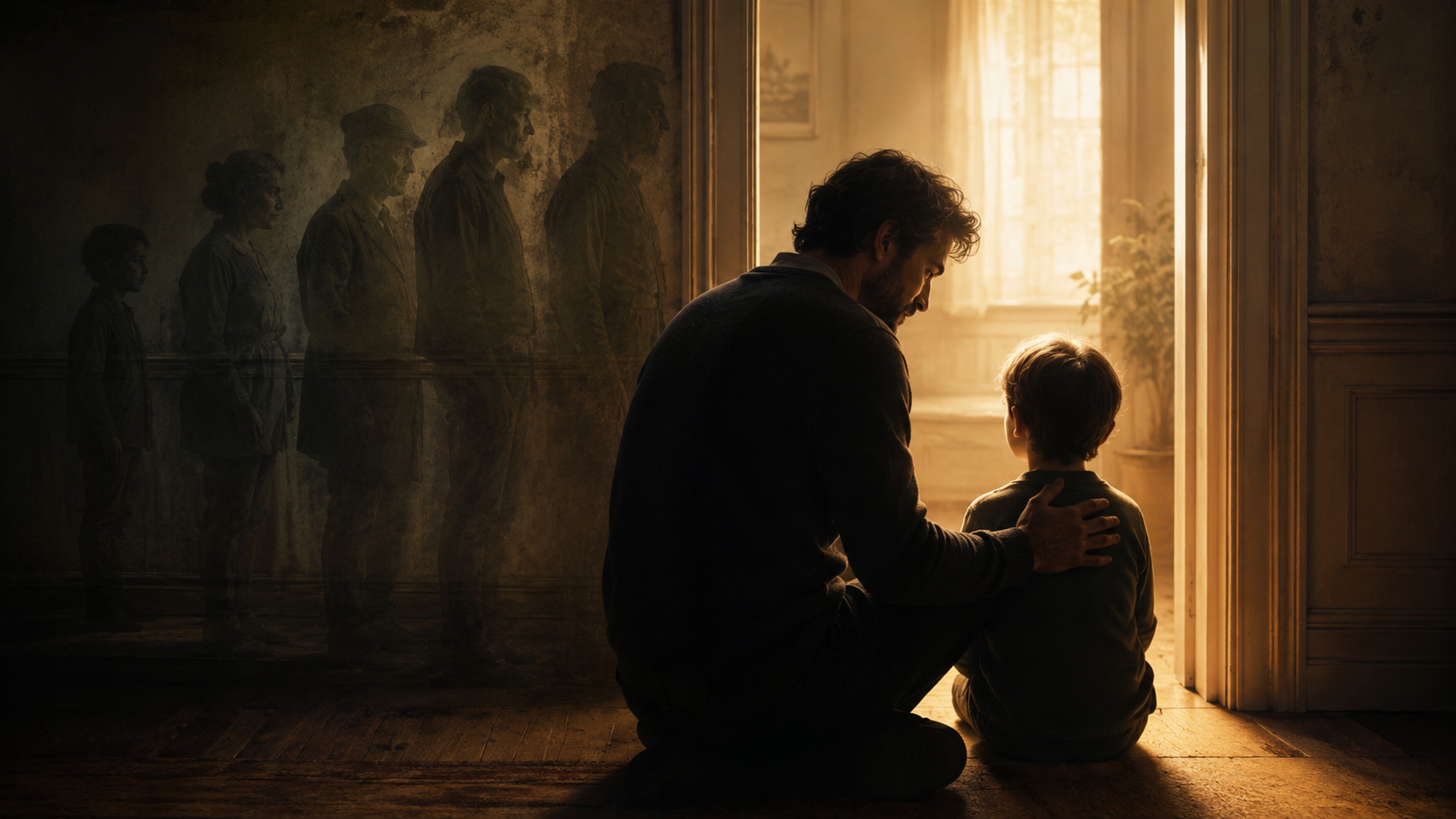
The Central Claim
Healing is not only a personal achievement. It is a moral act with consequences that travel forward in time. The person who does the work of understanding and interrupting their inherited patterns is not merely improving their own psychological wellbeing. They are changing what the next child will carry, and the child after that, and the community those children will inhabit. The private work of becoming more integrated has public consequences.
The Generation That Refuses to Pass It On
There is a particular kind of courage that does not appear in the stories we normally tell about courage.
It does not involve a battle, or a summit, or a declaration. It does not require an audience. It will not make headlines or secure a legacy. It is too quiet for any of that, and its costs are paid in full by the person who undertakes it, usually without recognition and sometimes without their even fully understanding what they have done.
It is the courage of stopping.
Not running, not conquering — stopping. Looking at what is coming through you and saying: not through me. Not like this. Not to them.
This essay is about that generation. The one that looked at the inheritance, understood enough of it to be responsible before it, and made a decision that changed everything downstream. Quietly. Often painfully. Without the dramatic moment of transformation the culture promises. One ordinary day at a time.
You may be that generation.
You may not know it yet.
What the Pattern Looks Like From the Inside
Patterns do not announce themselves.
They present as normal.
The adult who grew up with a parent who raged does not usually say, "I have inherited a pattern of dysregulated anger and I express it in ways that frighten the people I love." They say, "I have a quick temper." The adult who grew up with a parent whose love was conditional on performance does not say, "I have an anxious attachment style rooted in early relational insecurity." They say, "I am a perfectionist," or "I have high standards," or "I simply like to know things are done properly."
The adult who learned that vulnerability was dangerous does not say, "I developed an avoidant coping strategy to survive an environment in which emotional need was consistently unmet or punished." They say, "I'm private," or "I don't like to make a fuss," or — most commonly, most invisibly — "That's just who I am."
The self-description is not dishonest.
It is innocent.
The pattern has been so long-running, so consistently reinforced, so thoroughly integrated into the sense of self, that it has become identity. Not adaptation. Identity. Not the strategy a child built in response to conditions they did not choose. The thing they simply are.
The work of this generation begins with the willingness to ask: where did this come from? Not as accusation. Not as excavation for blame. But as honest inquiry into the architecture of the self — which parts were chosen and which were simply absorbed.
The question is not comfortable.
Comfortable would be to continue calling the pattern personality, to honour the inheritance by repeating it, to let the script run to its conclusion because the script is familiar and familiarity has always felt safer than revision.
But the question is necessary.
Because patterns that are seen can be interrupted. Patterns that are called personality cannot.
The Neuroscience of Change
The news here is genuinely good.
Better, perhaps, than the culture has yet absorbed. The prevailing myth of the self — still operating in many quarters despite the evidence against it — is that character is set in childhood and that what you have become by a certain age is substantially what you will be. The scientific evidence runs in a different direction.
The brain changes.
Donald Hebb's foundational principle — often summarised as "neurons that fire together, wire together" — remains one of the most important ideas in neuroscience. Neural pathways that are activated repeatedly become stronger. Synaptic connections between neurons that consistently fire in sequence are reinforced through long-term potentiation. What was once an effortful, deliberate response becomes, through repetition, the automatic one.
This is how patterns form.
It is also exactly how they change.
The same principle that creates an entrenched pattern can create a different one. Consistent, repeated activation of an alternative pathway — through practice, through therapeutic encounter, through the sustained experience of responding differently in situations that previously would have triggered the old response — begins to build new circuitry. The old pathway does not disappear. But alongside it, a new one forms. With continued use, the new pathway can become the one that activates first.
What Plasticity Actually Means
Neuroplasticity is not the claim that any brain can become any other brain through sufficient effort. It is the more modest and more real claim that the brain continues to change throughout life in response to experience, and that deliberate, sustained effort in a particular direction — with adequate support — can produce measurable changes in how the nervous system responds. This is not transformation. It is revision. Revision is enough.
This will not be clean work.
The old pathway will fire — especially under stress, especially when tired, especially when the situation resembles too closely the original conditions in which the pattern was formed. The man working to manage his anger will still feel the surge. The woman working to stop performing for love will still feel the pull toward people-pleasing when approval seems at risk. The person working to trust will still feel the urge toward pre-emptive withdrawal when intimacy becomes real.
The work is not the elimination of the old response.
It is the building of a pause between stimulus and response — a gap in which choice becomes possible. A gap that did not exist before the work began.
The brain that formed the pattern can form a different one.
That is plasticity. And plasticity is hope, working in its most ordinary and most demanding form.
Earned Security — The Adult Who Changed the Map
We discussed earned secure attachment in the second essay in this series.
It deserves more space here, in the context of what this generation actually does and how it actually happens.
The Adult Attachment Interview — a clinical tool developed by Mary Main that assesses not what adults experienced in childhood but how they currently make sense of those experiences — has found something extraordinary across decades of careful research.
Adults who experienced insecure or adverse attachment in childhood can be found, in adulthood, in the secure attachment classification.
Not because their childhoods were different.
Because they have processed them.
What distinguishes the "earned secure" adult from those who remain in insecure categories is not the content of their history but the coherence of their narrative. They can tell their story with all its complexity. They can acknowledge difficulty without being overwhelmed by it. They can describe difficult parents without either idolising them to the point of self-betrayal or demonising them to the point of caricature. They can connect past experience to present patterns without using the past as a permanent excuse. They can say: this happened, it was hard, I understand more of it now, and it is part of who I am without being the whole of who I am.
Their internal working model has been revised.
Not erased. Revised. The original map is still there — the child's cartography of a particular world at a particular time. What has changed is that a more accurate map has been drawn alongside it, consulted more readily, trusted more fully with the accumulated evidence of a life that contradicted the old predictions.
The revision typically came through one or more of the following: sustained therapy with a skilled, consistent, genuinely attuned therapist; a significant intimate relationship that maintained security through difficulty over time; a spiritual or community practice that offered the sustained experience of being known and accepted without performance; or — not infrequently — the demanding, clarifying experience of becoming a parent and finding themselves face-to-face with the patterns they had inherited at precisely the moment when those patterns had the most to cost.
That last one deserves a moment.
Becoming a parent can be among the most powerful catalysts for attachment revision that exists — not because parenthood is automatically healing (it is not; it can also activate and transmit old patterns with new urgency and new recipients), but because the child's absolute need makes the internal working model visible in ways that adult life can sometimes avoid. The parent who did not receive tenderness holds their infant and feels the full weight of that absence in a new way. The parent who was shamed for need watches their child need something and recognises, perhaps for the first time, that the need is innocent.
And some of them decide, in that recognition, to become different.
That decision is not a moment.
It is a direction.
The Thirty Percent That Changes Everything
Research on parent-infant interaction suggests that even sensitive, attuned parents are in genuine emotional synchrony with their children roughly thirty percent of the time.
The remaining seventy percent is misattunement — misreading, preoccupation, poor timing, the ordinary distraction of a human being who has other demands and a limited nervous system.
This is not a failure.
This is the structure of relationship.
The work is not to achieve perfect attunement — a goal that would crush any parent who attempted it and produce children with no experience of normal human limitation. The work is to repair misattunement. The work is the consistent practice of noticing the rupture and returning: the moment when connection was lost, when you misread, when you were too sharp, when your own history activated in a way that had nothing to do with this child in this moment — and coming back.
The coming back is the lesson.
A child who grows up in a home where adults repair — where "I was wrong, I'm sorry" is something a parent can say, without drama, without requiring the child to manage the adult's shame at having been wrong — learns something that will serve them in every relationship for the rest of their life. They learn that rupture is survivable. That connection can break and be re-established. That adults can fail without the relationship ending. That apology is not weakness but the evidence of genuine care.
A parent who repairs is not simply being kind.
They are teaching the most foundational social grammar a human being can receive: that imperfection does not have to mean abandonment, that honesty does not have to cost belonging, that the people who love you can be wrong and stay.
These are not soft lessons.
They are the infrastructure of every working relationship, every functional team, every marriage that endures difficulty, every community that can hold disagreement without fracturing.
The parent who repairs is teaching all of that.
In the ordinary imperfection of an ordinary afternoon.
What Changed Families Look Like
Changed families are not serene.
This distinction matters, because the fantasy of what healing produces often does more damage than the reality. People compare their interior life — its ongoing turbulence, its recurring failures, its persistent old patterns — against an imagined version of healed people living in emotional clarity. The comparison is always unflattering and always false.
Changed families argue.
They have difficult seasons. They make mistakes. They occasionally make a mess of their honesty — saying the right thing at the wrong time, speaking a truth without enough care for how it lands, underestimating what a particular conversation will cost. The family dinner is not consistently a scene from an aspirational magazine. Christmas is not always easy. The conversation about money, or care, or history, or what one person needed and did not receive, is not always held gracefully.
What changes is not the presence of difficulty.
What changes is the capacity to return from it.
Changed families are families where truth can be spoken without the relationship ending. Where apology is possible without performance. Where history can be named — not as a weapon but as a fact that deserves honest recognition. Where love does not require performance. Where belonging is not conditional on getting it right.
These are not dramatic changes.
They are architectural ones.
A slightly more honest house. A slightly more forgiving room. A slightly safer atmosphere for a small person who is currently doing what every child has always done: learning what the world is like from the only world they have ever known.
The changes made in one generation become the atmosphere of the next.
What felt like heroic effort to the parent will simply feel like normal to the child.
They will not know what was overcome to give it.
They will simply live in a warmer room.
The Moral Dimension
Healing is not only personal.
This is the point that the culture of individual therapy — for all its extraordinary value — can sometimes obscure. When the language of mental health is framed exclusively around individual wellbeing, individual function, individual improvement, it risks making healing feel like a private project with primarily private stakes.
It is not.
When a person does the work of understanding and interrupting their inherited patterns, they are not only improving their own psychological health. They are changing what their children will carry. And what their children's children will carry. And what the communities those children inhabit will encounter.
They are altering the future.
The research on this is not ambiguous. Secure attachment is the most statistically likely outcome for children of securely attached parents. The probability of disorganised attachment — the pattern most strongly associated with adverse developmental outcomes — drops significantly when a parent has achieved earned security. The child's nervous system is shaped, in part, by the nervous system of the caregiver. A parent who has done their own work offers a different biological and relational environment to the child than one who has not.
The Private Work, the Public Consequence
A leader who has processed their own relational patterns is a different kind of leader. They are less likely to need their team's admiration to regulate their self-worth. Less likely to confuse silence with agreement. Less likely to punish vulnerability in others because they have not made peace with their own. The private work of becoming more honest and integrated travels into every room the healed person enters.
A community that contains people who have done this work — who have become a little more honest, a little more capable of repair, a little less governed by unexamined patterns — is a community with more social trust, more capacity for productive disagreement, more resilience under pressure, more grace available in moments of collective failure.
None of this is automatic.
None of it is guaranteed.
But it is real, and it is consequential, and it is the reason healing deserves to be thought of as a moral act rather than only a personal one.
The Obligation of Knowing
In the first essay of this series, we argued that knowledge changes responsibility.
Once you can see the pattern, you can no longer call it fate with the same confidence. Once you recognise the inherited script, you become accountable — not legally, not in the courts of external judgement, but in the internal court where a person stands before what they understand and asks what they intend to do with it.
This is even more true at the end of a series that has examined prenatal formation, early attachment, the nervous system's education in the home, the damage that silence does, and the biological dimensions of trauma and inheritance.
To know these things and to continue passing on what should not be passed — to know that the harshness is inherited and choose to perpetuate it, to know that the silence is harmful and maintain it, to know that the pattern is not personality and continue calling it personality — this is a different moral position than the innocence of those who genuinely did not know.
This is not an indictment. It is an invitation. The knowledge does not condemn. It opens a door that was always there but is now, for the first time, visible.
The invitation is to become the one who changes things. Not dramatically, not through a single heroic moment of transformation, but through the sustained, unglamorous, profoundly consequential work of becoming a little more honest, a little more healed, a little more capable of the love and presence that the next person in your life — the partner, the child, the colleague, the student — deserves to receive.
The alternative is available.
But it carries a weight now that it did not carry before.
What We Will Have Been
There is a moment in some rivers where the current shifts.
You cannot always see it from the bank. The surface of the water looks much the same. But below the surface, the water is moving differently. Something in the riverbed changed. The direction altered. The river will empty, eventually, into a different place than it was heading before.
This is what it looks like when a generation changes direction.
From the outside, it may not appear dramatic. The house looks much the same. The person looks much the same. The ordinary life continues in its ordinary form. And inside the house, something has changed. The apology now happens that did not happen before. The truth gets spoken that would once have been left to fester. The child is comforted in a way the parent was never comforted — by a parent who had to learn to offer what was never modelled, who practised it before it felt natural, who chose it when the old response was available and easier.
The silence is broken.
The story is told.
The wound is given a name.
These are not small things.
They are how history changes direction inside ordinary lives.
The person who does this work will not receive a memorial. They will not always be recognised for what they have done. They may not live to see the downstream effects — the grandchildren raised in a warmer room, the great-grandchildren who will never know what they were spared.
But they will have changed the direction of the current.
And the river will empty somewhere different.
What Is Required
You did not choose what you inherited. No one does. You did not ask for the patterns, the silences, the biological calibrations, the internal working models built from the only material available to a child who had no other options. None of it was your fault. But you are responsible now — not because guilt has assigned the responsibility, but because you are the one here, with enough safety, enough access to reflection, enough understanding of what hangs in the balance. That is not a burden. It is a privilege.
You are not the last chapter of your family's story.
You may not even be the most important chapter — that distinction belongs to those who come after you, who will have more freedom than you had, who will stand on ground you are currently breaking, who will breathe more easily in a room you are currently airing.
But you are the chapter in which the direction changes.
And that is not nothing.
That is, in fact, the only thing the future requires of the present: that someone, somewhere in the chain of inheritance, becomes the person who looked at what was coming through them and decided to change what they passed forward.
You did not choose what you received.
But you are responsible for what you send.
The generation that refuses to pass on what should not be passed is not heroic in the conventional sense. They do not always win. They are not always recognised. They are often in the middle of doing ordinary work with extraordinary stakes: raising a child, managing a marriage, showing up to therapy, making a different choice in the same old situation, practising the pause before the old response fires.
They are not perfect.
They are trying.
And trying — in this direction, with this understanding, with this intention — is enough to change things.
One house at a time.
One apology at a time.
One truth spoken where silence was.
One child received differently than you were received.
One direction changed.
It is enough.
It is more than enough.
It is, in the end, everything.
The Question This Series Leaves
What have you inherited that must be honoured? What have you inherited that must be healed? And what must change in your hands — before it reaches those who come after you?