The Architecture of Ascension
12 Pillars for the Sovereign Household
A civilizational blueprint for restoring order at the level of the household. From entropy to engineered legacy.
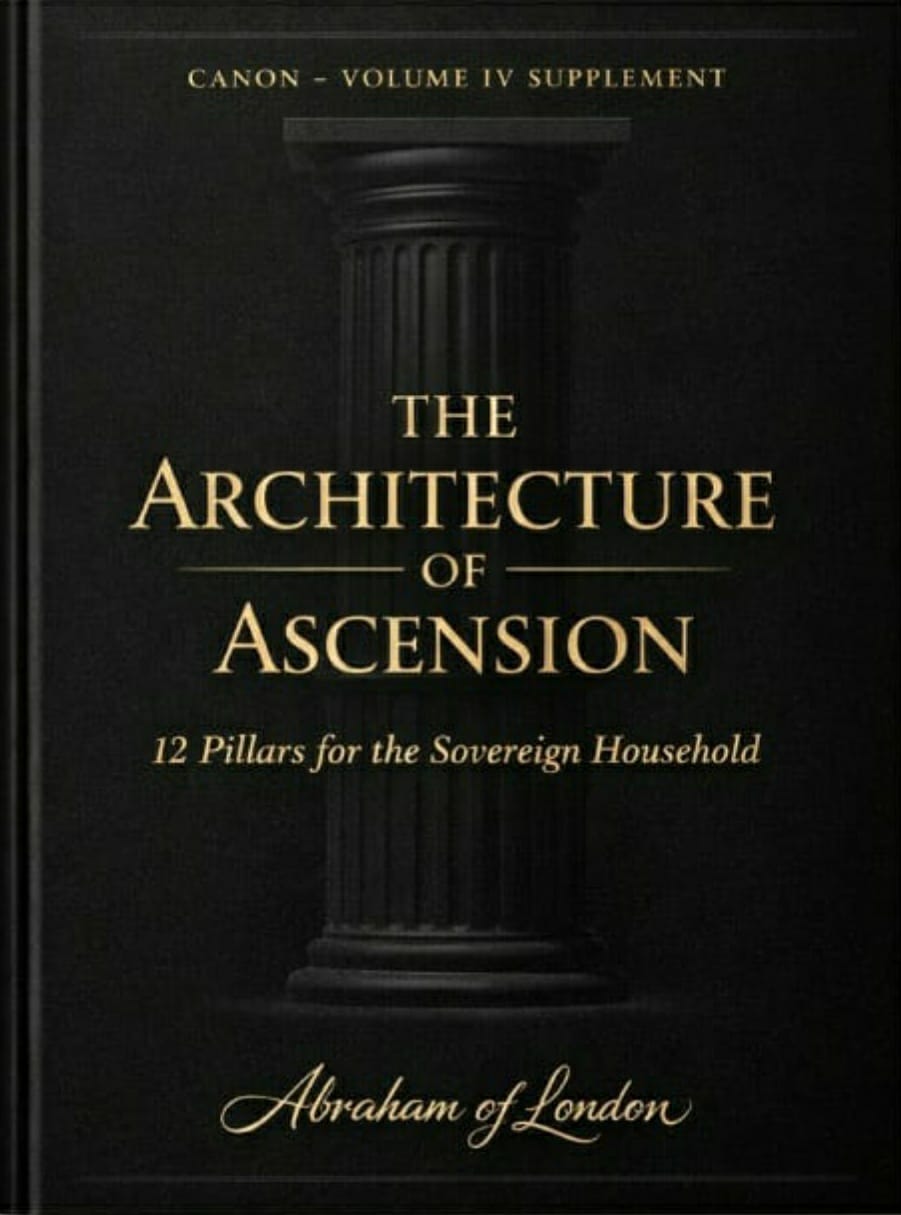
THE ARCHITECTURE OF ASCENSION
12 Pillars for the Sovereign Household
Doctrinal Asset // Volume IV Supplement
The Great Restoration is not a protest.It is not outrage. It is not retreat. It is architecture.
PROLOGUE: THE GEOMETRY OF GOVERNANCE
The architecture of a sovereign household is not an accumulation of ad-hoc responses to external pressure; it is a deliberate blueprint designed to withstand civilizational decay. To build an asset capable of multi-generational continuity, the foundational geometry must be flawless.
A common error in evaluating this framework is the expectation that all structural elements must exist at the identical level of abstraction. They do not. The 12 Pillars detailed herein are not all of the same kind. Instead, they represent a highly deliberate composition of four distinct structural dynamics:
- Domains: Concrete areas of household operation requiring explicit administration.
- Relationships: Interpersonal and alignment protocols that safeguard the human architecture.
- Instruments: Formal tools, mechanisms, and legal-operational levers.
- Principles: Cross-cutting philosophical and aesthetic parameters that bind the entire structure.
The Structural Composition Matrix
| Pillar | Classification | Operational Vector | Core Mandate |
| --- | --- | --- | --- |
| I. The Sovereign Household | Meta-Pillar / Container | Institutional | Absolute administrative autonomy |
| II. The Economic Fortress | Domain-Specific | Financial | Non-correlated wealth generation |
| III. The Education of Heirs | Domain-Specific | Intergenerational | Transmission of elite competence |
| IV. The Parallel Estate | Domain-Specific | Critical Infrastructure | T-90 systemic self-reliance |
| V. The Brotherhood Protocol | Relational | External Alliance | Peer-to-peer structural accountability |
| VI. The Sisterhood & Hearth | Domain-Specific | Internal Alliance | Relational stability and culture |
| VII. The Covenantal Oath | Instrument | Formal Lock | Irrevocable structural alignment |
| VIII. The Ledger of Legacy | Instrument | Information / Lore | Institutional memory and asset tracking |
| IX. The Sovereignty of Time | Cross-Cutting Principle | Resource Allocation | Isolation of attention and rhythms |
| X. The Inner Circle | Relational | Core Council | Eliminating asymmetric communication |
| XI. The Geography of the Estate | Domain-Specific | Physical Spatiality | Jurisdictional and physical security |
| XII. The Aesthetics of Order | Cross-Cutting Principle | Environmental | Visual and spatial counter-subversion |
FRAMEWORK ENTRY POINT
THE RISE–DECAY INDEX
Before building, diagnose.
| Domain | Decay Vector | Rise Vector |
|--------|--------------|-------------|
| Household | Consumption cell | Sovereign Oikos |
| Economy | Permission-based claims | Seizure-resistant capital |
| Education | Compliance training | Mastery transmission |
| Infrastructure | Centralized dependency | Redundant autonomy |
| Alliances | Transactional | Covenantal |
| Culture | Digital immersion | Embodied governance |
| Time | Reactive calendar | Sacred rhythm |
| Legacy | Accidental inheritance | Engineered transmission |
You cannot ascend without first admitting where you stand.
DIAGNOSTIC METRICS
SOVEREIGNTY SCORECARD (Condensed)
Score yourself 0–5 in each category:
- Household governance clarity
- Seizure-resistant asset ratio
- Skill competence within home
- Infrastructure redundancy
- Brotherhood depth
- Cultural discipline
- Time sovereignty
- Intergenerational documentation
This is not ego fuel.
It is engineering feedback.
PILLAR ONE
PILLAR I
The Sovereign Household
Core Directive: Establish the household not as a domestic consumer unit, but as an independent, legally insulated, and self-governing institution.
Failure Mode: Administrative vulnerability; treating family operations as informal, personal matters, leaving them exposed to state and corporate overreach.
Implementation Criteria: Formalize household rules, clear division of labor, and distinct operational separation between personal lifestyles and institutional preservation.
→ View Technical Brief: The Modern Household VAULT 001
PILLAR TWO
PILLAR II
The Economic Fortress
Core Directive: Secure non-correlated, sovereign revenue streams insulated from corporate dependency, fiat degradation, and ideological de-platforming risk.
Failure Mode: Financial capture; reliance on single-point-of-failure counterparty relationships or highly centralized banking vectors.
Implementation Criteria: Diversification into productive tangibles, private operating companies, and secure digital bearer assets held via un-compromised custody protocols.
→ View Technical Brief: The Economic Fortress VAULT 002
PILLAR THREE
PILLAR III
The Education of Heirs
Core Directive: Drive the transmission of elite competence, historical worldview, and functional mastery directly through the household line, bypassing public indoctrination.
Failure Mode: Cultural abandonment; outsourcing intellect and values to state-run or institutional education systems that incentivize compliance over sovereignty.
Implementation Criteria: Structured daily training regimes, early language and technical immersion, strict ideological counter-subversion protocols, and mandatory physical resilience trials.
→ View Technical Brief: The Education of Heirs VAULT 003
PILLAR FOUR
PILLAR IV
The Parallel Estate
Core Directive: Construct fully redundant, off-grid infrastructure ensuring an uncompromised T-90 baseline (90 days of absolute self-reliance) across all core survival vectors.
Failure Mode: Infrastructure fragility; total dependence on municipal utility matrices, leaving the household vulnerable to systemic disruptions, grid strain, or political leverage.
Implementation Criteria: Establish independent, localized loops for water procurement, caloric storage, energy generation, localized communications, and physical tactical security.
The Parallel Estate Audit Matrix
To achieve production-grade readiness, the household must evaluate its infrastructure across five key domains against a strict 0–5 metric:
```
0: Total Municipal Dependency
1: 7-Day Emergency Reserves (Passive)
2: 30-Day Storage / Basic Redundancy
3: 60-Day Capacity / Semi-Active Micro-Generation
4: T-90 Validated Independent Loop (Full Capacity)
5: Permanent Multi-Generational Autarky / Export Capacity
```
| Infrastructure Domain | Target T-90 Baseline Requirements | Current Score (0-5) | Critical Deficit Factor |
| --- | --- | --- | --- |
| Water | 90 days of potable water storage (3 liters/person/day) plus active on-site mechanical filtration and independent well/catchment loops. | | |
| Food | 90 days of shelf-stable, high-density caloric reserves (2,500 kcal/person/day) combined with active micro-farming/livestock lines. | | |
| Power | 90 days of continuous off-grid energy generation via combined solar-PV arrays, battery storage banks, and dual-fuel backup systems. | | |
| Information | Hardened localized storage of critical family files, offline maps, encyclopedic references, and independent RF communication channels. | | |
| Security | Multi-layered physical access control, continuous automated site telemetry, and defined kinetic/tactical defense perimeters. | | |
→ View Technical Brief: The Parallel Estate VAULT 004
PILLAR FIVE
PILLAR V
The Brotherhood Protocol
Core Directive: Forge ironclad, non-transactional alliances with peer sovereign households to build a mutual network of security, commerce, and shared defense.
Failure Mode: Social isolation or superficial networking; lack of deep, vetted alliances capable of withstanding systemic or legal pressure.
Implementation Criteria: Enforce mutual accountability loops, regular physical councils, shared investment initiatives, and clear, written assistance protocols for moments of crisis.
→ View Technical Brief: The Brotherhood Protocol VAULT 005
PILLAR SIX
PILLAR VI
The Sisterhood & Hearth
Core Directive: Cultivate an unassailable internal culture of relational stability, psychological safety, and deep aesthetic order centered around the domestic core.
Failure Mode: Internal subversion or emotional fragmentation; friction between partners or generation lines that sabotages external operational effectiveness.
Implementation Criteria: Clear relational boundaries, highly protected domestic rituals, shared responsibility for household health and legacy, and consistent execution of the Hearth Audit.
The Four Charges of the Hearth
1. Establish the Domestic Calendar
The household runs on rhythm, not reaction. The sisterhood owns the calendar at the level of daily, weekly, and seasonal structure.
- Daily: Morning gathering and evening close. Not negotiable. These are the bookends that prevent the day from drifting.
- Weekly: The sabbath or sacred rest day. No labour. No commerce. No screens. Presence.
- Seasonal: Three anchor points per year — a planting feast, a harvest gathering, a midwinter council. These mark time so the household knows where it is in the year.
2. Curate the Sensory Environment
What enters the household through the senses shapes what the household becomes.
- Sound: What music is played, when, and why. Silence is also a choice.
- Sight: What is on the walls. What is on the tables. What is allowed to remain in common space and what is removed.
- Smell: Cooking, cleaning, burning — the olfactory memory of the home is being set whether it is designed or not.
- Touch: Texture of linens, temperature of rooms, weight of objects used daily.
3. Guard the Threshold
The threshold is the boundary between the household and the world. The sisterhood governs what crosses it.
- People: Who enters the home, when, and under what conditions. Hospitality is a virtue; open borders are not.
- Information: What media enters. What news is discussed at the table. What is allowed to shape the household's understanding of reality.
- Goods: What is bought, what is made, what is accepted as gift. Consumption without discernment is entropy.
4. Transmit the Culture
The sisterhood is the primary transmitter of household identity to the next generation.
- Story: The children should know the family history — not as dates, but as stories with moral weight. Who were the ancestors? What did they survive? What did they build?
- Skill: Domestic competence — cooking, cleaning, mending, organising, hosting — is taught, not assumed. A child who leaves the household unable to feed themselves or keep a room is not educated.
- Ritual: The household's rituals (mealtime prayers, holiday traditions, Sunday rhythms) are maintained and passed on. If the sisterhood does not keep them, they will be forgotten in one generation.
The Hearth Audit (Annual)
| Domain | Current State | Target | Action |
|--------|---------------|--------|--------|
| Domestic Calendar | Visible? Known? | Yes to both | Establish if missing |
| Sensory Environment | Intentional or accidental? | Intentional | Audit one room per month |
| Threshold | Known boundaries? | Written and communicated | Draft household media policy |
| Cultural Transmission | Children being taught? | Measurable competence | Set skill milestones per child |
Failure Mode: The hearth becomes a prison — control without warmth, ritual without meaning, beauty without hospitality. The sisterhood governs atmosphere, not people. The difference is essential.
Balance: Authority + warmth. Standards + mercy. The household is not a museum. It is a forge. The heat must be high enough to shape iron but not so high that it burns the hands holding it.
→ View Technical Brief: The Sisterhood & Hearth VAULT 006
PILLAR SEVEN
PILLAR VII
The Covenantal Oath
Core Directive: Institutionalize the foundational commitments, boundaries, and long-term trajectory of the household through a formal, legally insulated, and spiritually binding oath structure.
Failure Mode: Operational drift; treating family commitments as casual agreements that can be shifted by temporary emotions or external cultural trends.
Implementation Criteria: Draft and execute an explicit, written Household Covenant. This instrument transforms informal intent into a permanent structural reality.
The Four Pillars of the Oath
```
┌────────────────────────────────────────┐
│ THE COVENANTAL OATH │
└───────────────────┬────────────────────┘
│
┌────────────────────────────┼────────────────────────────┐
▼ ▼ ▼
┌─────────────────┐ ┌─────────────────┐ ┌─────────────────┐
│1. HIGHER │ │2. CLEAR │ │3. WITNESS │
│ INVOCATION │ │ TERMS │ │ PROTOCOLS │
├─────────────────┤ ├─────────────────┤ ├─────────────────┤
│Anchors the oath │ │Defines concrete │ │Requires external│
│beyond human │ │responsibilities,│ │vetted family │
│convenience or │ │boundaries, and │ │lines to enforce │
│whim. │ │consequences. │ │accountability. │
└─────────────────┘ └─────────────────┘ └─────────────────┘
│
▼
┌─────────────────┐
│4. SYMBOLIC │
│ RATIFICATION │
├─────────────────┤
│Physical signing │
│and ritual sealing│
│of the document. │
└─────────────────┘
```
- Higher Invocation: The oath must be anchored in an authority that sits above human whim. It invokes divine, historical, or multi-generational imperatives to ensure it cannot be set aside for personal convenience.
- Clear Terms: Generalities breed conflict. The covenant must explicitly outline the household's material duties, asset allocation rules, educational paths, and non-negotiable boundaries. It must detail specific consequences for structural violations.
- Witness Protocols: An oath taken in total isolation lacks teeth. It must be executed before a minimum of two vetted heads of allied family lines. These witnesses hold explicit authority to counsel and arbitrate should an internal breakdown occur.
- Symbolic Ratification: The covenant is formalized through a physical ceremony: hand-signed execution of the document, witnessed, and placed into physical storage within the Ledger of Legacy.
Covenantal Architecture: Structural Template
```text
IN THE PRESENCE OF THE ALMIGHTY AND BEFORE THESE VETTED WITNESSES,
THE HOUSEHOLD OF [SURNAME] IS HEREBY ESTABLISHED AS A SOVEREIGN ESTATE.
I. RECOGNITION OF AUTHORITY
We declare that this line is bound to the eternal laws of order, faith, and discipline.
We renounce the transient path of consumer compliance and claim absolute responsibility
for our economic, intellectual, and physical self-reliance.
II. OPERATIONAL MANDATES
- THE ASSETS OF THIS ESTATE shall be managed exclusively for long-term multi-generational
- THE HEIRS OF THIS LINE shall be trained directly by this household in elite competence,
- THE PARALLEL INFRASTRUCTURE shall be maintained at a minimum T-90 operational baseline.
III. THE BOUNDARIES OF ALIGNMENT
We pledge mutual defense, radical communication, and financial transparency within this
inner circle. Should internal friction threaten this framework, we authorize the signed
witnesses to arbitrate according to the written rules of the Canon.
EXECUTED THIS ______ DAY OF _______________, 20____
_________________________________ _________________________________
Head of Household Partner / Co-Architect
WITNESSED BY:
_________________________________ _________________________________
Head of Allied Line [Name] Head of Allied Line [Name]
```
→ View Technical Brief: The Covenantal Oath VAULT 007
PILLAR EIGHT
PILLAR VIII
The Ledger of Legacy
Core Directive: Maintain a secure, physical archive documenting the household's lineage, assets, legal instruments, and historical lessons.
Failure Mode: Institutional amnesia; loss of critical operational knowledge, property titles, or foundational wisdom across generational transfers.
Implementation Criteria: Secure deployment of the "Book of Lore" containing asset histories, genealogy trackers, legal trust structures, and unedited logs of critical historical events.
The Three Books
- Book of Lore — history, stories, identity
- Book of Standards — principles, rules, expectations
- Book of Assets — inventory, titles, access
→ View Technical Brief: The Ledger of Legacy VAULT 008
PILLAR NINE
PILLAR IX
The Sovereignty of Time
Core Directive: Reclaim control over attention, focus, and schedule from the demands of external commercialism, algorithmic notifications, and reactive commitments.
Failure Mode: Constant fragmentation of focus; allowing outside parties or low-value interactions to dictate the household's daily energy and focus.
Implementation Criteria: Enforce structural boundaries around morning and evening routines, dedicate focused time to deep work and strategy, and block out dedicated family time to build real multi-generational wealth.
Operational Rhythms & Time Allocation Architecture
```text
┌───────────────────────────────────────────────────────────────────────────┐
│ DAILY ATTENTION ISOLATION WAVE │
└───────────────────────────────────────────────────────────────────────────┘
[05:00 - 08:00] [08:00 - 17:00] [17:00 - 21:00]
┌──────────────┐ ┌──────────────┐ ┌──────────────┐
│ THE MORNING │────────>│ OPERATIONAL │────────>│ THE EVENING │
│ PERIMETER │ │ DEEP SHIFT │ │ PERIMETER │
└──────────────┘ └──────────────┘ └──────────────┘
Zero Network Fortress Build Hearth / Lore
Input Allowed & Revenue Run No External Work
```
Daily Architecture
The Morning Perimeter (05:00 - 08:00): Strictly zero external network input. No emails, news feeds, or reactive notifications are permitted. This time is dedicated entirely to physical fortification, tactical review, and internal alignment.
The Evening Perimeter (17:00 - 21:00): Digital disconnect. The focus shifts inward to family cohesion, the transmission of lore, physical meal preparation, and personal reflection. External business or commercial concerns cannot breach this block.
Weekly / Annual Architecture
The True Sabbath vs. The "Day Off": A day off is reactive, unstructured recovery from exhaustion. The True Sabbath is an active, structured baseline of sovereignty. It is 24 hours entirely free from commercial transactions, labour, or digital inputs. It is structured around study, strategic review of the estate, and communal family connection.
The Annual Audit Block: A dedicated 4-day period every winter where the household withdraws to assess its positioning against the Rise-Decay Index, update the Ledger of Legacy, and set capital allocation targets for the next year.
Emergency Breach Protocol
When an unpredictable crisis occurs (legal, financial, or physical) that threatens to break these time perimeters, the household activates this protocol to avoid sliding into chaos:
- Declare Containment Status: Explicitly announce to the household that a containment window is active.
- Assign the Crisis Desk: One co-architect is assigned to handle the disruption. The other maintains the standard household schedule to keep routines completely stable for the children.
- Isolate the Damage Box: Set a hard time limit (e.g., maximum 90 minutes at 14:00) to deal with the crisis. Do not let it spill into morning or evening routines.
- De-escalate to Normal Operations: Within 72 hours, the crisis must be resolved or moved into a standardized category within the Economic Fortress or Parallel Estate, returning the household to its normal daily rhythms.
→ View Technical Brief: The Sovereignty of Time VAULT 009
PILLAR TEN
PILLAR X
The Inner Circle
Core Directive: Restrict the intimate governance of the household to vetted co-architects, eliminating asymmetric communication and ensuring absolute clarity.
Failure Mode: Operational leakage; allowing extended family, casual acquaintances, or outside advisors to influence core household strategy.
Implementation Criteria: Establish a radical honesty protocol, conduct weekly alignment meetings, and maintain a unified front across all outward-facing environments.
→ View Technical Brief: The Geometry of the Inner Circle VAULT 010
PILLAR ELEVEN
PILLAR XI
The Geography of the Estate
Core Directive: Anchor the household in a physical location chosen strictly for its legal, political, and material safety, ensuring the environment supports long-term continuity.
Failure Mode: Spatial passivity; living in a high-risk tax, legal, or physical environment out of habit, convenience, or professional inertia.
Implementation Criteria: Execute a deep spatial audit across legal jurisdictions, tax structures, and physical resource lines using a structured decision matrix.
Jurisdictional Mechanics: "Jurisdiction First"
Physical security is ultimately governed by local law. "Jurisdiction First" means the household prioritizes the legal and regulatory framework of its location above simple proximity to work or social circles.
The estate must be situated in an area where property rights are secure, self-defense laws are clear, homeschooling is legally protected, and asset exposure to arbitrary seizure or excessive taxation is heavily minimized.
Location Evaluation Checklist Matrix
| Evaluation Vector | Core Strategic Metric | Min. Acceptable Threshold | Location Alpha Score (1-5) | Location Beta Score (1-5) |
|---|---|---|---|---|
| Legal/Regulatory | Explicit protection for homeschooling, medical autonomy, and private asset structures. | Zero restriction on core family choices. | | |
| Tax Optimization | Freedom from heavy property or capital gains taxes that drain the household estate. | Total tax drag below 25% of annual revenue. | | |
| Resource Proximity | Direct physical access to clean water lines, productive agriculture, and reliable supply chains. | Within 15 miles of a secure distribution node. | | |
| Allied Density | Physical distance to peer households within the wider network. | At least 2 allied lines within a 45-minute travel radius. | | |
| Risk Insulation | Spatial isolation from dense population centers, flooding zones, or high-crime municipal areas. | Minimum 30 miles from major metropolitan cores. | | |
→ View Technical Brief: The Geography of the Estate VAULT 011
PILLAR TWELVE
PILLAR XII
The Aesthetics of Order
Core Directive: Enforce a clean, intentional, and dignified visual and spatial environment across the estate to actively resist cultural decline and mental friction.
Failure Mode: Domestic disarray; allowing low-quality, disposable, or chaotic modern consumer design to compromise the focus and discipline of the household.
Implementation Criteria: Remove all clutter, prioritize durable, natural materials, archive historical art, and design spaces to elevate focus, study, and shared purpose.
→ View Technical Brief: The Aesthetics of Order VAULT 012
DIAGNOSTIC SYNCHRONIZATION
DIAGNOSTIC SYNCHRONIZATION
To prevent the 12 Pillars from becoming isolated theories, they must map directly to your day-to-day diagnostic tools. The table below connects the 8 items on the Sovereignty Scorecard with their primary load-bearing pillars.
Sovereignty Scorecard Mapping Matrix
| Scorecard Metric | Primary Pillar | Secondary Support Pillars | Operational Focus Area |
|---|---|---|---|
| 1. Household Governance Clarity | Pillar I: Sovereign Household | Pillar VII (Covenant), Pillar X (Inner Circle) | Clearly defines lines of internal authority and administrative rules. |
| 2. Economic Non-Correlation | Pillar II: Economic Fortress | Pillar XI: Geography of the Estate | Insulates the household's capital from single-point failure vectors. |
| 3. Intergenerational Alignment | Pillar III: Education of Heirs | Pillar VIII: Ledger of Legacy | Ensures values and technical mastery transfer cleanly to children. |
| 4. Off-Grid Infrastructure Index | Pillar IV: Parallel Estate | Pillar XI: Geography of the Estate | Validates physical resilience across critical T-90 survival loops. |
| 5. Brotherhood Depth | Pillar V: Brotherhood Protocol | Pillar VII: Covenantal Oath | Tracks the practical defense and commercial strength of peer alliances. |
| 6. Domestic Cultural Health | Pillar VI: Sisterhood & Hearth | Pillar XII: Aesthetics of Order | Protects the psychological safety and internal visual order of the home. |
| 7. Time Sovereignty | Pillar IX: Sovereignty of Time | Pillar II: Economic Fortress | Guards daily focus blocks from external distraction or commercial drain. |
| 8. Spatial/Jurisdictional Safety | Pillar XI: Geography of the Estate | Pillar IV: Parallel Estate | Optimizes the physical placement of the asset under secure laws. |
STRATEGIC COMMISSION
STRATEGIC COMMISSION
You are not called to survive the age.You are called to outlast it.
The Architecture of Ascension is not reaction.
It is disciplined construction.
Begin today:
- Establish council.
- Audit assets.
- Draft the Three Books.
- Guard sacred time.
- Identify your brotherhood.
The Architect's Mandate
A final note must be made regarding the selection of twelve structural pillars. This choice is driven entirely by architectural and systemic necessity, completely free from superstition or numerology.
In system engineering, a complex structure requires a specific number of load-bearing coordinates to maintain balance across multiple dimensions. The number 12 represents the exact minimum framework required to build a self-correcting, multi-generational system of governance. It ensures three balanced coordinates across four core vectors:
Three coordinates across four core vectors produce the twelve structural pillars required for a stable, self-correcting system.
Architectural Note: The four vectors below represent a different cross-section of the same architecture — the load-bearing axes rather than the structural element types outlined in the prologue composition matrix.
```
┌────────────────────────────────────────┐
│ THE FOUR CORE VECTORS │
└───────────────────┬────────────────────┘
│
┌────────────────────────────┼────────────────────────────┐
▼ ▼ ▼
┌──────────────┐ ┌──────────────┐ ┌──────────────┐
│ INSTITUTIONAL│ │ MATERIAL │ │ ALLIANCE │
├──────────────┤ ├──────────────┤ ├──────────────┤
│• Household │ │• Economy │ │• Brotherhood │
│• Covenant │ │• Parallel Est│ │• Sisterhood │
│• Ledger │ │• Geography │ │• Inner Circle│
└──────────────┘ └──────────────┘ └──────────────┘
│
▼
┌──────────────┐
│ PHILOSOPHICAL│
├──────────────┤
│• Education │
│• Time │
│• Aesthetics │
└──────────────┘
```
If you remove even one element — such as the Geography of the Estate or the Sovereignty of Time — the system becomes unstable under pressure. The remaining pillars are forced to bear a load they were not designed to carry, creating an operational point of failure.
Twelve is not a symbolic design; it is the exact blueprint required to construct a stable, self-correcting foundation for a sovereign life.
Each pillar has a corresponding technical brief in the Vault.
The manifesto provides the vision; the briefs provide the specifications.
Study both. Build accordingly.
THE ARCHITECTURE OF ASCENSION
Canon – Volume IV Supplement
© 2026 Abraham of London
All Rights Reserved.