What We Carry: The Science of Inherited Selves
Abraham of London
The Core Thesis
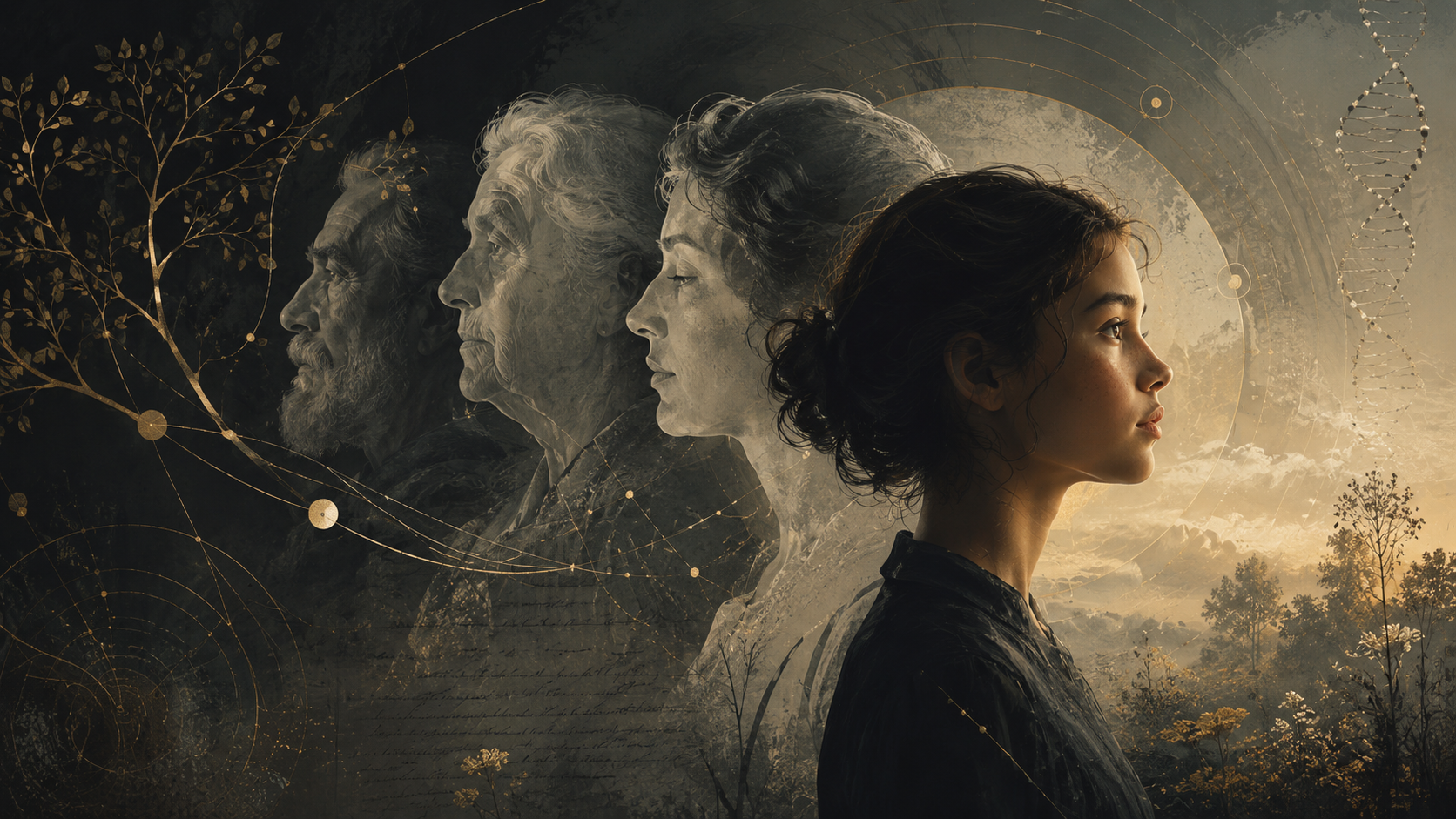
You are not self-made. Before you had language, before you could explain yourself, before you could remember anything, you were already carrying inheritance: biological, emotional, relational, and spiritual. But inheritance is not imprisonment. What is handed down can also be understood, interrupted, redeemed, and transformed.
What We Carry: The Science of Inherited Selves
You did not begin at birth.
This is the first truth modern individualism finds difficult to bear.
You arrived with a body, yes. A name, eventually. A date printed on a certificate. A place of birth. A family line. A nationality. A set of circumstances into which you were received, welcomed, endured, celebrated, hidden, resented, prayed over, or simply absorbed.
But you did not begin there.
Before your first cry, you were already listening with your body. Before your eyes learned faces, your nervous system was already gathering information. Before memory formed, inheritance had begun its work.
You were carried by a woman whose body was not only a shelter but an atmosphere. Her stress, safety, nutrition, fear, rest, grief, resilience, and hope were not abstract conditions around you. They were part of the world through which your earliest development took shape.
Then you were born into arms.
Or into their absence.
Into rhythm or chaos. Into warmth or vigilance. Into a house where voices softened when a child entered the room, or into a house where the child learned too early to read the weather in an adult’s face. You entered a family that had its own unfinished stories, its own silences, its own loyalties, its own patterns of attachment and avoidance, its own buried wars.
Some of those wars may have ended before you were born.
Some had not.
The past does not always stay in the past. Sometimes it learns your name before you do.
This is not mysticism dressed in scientific clothing. Nor is it science inflated into prophecy. It is a sober recognition now emerging from several directions at once: epigenetics, developmental psychology, attachment theory, trauma research, family systems, neuroscience, and the long moral wisdom of cultures that understood ancestry before laboratories learned how to measure methylation.
A human being is not a sealed unit.
You are not an isolated mind floating above history, making choices from nowhere. You are a living meeting point between biology, family, memory, wound, care, culture, and will.
That truth can frighten people. It can sound as if freedom has been reduced, as if the self has been demoted from author to outcome. But the truth is more demanding and more hopeful than that.
You are not self-made.
But you are not merely inherited either.
The Child Before the Story
There is a kind of inheritance that arrives before speech.
A child does not need to understand danger to be shaped by it. The body understands before the mind can explain. The heart races before the vocabulary arrives. The infant does not say, “This environment is inconsistent, therefore I must become hypervigilant.” The infant simply adapts.
This is mercy at first. The human body is designed to survive. If tenderness is reliable, the child learns one world. If fear is reliable, the child learns another.
In one house, footsteps in the corridor mean comfort.
In another, they mean calculation.
In one house, a raised voice means someone is excited.
In another, it means the child must disappear inside themselves until the storm passes.
Children learn these things with terrible brilliance. They become students of tone, breath, silence, movement, and mood. They learn when to speak, when to freeze, when to smile, when to please, when to shrink, when to become useful, when to become invisible.
Long before they can say what happened, something in them has already decided what kind of world this is.
That decision may be wrong later.
But it was not foolish then.
The Body Keeps an Early Ledger
A child’s earliest adaptations are often mistaken for personality later in life. What looks like temperament may once have been protection. What looks like distance may once have been wisdom. What looks like overreaction may once have been the only available form of safety.
This is why childhood matters. Not sentimentally. Structurally.
The home is the first school of reality. Not because parents sit children down and deliver lectures on trust, love, shame, authority, fear, truth, conflict, and belonging. Most of what matters is not taught that way. It is absorbed.
A child learns whether comfort comes.
A child learns whether apologies happen.
A child learns whether adults can be wrong and still remain safe.
A child learns whether anger destroys connection.
A child learns whether truth is welcomed or punished.
A child learns whether love is steady or must be earned by performance.
Later, that child becomes an adult and calls these lessons “how life is”.
Then they marry. Lead. Parent. Avoid. Overwork. Hide. Control. Please. Explode. Withdraw. Distrust kindness. Crave approval. Fear abandonment. Recreate conflict. Sabotage peace because peace feels unfamiliar and therefore unsafe.
The story continues.
Unless someone stops long enough to ask where the script came from.
The New Language of Old Truths
Science has begun to give names to things older cultures recognised in other ways.
One of those names is epigenetics.
The word means, roughly, “above the gene”. It refers not to changes in the DNA sequence itself, but to the systems that regulate how genes are expressed. Genes are not simple switches permanently set at birth. They operate in conversation with environment. Stress, nutrition, exposure, toxins, care, adversity, and experience can influence how certain biological instructions are read.
This does not mean every feeling has an inherited gene mark behind it. That kind of claim is crude. The science is not a parlour trick by which one can point to a specific sadness and say, “That came from your grandmother.” Reality is more complex and more honest than that.
But epigenetic research has shown something profound: the body is not indifferent to history.
In animal studies, where conditions can be controlled far more carefully than in human life, parental stress and early care can affect offspring behaviour, stress physiology, and gene regulation. Researchers have observed changes involving methylation, histone modification, and small RNA molecules, including in pathways connected to the stress-response system.
In humans, the evidence is more difficult, because human beings do not live in controlled cages. They inherit not only biology but homes, stories, poverty, diet, neighbourhoods, parenting patterns, social status, danger, affection, and silence. A child of trauma may inherit altered stress biology, but that same child may also inherit anxious parenting, economic instability, family secrecy, and the emotional absence of adults who survived more than they could process.
Separating these threads is not easy.
Still, some signals are too important to ignore. Studies of trauma-exposed families, including Holocaust survivors and their descendants, have found differences in genes associated with cortisol regulation and stress response, such as FKBP5. Other research has examined NR3C1, a gene involved in glucocorticoid receptor function, in relation to maternal trauma and early adversity.
These findings must be handled carefully. They are not destiny. They are not diagnostic labels. They do not mean a child is doomed because a parent suffered. They are population-level signals, not personal verdicts.
But they suggest something morally serious.
Extreme experience does not always end with the person who endured it.
Trauma may enter history as an event, but it often continues as an atmosphere.
And atmosphere matters.
This is where science and lived experience begin to recognise one another across the room. The laboratory measures stress regulation. The family remembers how grandfather never spoke about the war. The researcher sees methylation differences. The daughter remembers the way her mother flinched at ordinary conflict. The paper says “intergenerational transmission”. The child says, “I never knew what happened, but I grew up inside it.”
Both are telling part of the truth.
What Silence Gives to the Next Generation
Every family has a theology of silence.
Not always a stated one. Often, it is practised more than explained.
Some things may be said.
Some things must be hinted at.
Some things are known but never named.
Some things are buried so deeply that the next generation grows up walking over them like ground.
But buried things are not always dead.
In families shaped by trauma, silence often begins as protection. A parent does not speak because speech would reopen the wound. A grandparent does not explain because the memory is too heavy. A community does not name what happened because survival required forward motion, not reflection.
There is mercy in that. One should not speak lightly about what people had to do in order to continue living.
But silence has children.
What cannot be spoken cannot be properly mourned. What cannot be mourned cannot be integrated. What cannot be integrated often returns in disguise.
It returns as anxiety no one can explain.
It returns as anger out of proportion to the moment.
It returns as a family rule nobody remembers making.
It returns as emotional distance called strength.
It returns as control called care.
It returns as suspicion called wisdom.
It returns as a child learning to manage an adult’s emotions because the adult never learned to carry their own.
Silence can preserve dignity for a season. But if it becomes permanent, it often passes the burden to those least equipped to understand it.
The child inherits not the story, but the symptoms.
The Cost of Unnamed History
When a family refuses to tell the truth about its wounds, the next generation may still inherit the consequences — but without the map. They feel the pressure without knowing the source.
This is why testimony matters. This is why story matters. This is why cultures that remember well do more than preserve facts. They give suffering a place in meaning.
There is a difference between memory and haunting.
Memory has language.
Haunting has atmosphere.
Memory can be carried in community, ritual, prayer, lament, record, teaching, and witness. Haunting circulates without form. It appears in the nervous system before the mind can interpret it.
A family that learns to tell the truth does not erase pain. But it may prevent pain from becoming a ghost.
The False Comfort of “That Is Just How I Am”
Modern people like the language of identity.
“I am anxious.”
“I am avoidant.”
“I am independent.”
“I am intense.”
“I am not good with vulnerability.”
“I do not trust people easily.”
Sometimes these statements are honest. But often they arrive too early. They become labels placed over mysteries that deserve excavation.
What if “I am independent” means “I learned early that needing people was unsafe”?
What if “I am not emotional” means “emotion was punished, mocked, or ignored until I learned to leave the room inside myself”?
What if “I hate conflict” means “conflict once threatened belonging”?
What if “I always expect betrayal” means “my nervous system is loyal to an old environment”?
What if “I am strong” means “I was never given permission to be held”?
The self is often a museum of adaptations.
Some exhibits are beautiful. Some are tragic. Some were necessary then and costly now. Some should be honoured for keeping you alive, then retired before they govern the rest of your life.
This is where the conversation becomes delicate.
Because to say that people are shaped by inheritance is not to excuse everything they do. It is not to remove responsibility. It is not to baptise dysfunction in the language of trauma.
A wound may explain a pattern.
It does not automatically justify its continuation.
Understanding is not absolution. It is the beginning of responsible freedom.
A person who discovers that fear shaped them is not therefore free to spread fear. A parent who suffered neglect is not licensed to neglect. A leader who grew up in chaos is not excused for making chaos feel normal to everyone under their authority.
The past may explain why the burden arrived in your hands.
It does not decide what you must do with it.
The Biology Is Not the Whole Story
It is tempting, in an age hungry for scientific authority, to make epigenetics carry more than it should.
This must be resisted.
Not because the science is unimportant, but because it is important enough not to be turned into mythology.
Epigenetics does not prove that every family wound has a neat molecular signature. It does not allow us to diagnose ancestry with poetic certainty. It does not mean suffering travels through blood in a simple, unbroken chain. Human inheritance is not a single pipe. It is a river system.
Biology matters.
So does attachment.
So does poverty.
So does prayer.
So does parenting.
So does culture.
So does war.
So does diet.
So does the presence of one stable adult.
So does the story a family tells about its pain.
So does whether shame is confessed or concealed.
So does whether someone, somewhere, chooses to become the first person in the line who refuses to pass the wound forward unchanged.
The danger in reducing inheritance to biology is that we may become impressed by the mechanism and forget the person.
A methylation pattern is not a soul.
A stress response is not a destiny.
A nervous system is not a moral imagination.
Science can reveal part of the architecture. It cannot tell the whole meaning of the house.
This is not an argument against science. It is an argument for proportion.
Good science makes us humble. Bad philosophy uses science to make us smaller.
A Necessary Distinction
The body may carry traces of history, but the human person is never reducible to those traces. We are biological, but not merely biological; shaped, but not sealed; inherited, but not exhausted by inheritance.
The best research does not tell us that fate is written in the blood.
It tells us that history can become embodied — and that embodied history can be met with care, truth, discipline, treatment, and love.
That is not fatalism.
That is hope with evidence.
The Hope Hidden in Plasticity
One of the most important words in this whole discussion is plasticity.
It is not a glamorous word. It sounds like something on a factory floor. But it carries a quiet mercy.
Plasticity means the system can change.
The brain changes. The nervous system adapts. Stress responses can be retrained. Attachment wounds can be repaired. Patterns can be interrupted. Even some biological marks associated with stress appear responsive to environment, treatment, and time.
This does not mean healing is easy.
It means healing is possible.
Some studies have found changes in methylation patterns following successful treatment for trauma-related conditions. Animal studies suggest enriched environments and improved care can reduce or interrupt some transmission effects. Clinical experience confirms what many lives already testify: people can become more integrated, less reactive, more trusting, more truthful, more capable of giving what they did not receive.
The body remembers.
But the body can also learn again.
This is why despair is a lie, even when it quotes evidence.
You may have inherited a nervous system trained for danger. You may have inherited family silence. You may have inherited patterns of withdrawal, rage, mistrust, emotional hunger, or spiritual confusion. You may have spent years mistaking protection for personality.
But inheritance is not the same as identity.
And identity is not the same as destiny.
There is a sacred defiance in healing. Not the shallow defiance that pretends the past did not matter, but the deeper defiance that says: it mattered, and still it will not have the final word.
You may not be responsible for the wound arriving in your hands. But you may be responsible for ensuring it does not leave your hands unchanged.
This is where therapy matters.
This is where confession matters.
This is where stable love matters.
This is where truthful family conversation matters.
This is where faith matters.
This is where disciplined community matters.
This is where the slow work of becoming honest about your own reactions, fears, habits, and loyalties begins to change the future.
Not dramatically at first.
Often quietly.
A calmer answer.
A truth spoken without cruelty.
A child comforted instead of shamed.
A silence broken.
A boundary held.
A memory named.
A prayer prayed honestly.
A story told without making it a weapon.
These are not small things. They are how history changes direction inside ordinary lives.
The Family as a Civilisational Organ
We often speak of civilisation as if it is built primarily by governments, markets, institutions, courts, schools, technologies, and armies.
It is not.
Those things matter. But they are downstream.
Civilisation begins much closer to the ground.
It begins in the room where a child learns whether the world is safe enough to trust. It begins where promises are kept or broken. It begins where anger is disciplined or indulged. It begins where love is steady or conditional. It begins where truth is welcomed or punished.
The family is not merely a private arrangement.
It is a civilisational organ.
When families fail at scale, institutions eventually inherit the debris. Schools inherit it. Workplaces inherit it. courts inherit it. hospitals inherit it. police inherit it. Churches inherit it. Marriages inherit it. Children inherit it most of all.
A society that treats the family as a lifestyle preference rather than a moral ecology should not be surprised when trust becomes scarce.
Trust does not appear magically in adulthood. It is cultivated first in dependence. The child who learns that care is reliable becomes more capable of secure relation. The child who learns that truth can be spoken without annihilation becomes more capable of honest citizenship. The child who learns that authority can be firm without being cruel becomes less likely to confuse all authority with oppression.
These are not soft matters.
They are infrastructure.
Before a society can build trustworthy institutions, it must produce people capable of trust.
This is why inherited selves matter beyond the therapy room. We are not only discussing private pain. We are discussing the emotional and moral supply chain of civilisation.
Who raises the people who will later lead?
Who forms the nervous systems that will later make decisions under pressure?
Who teaches future parents what love feels like?
Who gives future citizens their first model of justice?
Who teaches future leaders whether power protects or devours?
The answer is not only school. Not only policy. Not only church. Not only state.
The answer begins at home.
And because it begins there, what happens there never stays there.
The Moral Weight of Knowing
There is innocence in ignorance.
Not moral innocence in the absolute sense, but the innocence of not yet having seen the pattern. A person may repeat what they inherited because no one ever gave them language for it. A family may pass on fear because fear was mistaken for wisdom. A community may carry wounds because survival left little room for reflection.
But knowledge changes responsibility.
Once you begin to see the pattern, you can no longer call it fate with the same confidence.
Once you recognise the inherited script, you become accountable for whether you keep performing it.
This is not comfortable. It is much easier to say, “This is how my family is.” It is easier to baptise dysfunction as culture, temperament, tradition, or strength. It is easier to honour the past by refusing to question it.
But some inheritances should not be honoured by repetition.
They should be honoured by redemption.
A father who never received tenderness may honour his father best not by copying his hardness, but by becoming the first man in the line who learns to bless without fear.
A mother who grew up in chaos may honour survival best not by recreating urgency, but by building a home where peace no longer feels suspicious.
A leader formed in insecurity may honour their struggle best not by demanding worship from subordinates, but by creating conditions where others do not have to shrink in order to be safe.
A family shaped by silence may honour the dead best not by hiding the story forever, but by telling it carefully enough that the living can finally breathe.
Redemption Is Not Erasure
To redeem an inheritance is not to pretend it was good. It is to refuse to let what was evil, broken, neglected, or unprocessed remain the final form of the story.
The aim is not to despise ancestry.
The aim is to tell the truth about it.
There are gifts in the line too. Strength. Faith. humour. endurance. intelligence. craft. discipline. music. prayer. courage. tenderness that survived scarcity. Hope that crossed oceans. Women who held families together with almost nothing. Men who worked themselves into exhaustion because love was the only language they knew how to speak.
Do not reduce your inheritance to trauma.
That too would be false.
You carry wounds, yes.
But you also carry gifts.
The work is to know which is which.
What We Carry Forward
So what do we carry?
We carry biology, but not only biology.
We carry attachment, but not only attachment.
We carry stories, including the ones never told.
We carry the emotional habits of rooms we no longer live in.
We carry our parents’ unfinished grief and sometimes their unclaimed courage.
We carry ancestral alarms that ring in situations no longer dangerous.
We carry blessings we did not earn.
We carry burdens we did not choose. Or maybe we did and only forgot.
We carry names, faces, fears, prayers, debts, songs, silences, and unfinished sentences.
We carry more than we know.
But we do not carry it alone unless we refuse every form of help.
That is the hopeful scandal.
A human being can be met. A story can be told. A pattern can be named. A nervous system can learn to feel safe. A family can repent. A wound can be grieved. A child can receive what a parent never did. A community can remember without being ruled by memory.
And somewhere in that process, inheritance begins to change character.
What was once compulsion becomes understanding.
What was once atmosphere becomes language.
What was once a ghost becomes a story.
What was once fate becomes material.
And material can be worked.
You are your ancestors’ unfinished sentence. But you are not required to end the paragraph the way it began.
This is the difference between being governed by the past and becoming responsible before it.
The past is real.
It has weight.
It deserves witness.
It may explain more of you than you first wanted to admit.
But the past is not God.
It is not sovereign.
It is not final.
It is a field in which you have been placed, with soil already mixed by hands before yours. Some of that soil is rich. Some is poisoned. Some must be healed before anything good can grow. But still, you are called to cultivate.
That word matters.
Cultivate.
Not deny. Not worship. Not repeat. Not burn everything down in the name of freedom. Cultivate.
Receive what is good.
Name what is broken.
Grieve what was lost.
Refuse what must not continue.
Build what your descendants will not have to recover from.
The Question at the End of the Line
Every generation receives a question disguised as an inheritance.
What will you do with what reached you?
That question does not come dramatically for most people. It comes in the small hours of ordinary life. In how you answer a child. In whether you apologise. In whether you tell the truth. In whether you seek help. In whether you repeat the cruelty because it feels familiar. In whether you call distance strength. In whether you let fear make your decisions and then call it wisdom.
It comes in marriage.
In leadership.
In parenting.
In friendship.
In prayer.
In the moment when you realise that the thing you thought was simply “you” may have been a survival pattern waiting to be retired.
The science matters because it gives us evidence that history can enter the body. It does.
But wisdom matters because it tells us the body is not the whole person.
And hope matters because without it, knowledge becomes another burden.
So let us say the thing plainly.
You did not begin at birth.
You are not self-made.
You carry more than your own memories.
But you are not condemned to be a museum of inherited wounds.
The story did not start with you.
Thank God, it does not have to end with you either.
The Question That Remains
What have you inherited that must be honoured? What have you inherited that must be healed? And what must change in your hands before it reaches those who come after you?