What Silence Gives to the Next Generation
Abraham of London
The Central Claim
What a family refuses to name does not disappear. It changes form. The silence that began as protection becomes, over time, a kind of transmission — passing the emotional weight of what was not said to those who were never given the context to understand what they are carrying.
What Silence Gives to the Next Generation
Every family has an archive.
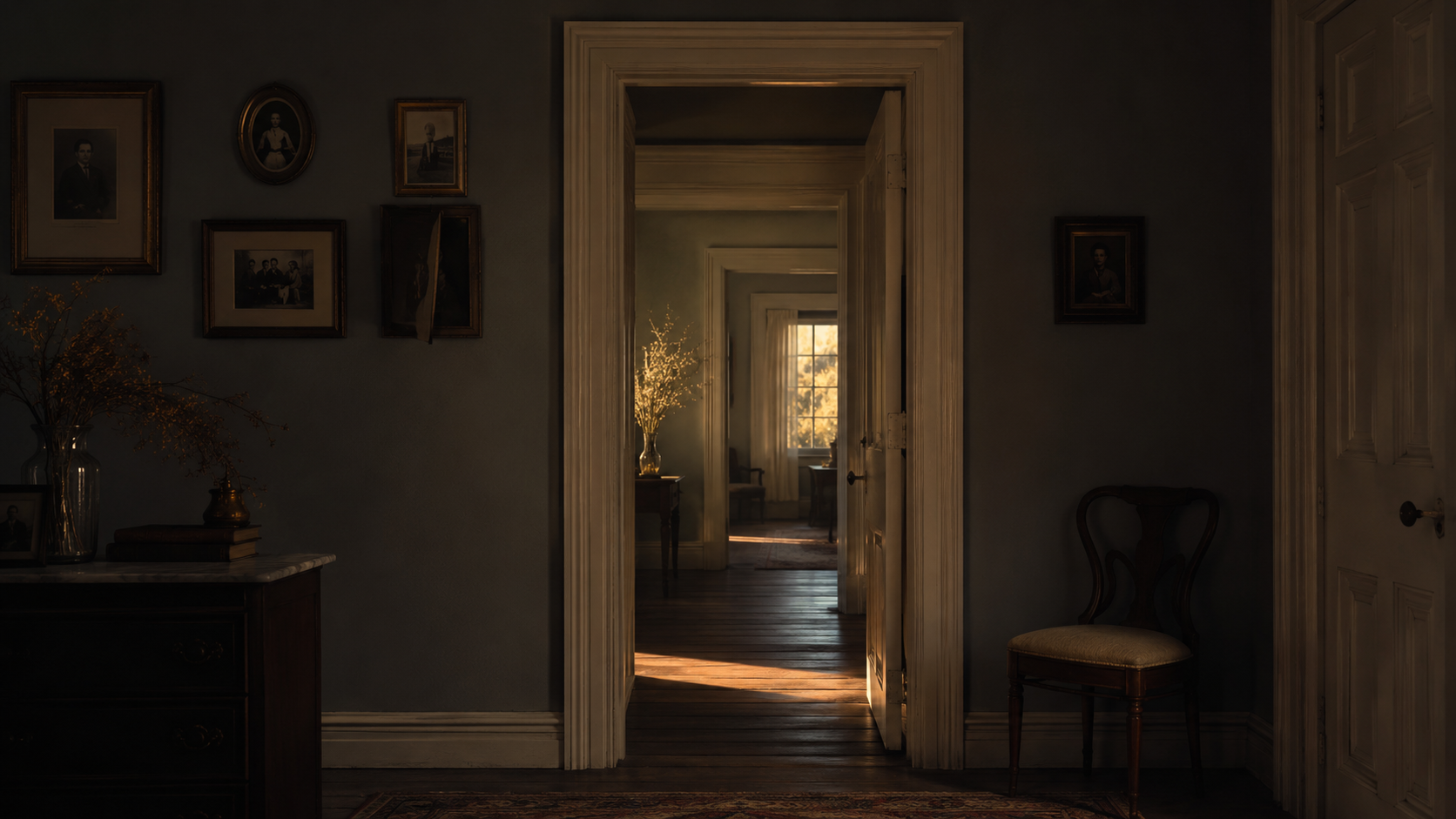
Some of it is kept in drawers — old photographs, immigration papers, letters written in languages the grandchildren cannot read. Some is kept in the body: the way a grandmother holds her shoulders against the world, the flinch that appears at certain words, the careful blankness that settles over an uncle's face when certain names are mentioned.
Some of it is kept in silence.
The silence is not empty.
The silence is the most heavily freighted archive of all.
What a family refuses to name does not cease to exist. It does not fade from the record. It does not die with the people who originally buried it. It does what silenced things have always done: it finds another form. It seeps. It pressurises. It appears in symptoms no one can trace to a cause. It arrives in the next generation as anxiety without a source, as grief without an object, as rage without a reason, as a rule that everyone follows and no one can explain.
The child inherits not the story.
The child inherits the pressure.
The Logic of Silence
Silence does not usually begin as damage.
It begins as mercy.
The survivor of something terrible does not always have language for it. Often there are no words that sit comfortably near what happened. The words that exist belong to the world that came before the event, and the event has made that vocabulary insufficient. The woman who has lost a child. The man who returned from a war that was nothing like what the words for war had prepared him to expect. The family that survived something — a famine, a pogrom, a bankruptcy, a violence that no one who was not there could be expected to understand. These people do not always have a clean narrative to offer.
So they do not offer one.
They get on with things. They work. They build. They love, in the imperfect ways available to them. They do not burden the children with what those children cannot help and do not need to carry. They believe they are protecting them.
They are not wrong to believe this.
Protection was the motive. The motive was genuine.
The problem is not the motive.
The problem is the consequence.
The children know something happened. They do not know what. But they feel the shape of it — in the weight of the closed room, in the territories where conversation pivots, in the quality of stillness that arrives around certain names.
They become expert in the geography of what cannot be said. They learn which doors do not open. Which questions produce which kind of deflection. Which silences mean "we don't talk about this" and which mean "this does not exist." They learn without being told. Because they were built to learn from the people around them, and silence is information too.
And then they wonder what is wrong with them — because they carry a weight they cannot account for, a heaviness that belongs to a story they were never given.
What Cannot Be Said
Selma Fraiberg was a clinical social worker and psychoanalyst who, in 1975, published a paper that became foundational in infant mental health.
She called it "Ghosts in the Nursery."
The ghosts she meant were not supernatural. They were the past.
Fraiberg had observed, in clinical work with parents and infants, something that appeared with enough regularity to deserve a name. Parents who had not processed their own childhood wounds would sometimes find those wounds reactivated by the birth of a child. The infant's vulnerability — its absolute need, its radical dependence — could mirror something in the parent's own history with such precision that the parent, without choosing it, began to relate to the infant through the distortions of what had not been grieved.
A parent who had been neglected might find themselves emotionally unavailable to their own infant. Not through indifference — through the reactivation of a self that had learned, too early, not to expect comfort, and so could not quite believe it was needed or welcome to provide it. A parent who had grown up in a household of unpredictable threat might find themselves unable to distinguish the infant's ordinary distress from something catastrophic. A parent who had never been held without conditions might find the unconditional need of an infant unbearable in ways they could not articulate.
The ghosts stood between the parent and the child.
What Fraiberg's clinical work demonstrated was that these ghosts could be named. A parent who was given the space to tell their own story — to grieve what had not been grieved, to speak what had never been spoken, to give form to what had only been atmosphere — often found themselves, sometimes startlingly quickly, able to see their child more clearly. As the specific, particular, present child they actually had, rather than through the lens of the child they had once been.
The talking did not cure by erasing the past.
It cured by giving the past a proper address.
Ghosts and Their Addresses
When the past has a name and a location — when it can be referred to as something that happened then, in that place, to those people, for those reasons — it can be visited without taking up residence. The ghost that has been named becomes, gradually, a memory. The memory can be carried. The ghost, unname, continues to inhabit the present.
The Conspiracy of Silence
The research on second-generation survivors of the Holocaust has produced some of the most widely discussed findings in the literature of intergenerational transmission.
Yael Danieli, a psychologist who worked extensively with survivors and their children over several decades, described what she came to call the "conspiracy of silence" — the agreement, sometimes explicit but more often tacit, between survivors and the society around them to not speak of what happened. Survivors were advised, by well-meaning people in the post-war years, to look forward. To rebuild. To not dwell.
The advice was given in the spirit of kindness.
The effect was not kind.
Many children of survivors described growing up in households where the enormity of what their parents had endured was omnipresent but unnamed. They knew, without being told. The knowledge was in the food saved obsessively, or in the fear that appeared disproportionately in ordinary situations, or in the love that had a desperate quality — as if the parent were trying to compensate for something immeasurable through the intensity of ordinary domestic devotion.
These children grew up carrying an inheritance they could not account for.
Some developed patterns that researchers identified: heightened vigilance, difficulty with separation, a sense of guilt around their own ease, the feeling of carrying something on behalf of people who were no longer present to carry it themselves.
It must be said with care: the research on second-generation survivors has been considerably debated and refined. The claim that specific trauma is straightforwardly transmitted to the next generation in a simple, direct, biological or psychological chain is not supported by the evidence in any clean form. People are shaped by far more than their parents' suffering. Resilience is common. Many survivors' children are not defined by their parents' wounds — and should not be categorised as though they inevitably would be.
But the general pattern — that a family's silence about its pain tends to shape the next generation's psychology in traceable ways — has been observed widely enough across enough different contexts to be taken seriously, not as diagnosis, but as a real and recurring dynamic.
Not because children are fragile.
Because children are perceptive.
They see what is there. They understand, without being told, that the truth has a shape — and the shape of the silence tells them something about the seriousness of what is not being said.
Memory and Haunting
There is a distinction that matters enormously and is rarely made precisely.
Memory is not the same as haunting.
Memory has language. Memory can be shared. Memory can be carried in ritual, in testimony, in story, in prayer, in the careful preservation of what happened for those who were not there to witness it. Memory has shape and location. It belongs to the past, even when it informs the present. It can be taken up and set down. It can be told to a child without making the child responsible for it.
Haunting has atmosphere.
Haunting is what happens when the past has not been given adequate form. When it has not been named, mourned, processed, or integrated. When it continues to circulate through a family system without anyone knowing quite what they are carrying. It is omnipresent but formless. It enters the nervous system before the mind can describe it. It is felt rather than remembered. It appears as a heaviness in certain rooms, a sensitivity no one can account for, a pattern that repeats itself without anyone consciously choosing it.
The child of memory knows the story.
The child of haunting knows the feeling.
The child of haunting often cannot explain why they feel it.
The Difference That Changes Everything
A family that has given its grief language — that can tell its difficult stories with care and without requiring the children to carry them on the family's behalf — produces children who can carry memory without being ruled by it. A family whose grief has no official form produces children who carry the consequences without the context. They feel the pressure without knowing the source. And they often interpret it as something about themselves.
This distinction has practical consequences.
When suffering cannot be spoken, it does not disappear into silence. It goes underground, where it continues to move — through emotional atmosphere, through parenting pattern, through the particular sensitivities and anxieties and relationship difficulties of people who were shaped by something they were never told about.
A family that learns to tell the truth does not erase pain.
It gives pain a form outside the nervous system.
Testimony as Medicine
Every serious tradition has rituals of testimony, and this is not accidental.
The Jewish practice of Yizkor — the saying of names, the bearing of witness, the insistence on not allowing catastrophe to disappear into silence — is not only about honouring the dead. It is about protecting the living from the particular damage that formlessness does. The telling is structural, not merely emotional. It gives the loss a location in time and meaning. It says: this happened, and it was real, and we will not pretend otherwise.
Dori Laub, a psychoanalyst and Holocaust survivor who spent decades working with testimony, wrote about the necessity of the witness. The traumatic event, he argued, in some sense occurred in the absence of an adequate witness — without anyone able to take in fully what was happening and confirm that it was real. The testimony is not merely memory. It is the creation of a witness after the fact. Someone who receives the story, who bears it, who confirms that it happened and that it matters.
This act — of telling, of being believed, of having the story received by another person who does not collapse under it — is not only emotionally comforting. It is structurally important.
When traumatic experience can be told, it can be integrated into narrative rather than remaining trapped in sensory and affective experience. It moves from haunting to memory. From atmosphere to language. From something happening perpetually in the body to something that happened, in a specific time and place, to real people, who can now be named.
The move from haunting to memory does not minimise what happened.
It gives it a place.
A place that is not inside the nervous system of the next generation.
What Honest Families Are Like
Honest families are not painless families.
This point cannot be overstated, because the fantasy of what honest family life looks like often does more damage than the reality. The goal of speaking truthfully about a family's history is not to produce a therapeutic idyll where everyone processes beautifully and no one is ever uncomfortable. The goal is to prevent the specific harm that silence causes.
Honest families argue. They have difficult seasons. They make mistakes and occasionally make a mess of their honesty — speaking clumsily, saying the right thing at the wrong time, underestimating what a particular truth will cost. Honesty is not always graceful.
The mess is better than the silence.
Because the mess can be apologised for. It can be revised. It leaves a mark, but a mark with a name — something that happened on a particular day for a particular reason, which can be understood and integrated into the story.
Silence leaves a mark too.
But without a name.
Without a reason.
Without anyone able to say: this is what it was.
There is a gift that honest families give their children which they may not recognise as a gift. They give the children their history. Not a sanitised version. Not a version designed to protect the child from sadness. The actual history — shaped for age and context, told with care — of who these people were, what they endured, what mistakes they made, what they survived. This gift is irreplaceable. A child who knows the family's story can locate themselves within it. They understand where certain sensitivities come from. They can carry the history consciously rather than being governed by it unconsciously.
A child who knows the story can decide what to do with it.
A child who only inherits the symptom has no story to decide anything about.
They just carry the weight, in silence, into a life they do not quite understand.
The Rule No One Remembers Making
Every family has rules it cannot explain.
Some are stated. Most are not. They exist in behaviour, in the things that happen reliably in response to certain situations, in the reactions that appear whenever certain subjects get too close.
We do not talk about father's first marriage.
We do not mention what happened with the business.
We do not bring up the years in between.
We do not speak about the child who died.
We do not acknowledge what everyone in the room knows happened.
We call it privacy. We call it discretion. We call it not wanting to upset people. We call it the past being the past.
But the children know there is a rule. Children always know. And knowing there is a rule — without knowing what the rule protects — often teaches something the family did not intend to teach: that the truth is dangerous. That certain realities cannot be survived in language. That honesty carries a cost that is too high for this family to pay.
What the Unspoken Rule Teaches
When children learn that certain truths are unspeakable, they learn something broader than the specific prohibition. They learn that truth itself has a ceiling. That there are things too dangerous or too shameful or too painful to say aloud. That feeling is something to be managed rather than named. These lessons travel far beyond the original silence that created them.
The rule was made, most often, to protect someone.
It usually did, for a season.
But rules outlast the season they were designed for. And the next generation, inheriting the rule without the context that created it, learns to apply it automatically — not to the specific wound it was built to protect, but to the entire domain of difficult truth.
This is how silence multiplies.
Not through malice, but through inheritance.
The Word Before the Wound
Every wound, if left unnamed, eventually finds a voice.
It will not speak in language. It will speak in behaviour, in pattern, in response, in the persistent emotional weather of people who do not know why they feel what they feel.
A woman who has never been told about her grandmother's loss carries something in her body she cannot account for, a tenderness around certain kinds of absence that seems disproportionate and embarrasses her. A man who was never told about his father's childhood carries a vigilance he cannot explain, a sensitivity to threat in neutral situations that his colleagues find difficult to understand.
They are not irrational.
They are carrying something real.
It is simply real in a language that no one ever translated for them.
Give the wound a name.
Not to celebrate it. Not to define the family by it. Not to use it as ammunition in old arguments. But to give it a proper address — somewhere outside the nervous system, somewhere in language and time — so that it may be met, mourned, and set down.
The family that speaks carries its history.
The family that cannot speak is carried by it.
And the difference — between carrying and being carried, between memory and haunting, between the story that can be told and the ghost that moves through rooms without a name — is the difference between a generation that can grieve and a generation governed by what was never grieved.
The word is not magic.
But it is mercy.
And sometimes mercy is exactly what a wound has been waiting for.
The Question This Essay Leaves
What are the things your family does not say? What rules exist in your household that no one remembers making? And what might the children around you be carrying that they were never given language for — and never asked to carry, but carry nevertheless?