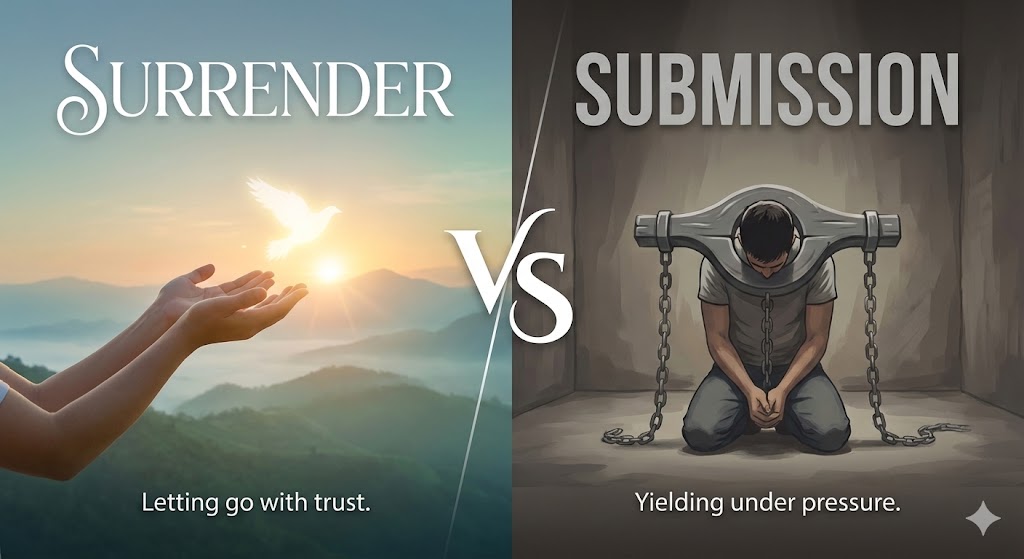
Surrender Not Submission
A rigorous yet accessible exploration of surrender versus submission--examining agency, love, leadership, and civilisational outcomes through theology, history, and strategy.


Surrender, Not Submission: The Path to Having It All
Surrender you live, that you may have it back.
That sentence has outlived empires because it is not sentiment -- it is mechanism.
A seed that refuses the "loss" of burial cannot multiply.
A man that refuses the "death" of ego cannot mature.
A leader that refuses surrender to principle cannot build an institution -- only a personality cult.
This is where serious lives separate from noisy ones:
- Substantive lives are built on principles, not laws.
- Principled people surrender; fearful people merely submit.
- Surrender is agency. Submission is compulsion.
*
Surrender vs Submission: A Necessary Distinction
Surrender and submission are often treated as synonyms. They are not.
Surrender* is the voluntary release of personal control -- often after struggle -- in order to align with a higher truth, principle, or reality. It is an act of will*.
Submission, by contrast, is typically imposed. It is compliance under pressure, driven by fear of consequence, domination, or coercive authority.
The differences are structural:
- Agency: Surrender preserves agency. Submission erodes it.
- Focus: Surrender is internal -- ego, posture, orientation. Submission is external -- rules, force, hierarchy.
- Outcome: Surrender produces peace, clarity, and empowerment. Submission produces obedience, constraint, and loss of autonomy.
- Motivation: Surrender is motivated by conviction and harmony with truth. Submission is motivated by fear, duty, or power imbalance.
We submit to laws.
We surrender to principles.
***
The Archetypal Example: "Not My Will, But Yours"
Jesus' statement -- "Not my will, Father, but Yours" -- is often misread as passive submission.
That interpretation collapses under the weight of His own words:
> "I have authority to lay it down, and I have authority to take it up again."
> -- John 10:18
This was not coercion. It was alignment. The surrender was chosen. The obedience was powerful. The will was intact.
***
Leadership Formation: What Surrender Produces
In institutional and civilisational terms, surrender is what makes leadership safe:
- Ego no longer steers.
- Principles become policy.
- Convictions become operating rhythm.
- Power becomes stewardship.
The leader becomes a stable reference point, not a variable. That is how institutions endure. That is how legacies are built.
*
The Core Mechanism: Love's Orientation
At the heart of surrender lies a deeper question: What do you love -- and in what order?
When love is vertical ordered, life gains coherence. Love vertical ordered produces freedom laterally expressed. Purpose flows from love. Formation follows surrender.
*
A Practical Diagnostic
Submission says: "I'll do it -- but I resent it."
Surrender says: "I'll do it -- and I will become the kind of person who can."
One is compliance. The other is formation.
Surrender you live, that you may have it back.