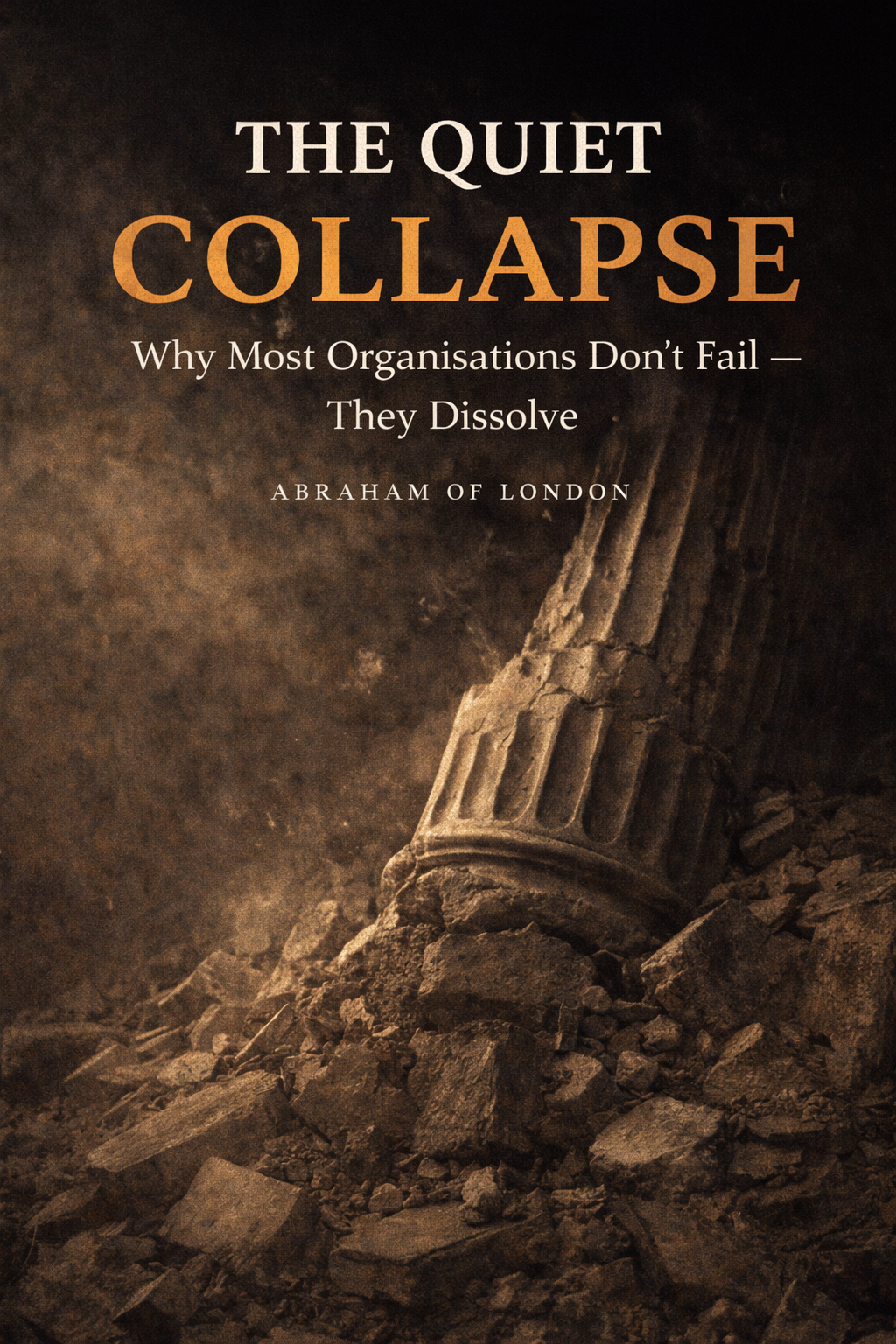
The Quiet Collapse: Why Most Organisations Don't Fail — They Dissolve
There is a difference between falling and fading. One is a headline. The other is a ghost.

The Opening Observation
I have watched organisations die. Not the dramatic kind of death — the one with sirens and boardroom explosions and journalists circling like vultures. That kind is rare. It makes for good television, but it is not how most institutions actually end. Most institutions dissolve. They do not go out with a crash. They go out with a sigh. A slow, imperceptible fading that no one notices until one day, the organisation is still there — technically — but the thing that made it what it was has somehow evaporated.
The Quiet Collapse: Why Most Organisations Don't Fail — They Dissolve
There is a difference between falling and fading. One is a headline. The other is a ghost.
The Death That Leaves a Body
Let me tell you about a kind of organisational death that never makes the news.
The logo remains. The website is still live. The emails still send. The invoices still get paid. The payroll still clears on the twenty-fifth.
But the conviction is gone.
The clarity has curdled into routine. The mission has become a memory, then a rumour, then a paragraph in an onboarding deck that no one reads. The people stay for a while — the salary is still there — but something essential has left the room.
This is not failure.
This is dissolution.
And it is far more common than collapse.
[Blockquote]
A falling organisation hits the ground. A fading organisation simply becomes hollow. The tragedy is that the hollow ones often look healthier for longer. They have not yet crashed. They have merely stopped mattering.
I have sat in rooms where drift was palpable. The language is still professional. The slides are still polished. The budget is still approved. But the questions have become smaller. The debates have become safer. The decisions have become predictable in a way that feels less like wisdom and more like exhaustion.
No one is actively destroying the place. That would require energy.
They are simply coasting.
And coasting, over a long enough timeline, is indistinguishable from dying.
The Drift That No One Mentions
There is a word for what I am describing, though we rarely use it in corporate settings. It sounds too soft. Too vague. Too human for the language of spreadsheets and shareholder letters.
Drift.
Drift is what happens when an organisation stops asking why it exists and simply continues operating out of momentum. It is not malicious. It is not even particularly conscious. It is the slow, gravitational pull of inertia — the tendency of any system to continue doing what it has been doing, long after the reasons for doing it have faded.
Drift is why a company can still function and still be dying at the same time.
A drifting organisation is not visibly broken. The lights are on. The meetings happen. The reports are filed. The paychecks clear. But the organisation no longer knows what it is for. It is running on procedure, not purpose. And procedure, without purpose, is just expensive habit.
The tragedy of drift is that it rarely announces itself. There is no single moment when the organisation went wrong. No villain to blame. No boardroom coup to dissect. Just a thousand small decisions, each one defensible in isolation, that collectively steered the ship into waters it was never meant to navigate.
The marketing team rebrands. The language shifts slightly. The tagline becomes more generic. "We help organisations achieve their goals" — which could mean anything, which means nothing.
The product team adds features. Not because customers asked, but because competitors added features. Feature creep becomes a substitute for strategy.
The hiring process lowers standards. Not dramatically — just a little, over time. The third-best candidate becomes acceptable. Then the fifth. Then whoever will accept the offer. The culture dilutes, but slowly enough that no one sounds the alarm.
The leadership team begins to value comfort over candour. Hard conversations get deferred. Conflicts get smoothed over rather than resolved. The meeting ends with "we will circle back" — which everyone knows means "we will never discuss this again."
This is drift.
And it is the single greatest threat to institutional health that no one is measuring.
The Signals That Precede the Silence
How do you know if your organisation is drifting?
Not in crisis — in drift.
> The Early Warning Indicators
>
Decision latency increases. The time between identifying a problem and acting on it stretches. Not because the problem is harder. Because the organisation has lost its hierarchy of judgment. Everything is equally important, which means nothing is urgent.
Rework becomes normal. The same conversations happen again. The same debates are re-litigated. The same mistakes are made twice because no one remembered — or bothered — to document the lesson.
Leadership language becomes abstract. The specificity drains out of communication. Words like "excellence," "innovation," and "value" appear more frequently. Concrete commitments appear less frequently.
Trust becomes conditional. People stop assuming good faith. They begin hoarding information, protecting turf, documenting everything for protection rather than clarity.
The mission becomes a museum piece. It is still on the wall. It is still in the deck. But no one tests decisions against it anymore. It has become decoration, not governance.
Any one of these signals could be an isolated symptom. Two or more together are diagnostic. Three or more mean the organisation is already dissolving — even if the revenue still looks acceptable.
Because here is the thing about drift: it is not always visible in the financials. Not at first.
A drifting organisation can still produce revenue. It can still serve customers. It can still hit quarterly targets — sometimes for years. The damage is not yet financial. It is structural. The organisation is becoming brittle. It is losing its ability to adapt, to inspire, to retain its best people, to make decisions under genuine pressure.
When the market turns — and markets always turn — the drifting organisation does not merely stumble. It shatters.
Not because the downturn was uniquely severe. Because the organisation had already hollowed itself out from the inside. The downturn was merely the moment the emptiness became visible.
[Blockquote]
The path to irrelevance is rarely a straight line down. It is a slow decline, marked by arrogance, denial, and the gradual erosion of the disciplines that made the organisation great in the first place.
The Seduction of the Status Quo
Why do organisations drift?
Not because the people are lazy or stupid. Most drifters are hardworking, intelligent, and genuinely confused about why things feel harder than they used to.
The answer is more subtle: drift is seductive.
It offers relief without resolution. It allows leaders to feel busy without being decisive. It rewards activity over progress. It confuses motion with movement.
> The Comfort Trap
>
The drifting organisation is not a comfortable place to work. It is often anxious, political, and exhausting. But it is predictable. And for many people — especially those who have been burned by change initiatives that promised more than they delivered — predictability feels safer than uncertainty.
The tragedy is that this safety is an illusion.
A drifting organisation is not stable. It is stagnant. And stagnation, in a changing world, is not safety. It is the slowest form of suicide.
The organisations that survive are not the ones that avoid change. They are the ones that remain capable of it — capable of genuine discernment, capable of hard choices, capable of remembering why they exist and acting accordingly.
Drift is the enemy of that capability.
It does not attack the organisation directly. It does not steal revenue or sabotage products. It erodes judgment. It makes the organisation slightly stupider, slightly slower, slightly less honest, every quarter. And the change is so gradual that no one notices until the gap between where the organisation thinks it is and where it actually is becomes unbridgeable.
That is when the real collapse begins.
Not the dissolution. The dissolution already happened.
The collapse is just the paperwork.
The Return: How Drift Reverses
If drift is the slow erosion of institutional coherence, then recovery is the slow restoration of it.
There is no single fix. No magic framework. No consultant who can save an organisation that has forgotten why it exists.
But there is a discipline.
Recovery begins not with action, but with attention. The organisation must first see itself clearly — not as it wishes to be seen, but as it actually is.
That means asking uncomfortable questions. Not in a retreat. Not in a survey. In the actual work.
Why does this meeting exist?
Why does this role exist?
Why does this product exist?
Why does this organisation exist?
The answers may be uncomfortable. They may reveal that half the meetings are unnecessary, that a third of the roles exist to manage the confusion created by the other two-thirds, that the product portfolio has grown beyond the organisation's capacity to care for it.
That discomfort is not a failure.
It is the beginning of clarity.
[Blockquote]
There is nothing so useless as doing efficiently that which should not be done at all.
The organisation that recovers does not merely cut costs. It restores hierarchy. It remembers what matters and what does not. It becomes willing to stop doing things that no longer serve its purpose — even if those things are profitable in the short term.
This is harder than it sounds.
Stopping things requires courage. It requires admitting that time, money, and attention were wasted. It requires disappointing people who have built careers around the old ways.
But the alternative is worse.
The alternative is to continue drifting until the organisation becomes so hollow that even the people inside can no longer pretend.
The Relationship Between This Essay and What Has Come Before
If you have read the preceding essays — on execution integrity, alignment audits, drift detection, and the Century Firm — you will recognise the thread.
This is not a sequel. It is a companion.
The other essays gave you frameworks. This one gives you a diagnosis.
The other essays told you what to do. This one tells you what you are looking for.
Drift is the condition that all the other frameworks exist to detect and correct. Without the ability to recognise drift — in yourself, in your team, in your organisation — no framework will save you. You will implement the protocol, check the boxes, and still feel the slow sinking sensation that something essential is missing.
That sensation is drift.
And it is not cured by technique.
It is cured by attention. By honesty. By the willingness to ask why, over and over, until the answer is no longer comfortable but is at least true.
> The Unbroken Thread
>
This essay is the fourth in a series, but it is not dependent on the others. It can stand alone. It is meant to. The diagnosis of drift is valuable whether you have read a single word I have written before or not. The frameworks are tools. This is the problem those tools were built to solve.
The Invitation
If you have felt what I am describing — the slow, imperceptible fading of institutional conviction — you already know more than most.
You do not need me to tell you that something is wrong.
You may only need permission to name it.
Consider this that permission.
The drift is real. But so is the possibility of return. Not to the past — that is not available. To coherence. To clarity. To a version of the organisation that knows what it is for and acts accordingly.
That is not nostalgia. That is strategy.
And it is available to anyone willing to stop drifting long enough to see where they actually are.
Postscript
The organisations that will survive the coming decades will not be the ones that never drifted.
They will be the ones that noticed.
And turned.
— A
---
> About the Author
>
Abraham of London is a writer and strategist whose work explores the relationship between purpose, leadership, institutions, and human flourishing in an age of drift.