Institutional Alpha12 Feb 2026purpose

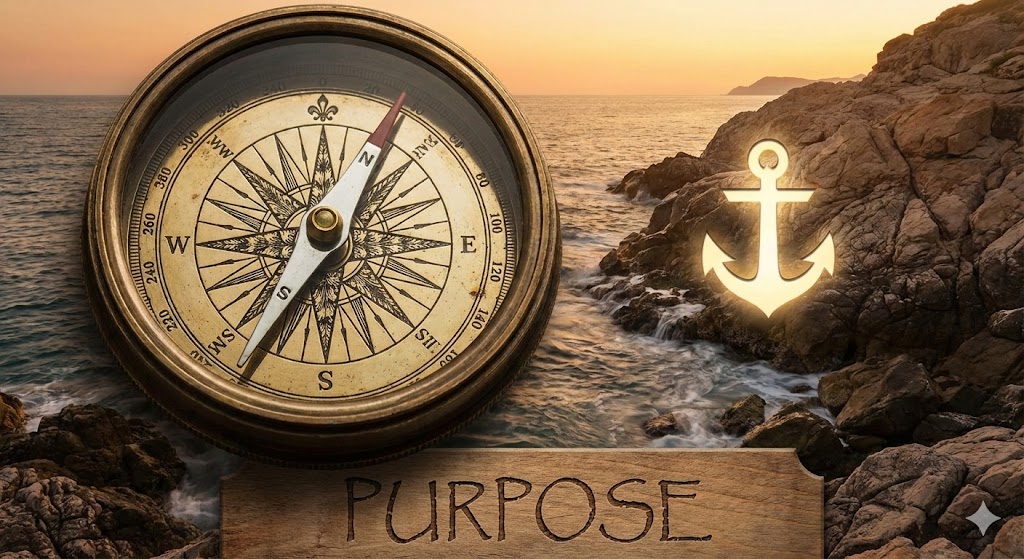
Purpose is The Anchor

A direct, literary essay on why meaning—not comfort—produces fulfilment, and how to audit your life back toward purpose.

Reading Time
Essay
Access
Public
Imprint
Abraham of London • Essays & Insights
Purpose is The Anchor
Reading Chamber

Most people are not exhausted because life is hard.
They are exhausted because life is unfocused.

They are busy, stimulated, entertained — and internally disoriented. Movement without meaning will drain you faster than suffering ever could.

Life without purpose is hardly one worth living — and not because life becomes hard, but because it becomes loose.

<Verse cite="Proverbs 29:18 (KJV)">Where there is no vision, the people perish...</Verse>

When there is no vision, there is no restraint. No direction. No architecture holding the weight of your days together. Purpose is the anchor. Remove it, and you don’t simply drift — you meander. You wake up busy but not advancing. Moving, but not arriving. Without a defined outcome, hopelessness becomes a matter of when, not if.

A drifting life does not collapse all at once. It erodes quietly.

Life is not meant to be happy — it is meant to be meaningful

Happiness is a mood — a visitor, not a landlord. Meaning is a foundation — it holds when everything else is shaking.

Meaning is what gives you fulfilment — not power. Not fame. Not hedonistic pleasure. Those things amplify what is already inside you; they do not repair what is missing. Meaning outlives moods. Meaning outlasts applause. Meaning remains when no one is watching.

The Architecture of Affliction

We often view hardship as an interruption to our "real" lives. But history and scripture tell a different story: Hardship is the construction site of greatness.

The figures we revere in history—the builders, the martyrs, the pioneers—did not become great in spite of their suffering, but largely because of it. Hardship was the furnace that developed the character and skills necessary for their destiny.

We now see this through the lens of science. Our neurobiology is designed for formation through friction. A specific part of the human brain—the anterior mid-cingulate cortex—is observed to develop and grow only when we engage in tasks that are not only difficult, but that we do not want to do.

Growth is found in the discipline of the "unpleasant." We are not being self-flagellating when we tell a man to embrace pain through discipline; we are reiterating what ancient wisdom taught and what science is finally starting to see. Discipline is not punishment; it is formation.

The Model of the Master

Jesus Himself models this thesis. His life was not one of curated comfort, but one of tremendous affliction and calculated suffering. He lived meaningfully and impactfully, yet He was only truly appreciated in retrospect, through the correct frame of His ministry and destiny.

He did not seek pleasure; He embraced purpose. In the final movement of His earthly ministry, as He commissioned Peter, He delivered a strategy that is as profound as it is uncomfortable:

<Verse cite="John 21:18">...but when you are old, you will stretch out your hands, and someone else will dress you and lead you where you do not want to go.</Verse>

What a staggering statement to use as a commissioning. He was telling Peter that his ultimate growth and final witness would be found in being led to a place his flesh would naturally reject.

This is the "Profound Strategy": Purpose over Pleasure. We cannot claim to fully understand it, nor are we always able to embrace it immediately, but we can lean into it. We can trust that the blessings and lessons awaiting us are found on the other side of the "difficult thing."

Final Word

Pleasure can imitate joy, but it cannot produce it.
Pleasure feeds the ego; Purpose
fortifies the soul.
Pleasure numbs; purpose strengthens.
One leaves you entertained. The other leaves you formed.

You do not need a perfect life. You need an anchored one.

Perfection is fragile. It shatters at the first tremor.
Comfort is conditional. It evaporates when pressure rises.
Reputation is unstable. It depends on the applause of others.
Mood is unreliable. It changes with the weather.

But purpose — purpose endures.

Purpose gives structure to suffering.
Purpose gives direction to discipline.
Purpose gives meaning to obscurity.
Purpose turns affliction into architecture.

When the storm comes — and it will — the question will not be whether life is difficult.
The question will be whether you are anchored.

If you are anchored, you will bend but not drift.
You will feel pressure but not panic.
You will suffer but not scatter.

Because the anchored man is not governed by mood, applause, or ease.
He is governed by mission.

And mission, once embraced, rearranges everything.
It orders your calendar.
It filters your friendships.
It disciplines your appetites.
It gives weight to your yes and steel to your no.

A loose life chases comfort.
An anchored life chooses formation.

Choose the difficult thing.
Choose the narrow road.
Choose the long obedience.

Because entropy is the default setting of success.
Drift is automatic.
Decay is natural.

Anchoring is deliberate.

And the man who chooses purpose over pleasure will not merely survive the storm —
he will be shaped by it.

Life is not meant to be easy.

It is meant to be anchored.

Abraham of London • Essays & Insights
On This Page