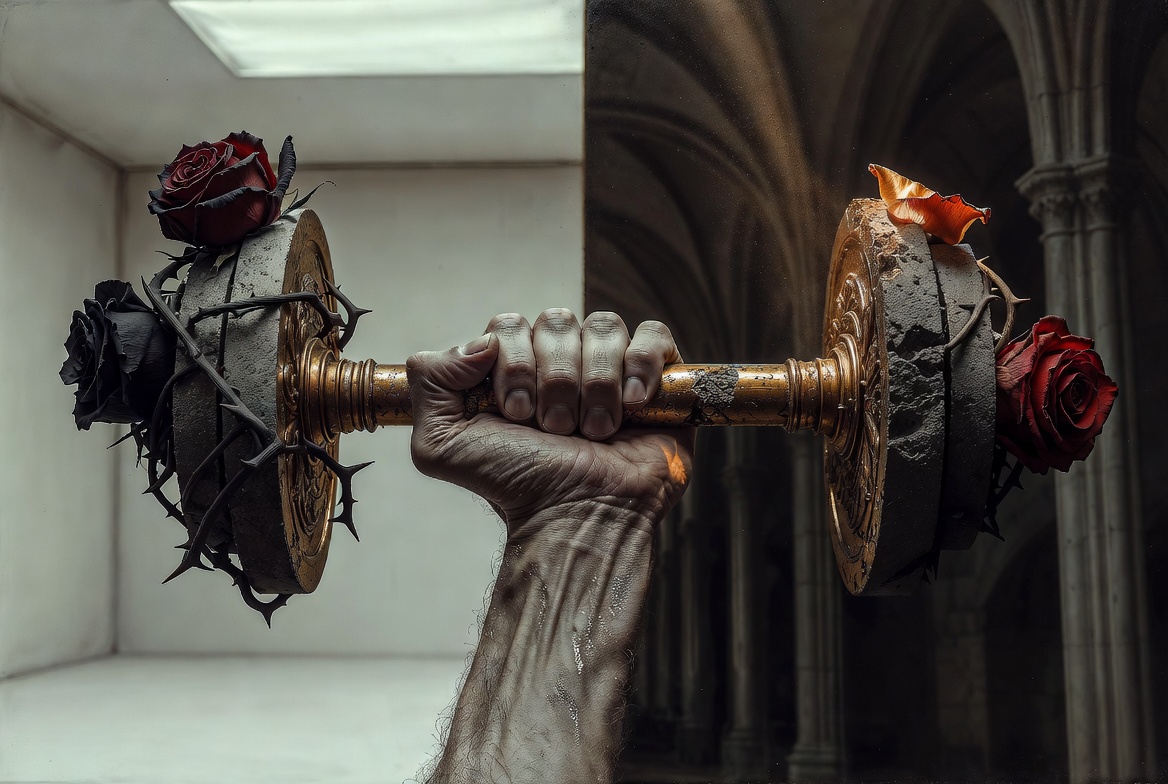
The Pain Paradox: Why Suffering Is Not the Problem — And What Actually Is
Suffering has been used as the ultimate argument against divine order. But what if we have been asking the wrong question entirely?

The Core Thesis
The oldest philosophical weapon against divine order is suffering. If a good and powerful Creator exists, why does He permit pain? The question has toppled faiths, haunted theologians, and driven millions into nihilism. But the question itself is misframed. Suffering is not the enemy. Meaninglessness is. And when you realign with purpose, pain ceases to be an objection — and becomes an engine.
The Pain Paradox: Why Suffering Is Not the Problem — And What Actually Is
There is an argument so old that its origins disappear into the fog of ancient debate. It has been carved into stone, inked onto papyrus, shouted from podiums, whispered in confessionals, and typed into a billion internet comments. It is the problem of suffering — the rock upon which many ships of faith have shattered.
If God is good, He would want to eliminate suffering.
If God is powerful, He could eliminate suffering.
Suffering exists.
Therefore, no such God exists.
It is clean. It is logical. It is devastating — or so it seems.
But what if the premise is wrong? Not the existence of suffering — that is undeniable. What if the framing is wrong? What if suffering has been cast as the villain when it is actually a signal, a tool, a necessary component of something far greater? What if the real problem is not pain itself, but pain without meaning — and what if meaning is exactly what divine order provides?
[Blockquote]
Pain and suffering are always inevitable for a large intelligence and a deep heart. The really great men must, I think, have great sadness on earth.
This is not a theodicy that pretends suffering is easy. It is not a spiritual bypass that waves away agony with platitudes. It is something harder and more hopeful: a reframing that does not deny the weight of pain but repositions it within a larger architecture. An architecture where suffering is not the enemy of flourishing but, under the right conditions, its catalyst.
Let us begin where all honest inquiry begins: not with answers, but with a better question.
The Wrong Frame: How Philosophy Misdiagnosed the Patient
The classical problem of suffering assumes that pain is an unqualified evil. It assumes that any benevolent power would eliminate it entirely. It assumes that a world without suffering would be better than a world with it.
These assumptions feel self-evident. They are not.
> The Hidden Assumption
>
The classical argument smuggles in a particular view of what a "good" world looks like: comfortable, pain-free, stable, predictable. It is the view of someone who has never trained for anything hard, who has never grown through struggle, who has never looked back at the hardest season of life and said, That made me who I am.
The classical argument smuggles in a particular view of what a "good" world looks like: comfortable, pain-free, stable, predictable. It is the view of a spectator, not an athlete. It is the view of someone who wants a finished masterpiece without the labour of painting, a sculpted body without the burn of the workout, wisdom without the wound.
But reality does not work that way. And if we are honest, we know it.
Ask any person who has built something worth building. Ask any person who has mastered a craft, raised a child, written a book, launched a company, recovered from addiction, healed a marriage. They will tell you a consistent story: the growth came through the difficulty, not around it. The strength came from the resistance, not despite it. The person they became was forged in the fire, not in the air-conditioned waiting room.
> The Honest Question
>
If you could wave a magic wand and remove every painful memory from your life — the failures, the losses, the rejections, the heartbreaks — would the person who remained be someone you would want to be?
This is the question the classical argument never asks. Because if suffering is an unqualified evil, then the answer should be a resounding yes. But most of us, if we are honest, would say no. We would say that the suffering, terrible as it was, mattered. It shaped us. It taught us. It gave us depths we would not trade for shallowness, even comfortable shallowness.
The problem, then, is not suffering. The problem is pointless suffering. Suffering without meaning. Suffering that does not lead to growth, does not produce strength, does not deepen character, does not serve any purpose beyond itself.
And that — meaninglessness — is a very different enemy.
The Analogy of the Gym: Pain as Signal, Not Enemy
Consider the gym. Or the track. Or the dojo. Any place where human beings voluntarily seek out physical challenge.
You walk in. You pick up something heavy. You move it in ways that your body, left to its own devices, would never choose. Your muscles tear at the microscopic level. Your lungs burn. Your heart pounds. Your nervous system screams a question: Why are you doing this to me?
And the answer is: Because this is how I grow.
> The Pain of Growth
>
The burn of a good workout is not a sign that something has gone wrong. It is a sign that something is going right. It is the signal that you have pushed past your current capacity, that adaptation is being demanded, that tomorrow you will be slightly stronger than you were yesterday — provided you rest, recover, and return.
Now imagine someone who has never exercised watching you. They see the sweat, the strain, the grimace. They hear you groan under the barbell. They witness you collapse onto the bench after a set. And they conclude: This is terrible. This person is suffering. Whatever they are doing must be wrong.
They have missed the frame entirely. They have seen the pain without understanding the purpose. They have observed the signal without grasping the system it belongs to.
Pain without purpose is suffering. Pain with purpose is process.
This is the distinction that changes everything. Pain without purpose is suffering — the kind that crushes and breaks and leaves people worse off. Pain with purpose is process — the kind that stretches and strengthens and transforms.
The classical problem of suffering collapses this distinction. It treats all pain as the first kind. But that is a category error. It is like saying that because some fire burns down houses, all fire is destructive — ignoring the fire that heats homes, forges steel, cooks food, and powers engines.
The question is not whether pain exists. The question is whether the pain is meaningful — whether it belongs to a larger order that turns it into something other than pointless agony.
The Learning Analogy: The Death of False Knowledge
The gym is not the only domain where this pattern holds. Consider learning.
Every genuine act of learning involves a kind of death. Not physical death, but the death of something perhaps more precious to the ego: the death of a previous understanding, a comfortable ignorance, a cherished certainty.
[Blockquote]
The discipline of learning requires the willingness to be taught — and to be taught means to admit that you do not already know.
Think of the last time you learned something that truly changed you. Not a trivial fact — a deep restructuring of how you see the world. It was probably uncomfortable. Probably disorienting. Probably involved moments of confusion, frustration, even anger.
You had to let go of something you believed. Maybe something you had believed for years. Maybe something tied to your identity, your community, your sense of who you were. And letting go hurt.
> The Pain of Paradigm Shift
>
The pain of learning is not a bug. It is a feature. It is the sensation of an old structure breaking down to make room for a new one. It is the demolition that precedes construction. It is the death that makes resurrection possible.
Now apply this to the problem of suffering. What if much of what we call "suffering" is actually the pain of learning — the discomfort of having our illusions stripped away, our false certainties exposed, our comfortable lies replaced with difficult truths?
That does not make it easy. But it does make it meaningful. It repositions the pain from the category of pointless tragedy to the category of painful but necessary transformation.
And that repositioning changes everything about how we endure it.
The Real Enemy: Not Pain, but Meaninglessness
If pain is not the enemy, what is?
The answer emerges when we look at the difference between two people undergoing similar difficulty. One is crushed. The other is strengthened. What distinguishes them?
> The Variable That Matters
>
After decades of studying trauma, resilience, and human flourishing, the research points to a single variable that predicts whether difficulty will destroy a person or develop them: meaning. Those who can locate their suffering within a larger story — who can say, "This is happening for something" rather than just "This is happening to me" — do not merely survive. They grow.
After decades of studying trauma, resilience, and human flourishing, the research points to a single variable that predicts whether difficulty will destroy a person or develop them: meaning.
Those who can locate their suffering within a larger story — who can say, This is happening for something rather than just This is happening to me — do not merely survive. They grow. They develop what psychologists call post-traumatic growth. They emerge from the fire stronger, wiser, more compassionate, more grounded.
Those who cannot find meaning — who experience their pain as random, pointless, disconnected from any larger purpose — are the ones who shatter. Their suffering does not lead to growth. It leads to despair. To bitterness. To nihilism.
Meaninglessness is the enemy. Pain is merely the messenger.
This is the inversion that the classical argument misses. The problem is not that God allows suffering. The problem is that a universe without God — a universe of random collisions, indifferent forces, and ultimate meaninglessness — cannot transform suffering into anything other than pointless agony.
Only a universe with meaning — with purpose, with order, with a story that our pain can belong to — offers the possibility that suffering might be redeemed.
The OGR Connection: Why This Reframing Powers the Great Work
This is not an abstract philosophical exercise. It is the engine of the OGR — the Ongoing Great Work, the restoration of all things, the realignment of civilisation with divine order.
Here is why:
> The Engine of Growth
>
If people believe that suffering is an unqualified evil, they will organise society to eliminate it at all costs. They will prioritise comfort over character. They will medicate every negative emotion. They will remove every obstacle from every path. They will produce generations of people who have never been tested — and who therefore have never been strengthened.
This is not compassion. This is disabling. It is the soft bigotry of low expectations dressed up in therapeutic language.
But if people understand that suffering — meaningful suffering — is part of the process of growth, they will organise society differently. They will not seek out pain for its own sake. But they will stop running from it. They will learn to distinguish between pointless suffering (which should be alleviated) and purposeful suffering (which should be embraced). They will build institutions that challenge people, not just comfort them. They will raise children who know how to fail, recover, and grow.
[Blockquote]
In some ways, suffering ceases to be suffering at the moment it finds a meaning, such as the meaning of a sacrifice.
This is the OGR at the level of the soul. The Great Work is not about eliminating difficulty. It is about ensuring that difficulty serves a purpose. It is about creating the conditions in which suffering can be redeemed — transformed from pointless agony into the fire that forges strength, wisdom, and character.
And this begins with a single realisation: Pain is not the problem. Meaninglessness is.
The Alignment Thesis: How Purpose Transforms Perception
When you are aligned with your purpose — when you know why you are here, what you are meant to do, what order you are meant to serve — your relationship to pain changes.
Not because pain stops hurting. It doesn't. The barbell is still heavy. The learning is still disorienting. The loss is still devastating. The diagnosis is still terrifying.
But the frame changes.
> The Lens of Purpose
>
Purpose gives pain a context. It answers the question that suffering always asks: Why? Not with a complete explanation — often there is none — but with a direction. This pain is not pointless. It belongs to something. It is serving something. It is making me into someone.
This is not stoicism. Stoicism says: Pain is indifferent. Do not let it move you. That is a form of dissociation, not transformation.
This is alignment. Alignment says: Pain is real. It hurts. But it is not the final word. The final word is what this pain produces. And I trust the order that is producing it.
When you live like this, you stop asking, Why is this happening to me? and start asking, What is this asking of me? The first question leads to victimhood. The second leads to agency.
The victim asks, "Why me?" The aligned asks, "What now?"
The victim asks, Why me? The aligned asks, What now? The victim seeks someone to blame. The aligned seeks something to become.
This is not toxic positivity. It is not pretending the pain isn't there. It is leveraging the pain — using its energy, its signal, its demand for change — as fuel for growth.
The Practical Application: How to Leverage Pain in Real Life
If this reframing is true, it must be practical. It must change how we actually live.
Here is how:
> The Four Practices of Pain Leverage
>
1. Distinguish between pointless and purposeful pain. Not all pain is productive. Chronic, unrelenting, truly meaningless suffering should be alleviated. But before you numb or escape, ask: Is this pain teaching me something? Is it demanding that I change? Is it the cost of something valuable?
2. Reframe the question. When pain comes, catch yourself before you ask, Why me? Instead, ask: What is this asking of me? What would growth look like here? What is this pain signalling that I need to attend to?
3. Locate the pain within a larger story. You cannot always choose your circumstances, but you can always choose the story you tell about them. Is this pain a random tragedy or a chapter in a larger narrative? Is it pointless or purposeful? Your answer shapes your experience more than the pain itself.
4. Do hard things on purpose. The ability to leverage pain is a muscle. It must be trained. Practice doing things that are difficult, uncomfortable, and challenging — not because you have to, but because you choose to. Exercise. Learn something hard. Have the difficult conversation. Take the risk. Each time you voluntarily embrace discomfort for a purpose, you strengthen your capacity to transform all pain into growth.
These practices are not easy. They are not quick fixes. They are disciplines — habits of mind and action that rewire your relationship to difficulty over time.
But they work. They have worked for millennia, in every tradition that understands that the path to flourishing runs through challenge, not around it.
The Divine Order: Why Christianity Gets This Right
The classical problem of suffering assumes that a good God would create a pain-free world. But what if a pain-free world is not the best possible world? What if a world where suffering can be redeemed — where difficulty can produce strength, where loss can produce depth, where death can be defeated — is actually better than a world where none of those things exist?
> The Cross as the Answer
>
Christianity does not answer the problem of suffering with a philosophical argument. It answers it with a person. A God who does not stand at a distance, waving away pain, but who enters into it — who takes it into His own body, who experiences abandonment, torture, and death, who transforms the worst thing that human evil could produce into the means of salvation for the world.
The cross does not explain suffering. It redeems it. It shows that the order of the universe is not one where pain is absent, but one where pain can be used. Where the worst thing becomes the best thing. Where death becomes the door to life.
[Blockquote]
The cross is the tree of life. It is the sign of the contradiction that has been resolved. It is the place where the pain of the world meets the love of God.
This is the frame that the classical argument misses. It assumes that a good God would prevent suffering. But what if a good God would share it? What if a good God would transform it? What if a good God would enter into the darkest pit and, from within it, begin the work of resurrection?
That is not an argument that eliminates the mystery of suffering. It is something better: a promise that the mystery is not meaningless. A guarantee that the pain is not pointless. An assurance that the One who oversees the order has been to the deepest depth and has come back — and is inviting us to follow.
The Invitation: Stop Fleeing and Start Leveraging
You are going to suffer. That is not pessimism. It is realism. Life in a broken world, in a body that decays, in relationships that fracture, in a civilisation that drifts — suffering is not an if. It is a when.
The question is not whether you will suffer. The question is what your suffering will produce.
> The Choice Before You
>
You can continue to see pain as the enemy — something to be avoided, numbed, medicated, escaped. You can organise your entire life around the pursuit of comfort and the avoidance of difficulty. You can raise your children in padded rooms and wonder why they cannot stand when the wind blows.
Or you can accept the paradox. You can recognise that pain, when it has meaning, is not the enemy but the instrument. You can stop fleeing and start leveraging. You can do the hard things on purpose, build your capacity for transformation, and become someone who does not merely endure suffering but uses it.
You can continue to see pain as the enemy — something to be avoided, numbed, medicated, escaped. You can organise your entire life around the pursuit of comfort and the avoidance of difficulty. You can raise your children in padded rooms and wonder why they cannot stand when the wind blows.
Or you can accept the paradox. You can recognise that pain, when it has meaning, is not the enemy but the instrument. You can stop fleeing and start leveraging. You can do the hard things on purpose, build your capacity for transformation, and become someone who does not merely endure suffering but uses it.
The choice is yours. The order stands. The purpose is waiting.
And the pain? The pain is not the problem. It never was.
The problem is meaninglessness. And meaninglessness is the one thing that alignment — real alignment with the order that governs all things — cannot survive.
Postscript: A Word to the Sufferer
If you are reading this in the middle of real pain — not the abstract pain of philosophical debate, but the raw, bleeding, exhausting pain of loss or illness or betrayal or failure — do not let this essay add to your burden.
I am not saying that your pain is easy. I am not saying that you should just cheer up or find the silver lining or pretend that everything is fine.
What I am saying is this: There is a frame that can hold your pain. Not explain it away. Not minimise it. Not rush past it. But hold it. Give it a place. Give it a purpose. Not a purpose you have to manufacture by your own effort, but a purpose that is already there, waiting to be discovered.
You do not have to find it today. Today, you may only be able to breathe. To survive. To put one foot in front of the other.
That is enough. That is suffering, too — the kind that does not feel meaningful yet, but that may become meaningful over time.
The invitation is not to pretend. The invitation is to trust — to trust that the order that holds the stars in place can hold your pain as well. To trust that the One who entered into suffering is with you in yours. To trust that meaning is not always visible in the moment, but that does not mean it is not there.
Hold on. Breathe. And when you are ready — not before — begin to ask not Why me? but What now?
The answer may surprise you.
This is the second in a series exploring the Edenic mandate, the nature of drift, and the path back to alignment. The next installment will examine how these principles apply to the problem of evil — and why the existence of moral darkness may be the strongest argument for divine light.
---
> About the Author
>
Abraham of London is a writer, strategist, and founder of the Purpose Alignment System. His work focuses on the intersection of timeless principles and contemporary challenges, helping individuals and organisations align with the order that governs all things.